Skip to content
When your child’s future is on the line, understanding your rights matters most.
You may be here because a child you love is living in chaos. Maybe you are a grandparent who has been doing school pickups, buying groceries, and calming bedtime fears while a parent struggles with addiction, instability, or violence. Maybe you are a stepparent, aunt, uncle, or family friend who has become the steady adult in a child’s life.
That kind of worry is heavy. It is also confusing, because love alone does not answer the legal question. In Texas, a third party custody suit texas case asks whether someone other than a parent can ask a court for conservatorship, possession, or access to protect a child.
Texas courts handle family conflict every day. According to the Texas Judicial Branch’s 2021 Annual Statistical Report, approximately 305,000 new or post-judgment family cases were filed that year. That does not make your situation small. It means your case is part of a legal system that regularly deals with difficult family realities and tries to protect children within them.
When a Child You Love Needs Protection
The hardest part for many caregivers is this: they already know something is wrong, but they do not know whether the law will let them step in.
A grandmother may say, “My grandson stays with me most weekends because his mother disappears.” A former stepfather may say, “I’ve raised her for years, but now I am being cut out.” A family friend may say, “The child has been living in my home, and I do not know what happens if the parent comes back without changing anything.”
Those are not just emotional problems. They can turn into legal ones very quickly.
Why this process feels so intimidating
Parents usually start with legal rights that other adults do not automatically have. That is why third-party cases feel uphill from the start. The court is not deciding who loves the child more. The court is deciding whether the law allows a non-parent to even ask for custody, and then whether the facts justify court intervention.
For many people, that feels backward.
You may be the one showing up. You may be the one keeping the child safe. But the law still asks extra questions before it lets you proceed.
Key point: In Texas, concern is not enough by itself. A third party usually has to show both a legal right to file and strong facts showing the child needs protection.
What this guide will help you understand
This process becomes easier to handle when you break it into parts:
- Can you file at all under Texas standing rules?
- What must you prove after you file?
- What evidence matters most to a judge?
- What outcomes are realistic for your family?
You do not need to know every Latin phrase or courtroom custom to begin understanding your options. You do need clarity about how Texas family courts think.
That starts with the first gate in the process.
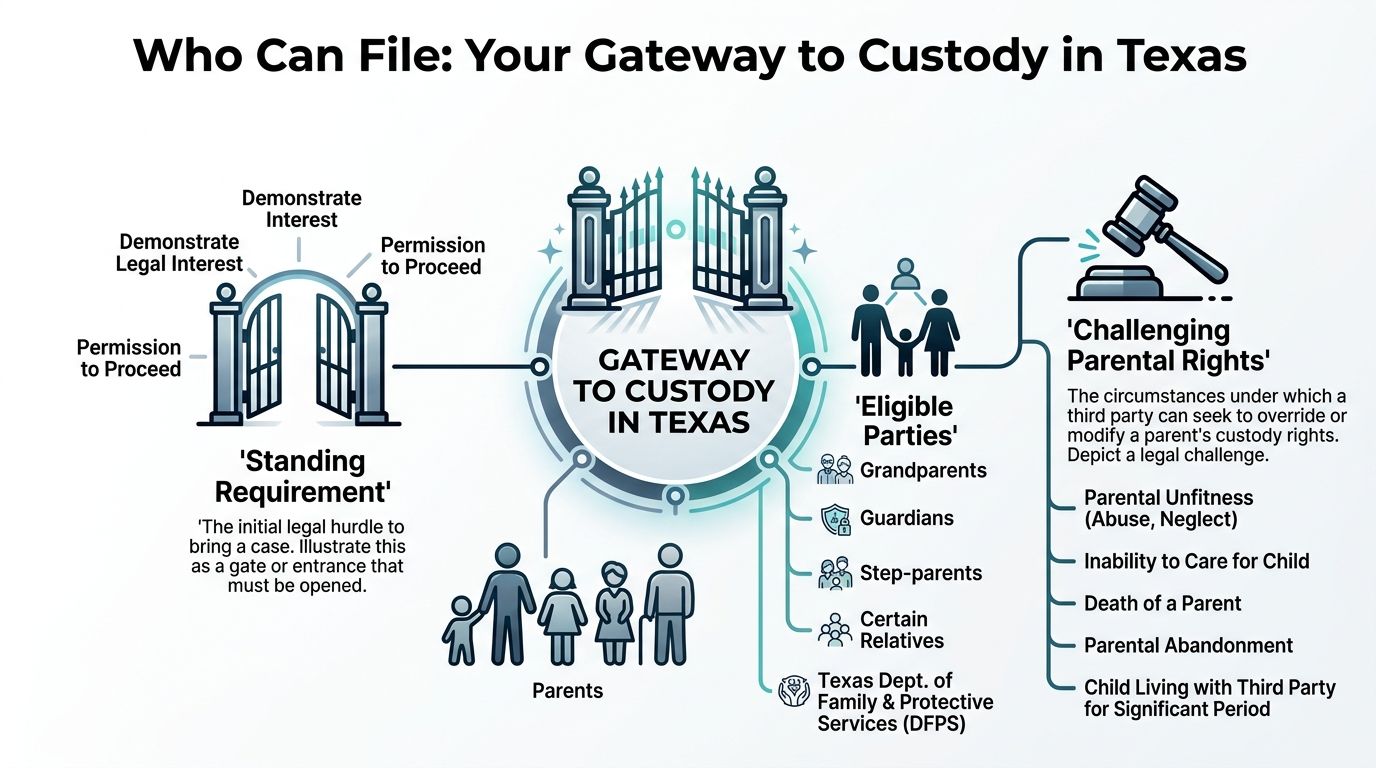
Who Can File a Third Party Custody Suit in Texas
The first legal word to know is standing.
Think of standing like a key to the courthouse door. If you do not have the right key, the judge may never reach the bigger questions about the child’s safety or your role in the child’s life. Your case can be dismissed before it really begins.
Texas law has long treated standing as a strict threshold in non-parent custody cases.
The basic timeline rule
Under Texas Family Code §102.003(a)(9), a non-parent must have had actual care, control, and possession of the child for at least six months, ending not more than 90 days before filing the petition, to have standing. Failing to meet that timeline can lead to immediate dismissal, as explained in this discussion of non-parent custody standing in Texas.
That rule causes a lot of confusion, so let’s put it into plain English.
A judge is not looking only at whether you helped. The judge is looking at whether you were acting in a parent-like role for a sustained period. Daily routines matter. Decision-making matters. Physical possession matters.
What actual care, control, and possession usually looks like
Courts often look for facts like these:
- Daily caregiving: You got the child up for school, handled meals, bedtime, homework, and appointments.
- Decision-making: You made practical choices about the child’s routine, health needs, or schooling.
- Physical presence: The child lived with you in a real, ongoing way, not just during visits or occasional weekends.
- Recent timing: Your qualifying period must fit within the filing window.
A common mistake is assuming emotional closeness equals standing. It does not.
A grandparent can be involved since birth and still struggle with standing if the child never lived in that grandparent’s care in the way the statute requires. At the same time, a non-relative living in the home may sometimes have an easier standing argument if that person exercised real day-to-day control over the child.
That result can feel unfair. But it reflects how tightly Texas law treats this issue.
How this applies to different caregivers
Here is a simple comparison:
| Caregiver | Standing question the court will likely ask |
|---|---|
| Grandparent | Did the child live in your care long enough, and recently enough, to meet the statute? |
| Stepparent | Were you functioning as the child’s real day-to-day caregiver, not just living in the same house? |
| Aunt or uncle | Did you provide sustained parental care rather than occasional help? |
| Family friend | Can you show the court a true caregiving role, not informal support? |
If you want a broader overview of these issues, this guide on non-parent custody in Texas can help frame the discussion.
Why the rules became harder after the 2025 reforms
Texas changed this area of family law in a major way. Sweeping 2025 reforms tightened standing rules and moved from a standard of “actual” care to “exclusive” care in some contexts, making it harder for many third parties to qualify, especially non-relatives. That policy shift is described in this analysis of new Texas family laws affecting custody and divorce.
In everyday terms, the law now leans even more strongly toward biological parenthood.
That does not mean third-party cases are impossible. It means they must be prepared carefully. Dates matter. Living arrangements matter. Details matter.
Practical tip: Before filing anything, build a simple timeline. Mark where the child lived, who handled daily care, and when that period ended. In standing disputes, a clean timeline can matter as much as strong emotions.
The Two Legal Hurdles Every Third Party Must Overcome
Getting through the courthouse door is only the beginning.
In a third party custody suit texas case, a non-parent usually faces two strong legal barriers. You can think of them as two hurdles on the same track. Clearing the first does not remove the second.

The parental presumption
Texas law starts from the idea that a parent should usually be appointed managing conservator. In plain language, managing conservatorship means the bundle of rights and duties tied to raising a child, such as making major decisions.
That starting point is called the parental presumption.
A third party does not overcome it by arguing, “I can give the child a nicer room,” or “I have a more organized home,” or “I disagree with the parent’s choices.” Courts do not remove or limit a parent’s rights just because another adult may seem more polished or more financially comfortable.
The question is much more serious.
The fit parent presumption
Texas courts also recognize a constitutional protection for fit parents. This is often called the fit parent presumption. It means the law gives special respect to a parent who is able to care for a child safely.
That is why these cases are not popularity contests.
A judge is not deciding which adult is more impressive. A judge is deciding whether leaving the child with the parent would seriously harm the child’s physical health or emotional development.
What standard must be met
A third party generally must show that appointing the parent would significantly impair the child’s physical health or emotional development. That is a high standard.
Some facts may support that argument:
- Substance abuse that affects parenting
- Chronic neglect
- Exposure to family violence
- Dangerous living conditions
- Repeated abandonment
- Serious untreated mental health issues that place the child at risk
Some facts usually do not meet that standard by themselves:
- A cluttered house
- Different parenting styles
- A parent dating someone you dislike
- Arguments over screen time, bedtime, or diet
- General frustration that the parent is immature
This distinction matters. Courts act when there is real danger or likely harm, not just disappointment.
Why 2025 matters in these cases
Texas made these cases harder through the 2025 family law reforms. As described earlier in the discussion of Texas family law changes, the state strengthened the policy favoring biological parenthood and raised the bar for third parties, including a stronger focus on parental unfitness and more restrictive standing rules.
That affects strategy in real life.
If you are a caregiver thinking about filing, you should expect close scrutiny. Judges may ask whether your case shows real risk to the child, or whether it is really an effort to solve a family conflict that should be handled another way.
A simple way to think about these hurdles
A useful analogy is this:
- Standing asks, “Do you get to step onto the field?”
- Parental presumptions ask, “Can you overcome the home team advantage?”
- Best interest asks, “What outcome protects this child going forward?”
A lot of people only prepare for the last question. That is a mistake.
Practical takeaway: If your case is built around “I have done more” or “I love this child like my own,” that is emotionally powerful but legally incomplete. Courts need facts showing risk, impairment, and why intervention is necessary for the child.
A note for mothers and fathers facing a third-party claim
If you are a parent reading this because someone else is threatening to file, you should know this: Texas still gives significant protection to parents who are fit and involved.
That means mothers and fathers should take these steps early:
- Respond quickly to any legal filing.
- Gather proof of stability such as housing, school involvement, treatment records, or counseling participation.
- Address safety concerns directly instead of minimizing them.
- Ask your attorney whether standing can be challenged early.
For parents and caregivers alike, these cases turn on evidence, not assumptions.
How Texas Courts Decide The Best Interest of the Child
If a third party gets past the earlier legal barriers, the court must decide what arrangement serves the best interest of the child.
That phrase sounds broad because it is broad. It allows judges to look at the child’s real life instead of relying on one single test.
Texas courts use the best interest of the child standard under Texas Family Code §153.002 and consider many Holley Factors, including emotional and physical needs, present or future danger, the stability of the proposed home, parenting skills, and the child’s wishes if the child is age 12 or older, as outlined in this discussion of third-party child custody rights in Texas.

Safety and stability
Judges first look closely at the child’s environment.
A stable home is not about wealth or appearances. It is about consistency. Does the child have a safe place to sleep? Are meals regular? Is school attendance steady? Are adults in the home predictable and sober? Is there violence, fear, or constant upheaval?
A parent with modest means can still present a stable and loving home. A higher-income household can still be chaotic. Many people misunderstand family court on this point. Judges are not grading lifestyles. They are measuring reliability and risk.
Emotional and developmental needs
Children need more than shelter.
Judges consider whether the adults involved understand the child’s emotional needs, medical needs, education, and long-term development. A child with anxiety, trauma, or learning issues may need a caregiver who consistently follows through with therapy, school services, medication, and routines.
That can matter in both parent and third-party cases.
For example, if one adult regularly gets the child to counseling and communicates with teachers while another repeatedly ignores those needs, the court may see that as highly relevant to best interest.
Parenting skills and cooperation
Texas courts also look at how adults parent.
That may include:
- Follow-through: Does the adult keep commitments and maintain routines?
- Communication: Can the adult work with schools, doctors, and the other side when needed?
- Judgment: Does the adult make child-focused decisions instead of revenge-driven ones?
- Protection: Does the adult shield the child from adult conflict?
This matters for both mothers and fathers. A court does not reward a parent for being a mother or father. The court looks at conduct.
If you want a deeper look at how judges weigh these points, this article on Texas custody and the Holley Factors is a helpful companion.
The child’s voice
A child’s wishes can matter, especially when the child is older.
That does not mean the child gets to choose custody like picking a team. It means the judge may consider the child’s preference as one part of a larger picture, especially when the child is 12 or older.
A judge will still ask whether the preference seems informed, safe, and consistent with the child’s well-being.
A child may want to live with a permissive adult because there are fewer rules. A judge may not give that much weight. But a child may also express fear, anxiety, or a strong sense of security with one caregiver. That can matter a great deal.
Here is a helpful overview from a family law discussion:
What joint managing conservatorship and possession schedules mean
Readers often get lost in these terms, so let’s make them simple.
Joint managing conservatorship usually means two people share major rights and duties involving the child. It does not always mean equal time. It often means shared decision-making, with one person possibly having the right to decide the child’s primary residence.
A possession schedule is the court-ordered calendar for when each person has the child. Many people call this visitation, but Texas often uses the word possession. The schedule may be standard, expanded, supervised, or customized to fit the child’s needs.
In third-party cases, a court may order different levels of involvement depending on what the evidence supports.
Key takeaway: Judges are trying to answer one practical question. “What living arrangement is most likely to keep this child safe, supported, and emotionally healthy over time?”
Gathering the Right Evidence for Your Custody Suit
Strong feelings do not win these cases by themselves. Specific proof does.
If you are thinking about a third party custody suit texas case, start building evidence as though you may need to explain the child’s life to a stranger who knows nothing about your family. That stranger is often the judge.
Documents that show a pattern
Good evidence usually shows a pattern over time, not just one bad day.
Helpful documents may include:
- School records: Attendance problems, repeated tardiness, behavior reports, or communication from teachers
- Medical records: Missed appointments, untreated conditions, or records that show who brought the child for care
- Text messages and emails: Communications that show abandonment, threats, instability, or admissions
- Police or agency records: If they exist and are legally available, they may support claims about danger or neglect
Keep copies organized by date.
A simple folder system can help. One folder for school. One for medical issues. One for communication. One for incidents.
Witnesses who see real life
Neutral witnesses can carry weight because they often have less personal bias.
Consider whether any of these people have direct knowledge:
- Teachers
- Counselors
- Doctors or therapists
- Coaches
- Neighbors
- Daycare staff
What matters is not how many witnesses you have. What matters is whether they can describe concrete observations.
A teacher saying, “The child frequently came to school exhausted and hungry,” is more useful than a relative saying, “I just think the parent is irresponsible.”
Photos, videos, and digital proof
Photos and videos can help, but they must be used carefully.
They are strongest when they show:
- unsafe living conditions
- visible injuries or dangerous surroundings
- missed care patterns connected to dates
- the child’s actual living setup over time
Random snapshots with no dates or context are less helpful.
Be careful not to alter, crop in misleading ways, or post sensitive material online. Courts care about credibility. Once a judge doubts your honesty, the whole case becomes harder.
Your own log can become powerful evidence
A caregiver journal is often overlooked.
Write down:
- Dates and times
- What happened
- Who was present
- How the child was affected
- Whether anyone else saw it
Keep the tone factual. Do not turn it into a rant.
“Child arrived without medication on Tuesday and said no one had picked up refill” is stronger than “Parent is always a disaster.”
If your concern is parental unfitness, this resource on how to prove an unfit parent may help you think about evidence in a more focused way.
Practical tip: The best evidence often answers two questions at once. It shows both why the child is at risk and why your home or role offers stability.
Potential Outcomes and Special Custody Circumstances
Many people begin these cases assuming there are only two outcomes. Full custody or nothing.
Texas family law is more flexible than that.
A court may tailor orders based on what the evidence supports and what protects the child best.

Possible outcomes in a third-party case
A third party may seek or receive one of several forms of relief.
Joint managing conservatorship
A court may name a third party and a parent as joint managing conservators. That means both may hold important rights and duties, though the order may still assign specific rights differently between them.
This can happen when the court believes the parent should remain involved, but the third party also needs a formal legal role.
Possessory conservatorship or access
A third party might receive possessory conservator status or court-ordered access instead of full managing rights.
In plain English, that means the adult gets legally protected time with the child, but not the same level of decision-making authority as a managing conservator.
This can be important for grandparents or other caregivers who need enforceable visitation or structured involvement.
Supervised possession
If the court has safety concerns, it may order supervised visitation or restricted possession.
That is the legal equivalent of saying, “Contact may happen, but it must happen safely.” Supervision can be useful when there are risks tied to violence, substance abuse, or instability, but the court does not want to cut off contact entirely.
Emergency concerns and temporary orders
Some families do not have the luxury of waiting calmly for a final hearing.
If a child faces immediate danger, a lawyer may discuss emergency relief such as temporary orders or other urgent requests. These tools are designed to stabilize the situation while the larger case moves forward.
Emergency cases usually require focused proof. General worry is not enough. Courts want facts showing immediate risk.
Military families and changing family structures
Military families often face added pressure because deployment, relocation, and schedule changes can disrupt a child’s routine. That does not automatically create a third-party claim, but it can complicate who is caring for the child and for how long.
Blended families can be even more complex.
A stepparent may have raised a child for years without formal rights. A sibling may seek access. Grandparents on both sides may become involved after a crisis. In those moments, families often discover that emotional bonds and legal rights are not always the same thing.
When two third parties both want custody
This issue surprises many families.
In complex cases with competing third-party claims, such as two sets of grandparents seeking custody, courts do not have an automatic preference. The decision turns on the best interest of the child, with judges examining each party’s health, financial stability, and the depth and history of the relationship with the child, as discussed in this article about challenges in third-party custody suits.
That means one grandparent does not automatically win because of age, family status, or who files first.
A judge may ask:
- Which home has been more stable?
- Who has been the child’s primary caregiver?
- Which adult is better able to support school, health, and emotional needs?
- Can siblings stay together?
- Which arrangement causes the least disruption while still protecting the child?
Important reminder: Courts do not award third-party rights to reward sacrifice or settle family arguments. They shape orders around the child’s current and future needs.
Your Next Steps to Protect a Child’s Future
If you have read this far, you already know the central truth. A third party custody suit texas case is not simple, but it is also not hopeless.
These cases usually turn on three things:
- whether you have the legal right to file
- whether the facts overcome the strong protections given to parents
- whether your evidence shows an outcome that serves the child’s best interest
That can feel like a lot. It is a lot.
But hard is not the same as impossible.
What to do next
1. Start documenting carefully
Write down dates, living arrangements, school issues, medical concerns, and specific incidents. Save messages and records. Keep everything factual and organized.
2. Be honest about standing
Ask yourself whether you were exercising a parent-like role, and whether the timeline fits what Texas law requires. This is the first place many cases rise or fall.
3. Focus on the child, not the conflict
Courts respond better to evidence of harm, instability, and child-focused needs than to anger at a parent. That is true whether you are a grandparent, a stepparent, a mother, or a father defending your rights.
4. Learn the language of the case
Know what terms like conservatorship, joint managing conservator, and possession schedule mean. When you understand the language, you can make better decisions and ask better questions.
5. Talk to an experienced Texas family law attorney
These cases are too fact-specific for generic advice. A lawyer can help you evaluate standing, identify weaknesses, prepare evidence, and avoid mistakes that could damage your case early.
Next step: If a child’s safety, stability, or emotional well-being is at stake, do not wait for the situation to sort itself out. Legal timing can matter just as much as legal merit.
If you need help with a child custody or visitation case in Texas, our experienced attorneys can guide you every step of the way. Contact The Law Office of Bryan Fagan, PLLC today for a free consultation.