Skip to content
When your child’s future is on the line, understanding what happens at the first custody hearing can feel overwhelming. It’s natural to feel anxious, but this initial court date is your first opportunity to establish stability for your child and advocate for their best interests.
Let’s be clear: this hearing isn't about deciding a final "winner" or "loser." Its purpose is to create immediate stability for your child by putting temporary rules in place for custody, visitation, and support while your family law case moves forward.
Your First Custody Hearing: A Quick Guide

Walking into a courtroom for the first time is nerve-wracking for any parent, but knowing what to expect is the best way to manage that anxiety. The judge’s primary goal at this first hearing is to establish a predictable and safe routine for your child—and to do it quickly.
The judge will listen to both you and the other parent and then issue temporary orders. Think of these as a legal roadmap your family will follow until a final decision is made. These orders are legally binding and usually cover three main areas under the Texas Family Code.
Understanding Key Texas Custody Terms
You’re going to hear a few legal terms, and it helps to understand them in plain English. Here are the essentials:
- Conservatorship: This is simply the Texas term for custody. It outlines which parent has the right to make important decisions for your child, such as those related to their school, medical care, and religious upbringing. Most often, parents are named "Joint Managing Conservators," meaning they share these rights and responsibilities.
- Possession and Access: This is the court-ordered visitation schedule, also known as a "possession schedule." It clearly defines when each parent will have the child, including weekdays, weekends, holidays, and summer breaks, providing crucial consistency.
- Child Support: This is the financial support one parent pays to the other to help cover the costs of raising your child.
Think of this hearing as setting the initial ground rules. The judge is creating a temporary structure that puts your child's well-being first. Interestingly, about 90% of custody cases in the U.S. settle out of court, which means these initial temporary orders often become the blueprint for the final agreement. You can find more family law insights and statistics on legal trends at Clio.
First Hearing at a Glance Who What and Why
To give you a clearer picture, this table sums up the key players and objectives for this initial hearing. It’s a quick snapshot to help you feel more prepared.
| Element | Description |
|---|---|
| Who Attends | You, the other parent, both of your attorneys, and the judge. Children are almost never present at these hearings. |
| Judge's Goal | To quickly gather information and make immediate decisions based on the best interest of the child, focusing on safety and stability. |
| Key Decisions | The judge will issue temporary orders for conservatorship, establish a possession schedule, and set temporary child and medical support. |
Once you understand these basics, the entire process feels much less intimidating. It allows you to walk into that courtroom with a clear head, ready to focus on what truly matters: advocating for your child’s needs. Your preparation and calm demeanor will go a long way in showing the judge you are a parent dedicated to creating a positive future for your family.
Understanding the "Best Interest of the Child" Standard in Texas
When you walk into a Texas family court, every decision the judge makes—from who gets the kids on Tuesdays to where they spend Christmas—boils down to a single, powerful concept: the best interest of the child. This isn't just legal jargon; it's the guiding principle of the entire custody process and the most important standard to understand before your first hearing.
This standard, found in the Texas Family Code, requires the judge to look past the parents' desires and focus entirely on what will help a child grow up healthy, happy, and safe. The judge acts as a guardian of your child's future, not as a referee in a dispute between adults.
The Holley Factors: What Texas Judges Look For
So, how does a judge determine what’s in a child’s “best interest”? They use a specific set of guidelines known as the “Holley Factors.” These factors come from a landmark Texas Supreme Court case and provide a roadmap for judicial decisions.
No single factor decides the outcome. Instead, the court pieces them together to get a complete picture of your child's world. Knowing these factors is like getting a peek at the judge's playbook.
Instead of a dry legal checklist, think of them as the questions the judge is trying to answer:
- Emotional and Physical Needs: What does this child need to thrive, both now and in the future? And who has been meeting those needs day-to-day?
- Parental Abilities: Which parent demonstrates the skills and stability to provide a loving home?
- Child’s Stability: Which home environment offers the most consistency and routine? Children need predictability, especially during family transitions.
- Potential Dangers: Is there any reason to believe the child would be in physical or emotional danger with one parent?
- Child's Preference: If a child is 12 or older, the judge can listen to their wishes. It’s not the only factor, but it is considered.
When you frame your evidence and testimony around these key areas, you're speaking the court's language. You're showing the judge that your goal is aligned with theirs: to protect your child. You can get a much deeper dive into how judges weigh these issues in our guide on the top considerations for determining the best interest of the child in Texas custody cases.
Proving You Can Meet Your Child’s Needs
Here’s a practical truth: telling the judge you’re a great parent isn’t enough. You have to show it. Your first custody hearing is your chance to provide the court with a snapshot of the safe, nurturing life you provide for your child.
A judge’s decision is built on the evidence they see and hear in court. Concrete examples and solid documentation showing a stable, child-focused life are always more persuasive than emotional appeals alone.
This means you need to gather proof that speaks directly to those Holley Factors. For instance, you could show report cards or emails with teachers to prove you’re involved in your child’s education. Photos of your child's bedroom or a sample calendar showing a consistent schedule can be powerful. Every document and piece of testimony should tell a story about your child's well-being and answer the central question: "How does this serve the child's best interest?"
How to Prepare for Your First Court Appearance
When your child’s future is on the line, solid preparation is the key to walking into court with confidence. Organizing your thoughts, documents, and evidence can relieve a significant amount of stress and help you present your case clearly and effectively.
Think of it this way: you are building a foundation for the judge to understand your family’s story. This first hearing is your chance to make a strong, positive impression and show the judge that you are a responsible, stable, and child-focused parent. Let's walk through the actionable steps you can take to prepare for this important day.
Gather Your Essential Documents
Before stepping into the courtroom, gather the paperwork that tells your story with facts. A well-organized file is one of the most powerful tools you can bring to a custody hearing, as it shows the judge you are serious, prepared, and have thoughtfully considered your child's needs.
Your attorney will guide you on specifics, but a strong starting point includes:
- Financial Records: Recent pay stubs, tax returns, and a list of monthly expenses are crucial for determining temporary child support.
- Proposed Possession Schedule: Don't just say you want a 50/50 schedule. Create a detailed calendar showing your ideal visitation plan. This proves you’ve considered your child's routine, school, and activities.
- Communication Logs: Keep records of texts and emails with the other parent. Calm, respectful, and child-focused communication can be incredibly persuasive.
- School and Medical Records: Report cards, attendance records, or notes from a doctor can demonstrate your hands-on involvement in your child’s education and health.
Having these documents ready will help your attorney build the strongest possible case for your temporary orders.
This diagram breaks down the core principles a judge considers—Needs, Stability, and Safety—when determining a child's best interest.
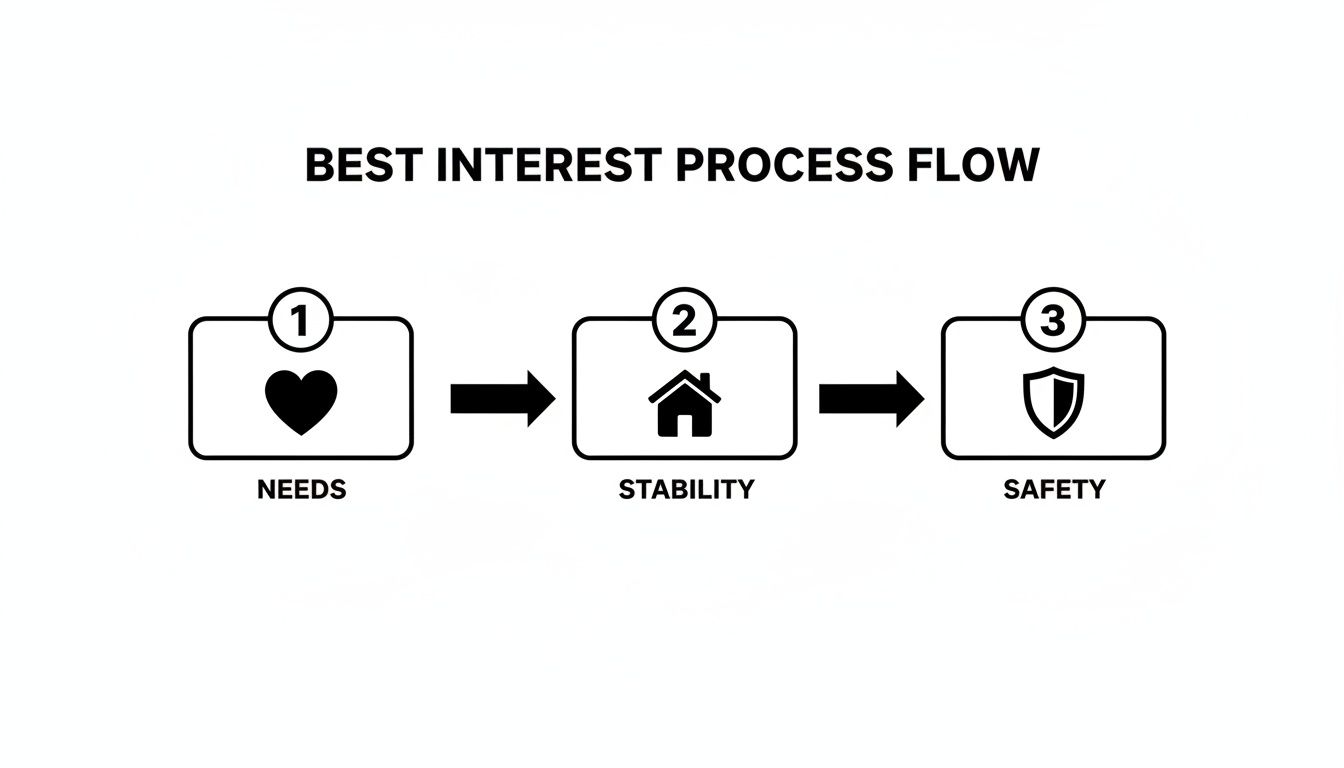
The flow from your child's essential needs to providing a stable environment and ensuring their safety is exactly what your evidence should demonstrate to the judge.
From Claims to Persuasive Evidence
It’s one thing to tell a judge you provide a good home; it’s another thing entirely to show them. Evidence is what turns your claims into credible facts. You don't need a mountain of it, but you do need thoughtful, relevant proof.
Think visually. A few clear photos of your child’s clean and organized bedroom, a stocked pantry, or a safe backyard can speak volumes. A short video of you helping with homework can be more powerful than hours of testimony. Your evidence should always connect back to the central theme: your child’s well-being.
In especially complex cases, such as those with concerns about a parent's mental fitness, expert testimony may be necessary. Engaging a specialized medico-legal consultancy for an evaluation can provide critical, objective evidence for the court.
Master Your Courtroom Conduct
How you act in the courtroom is just as important as what you say. The judge is observing your demeanor, your tone, and how you interact with everyone. Your conduct is a form of evidence in itself.
Your greatest asset in the courtroom is a calm, respectful, and child-focused demeanor. It shows the judge that you can put your child's needs ahead of your own emotions, which is the cornerstone of effective co-parenting.
Here are a few essential tips for your day in court:
- Dress Respectfully: Business casual is a safe choice. It shows you respect the court and the seriousness of the proceedings.
- Address the Judge Properly: Always refer to the judge as "Your Honor." Stand when you speak to them, and never interrupt.
- Stay Calm and Composed: The other parent may say things that are untrue or designed to provoke a reaction. It is critical that you do not take the bait. Let your attorney handle it.
Your composure under pressure demonstrates maturity and stability—two qualities every judge looks for in a parent. For more detailed guidance, our team has put together a comprehensive resource on how to prepare for a custody hearing that you may find valuable.
The Most Common Temporary Orders and What They Mean for Your Family

After the hearing, you won't leave with vague promises. You'll walk out with a legally binding document called a temporary order. This order is the tangible outcome of your first hearing and serves as your family's rulebook while the case moves forward.
Its purpose is to create immediate structure and predictability, which is exactly what children need most when their family is changing. These orders tackle the big questions head-on: where the child lives, who makes key decisions, and how financial needs are met.
Conservatorship: Who Makes the Decisions
In Texas, we use the term "conservatorship" instead of "custody." The judge's first job is to name the conservators, legally assigning parental rights and responsibilities. The overwhelming preference in Texas law is to name both parents as Joint Managing Conservators (JMCs).
Being named JMCs means you are both expected to share in the decision-making for your child. It is the court's way of affirming that having both parents actively involved is almost always in a child’s best interest.
However, the judge will almost always designate one parent as the "primary" JMC. This is the parent who has the exclusive right to:
- Establish the child's residence, usually within a specific geographic area like the county or its neighbors.
- Receive child support payments on behalf of the child.
The other parent is still a JMC, but without those specific primary rights. Both parents typically continue to share the right to make decisions about education and non-emergency healthcare.
Possession and Access: The Visitation Schedule
Once conservatorship is set, the court establishes a possession and access schedule. This is the detailed calendar that outlines exactly when your child will be with each parent.
In the vast majority of cases, judges will order the Texas Standard Possession Order (SPO). This is the default schedule built into the Texas Family Code, and it is legally presumed to be in the child's best interest.
The Standard Possession Order is designed to give children regular, predictable time with both parents. It’s a detailed blueprint covering weekends, holidays, and summer vacation, effectively taking the guesswork—and a lot of potential conflict—out of your co-parenting relationship.
For parents who live within 100 miles of each other, the SPO generally gives the non-primary parent possession of the child on the first, third, and fifth weekends of a month. It also divides major holidays and allocates an extended period for summer vacation.
Temporary Child and Medical Support
Finally, the judge will issue orders for financial support. Temporary child support is calculated using a state formula based on the paying parent’s net monthly resources. This ensures the child's financial needs are met consistently from day one.
The court will also order one or both parents to provide health insurance for the child and will specify how uninsured medical expenses are divided. These financial orders provide crucial stability when everything else feels uncertain. To get a better handle on the specifics, check out our guide on what a temporary custody order entails.
Navigating Unique Family Situations in Court
No two families are the same, and Texas law recognizes this. A one-size-fits-all approach to custody doesn't work for real families. Your first hearing is the time to bring any special circumstances to the judge’s attention, as these details can shape a more protective and effective custody order.
Whether you are an unmarried father seeking to establish your rights, a mother needing a protective order, a grandparent fighting for visitation, or a service member facing deployment, there is a legal path for you. The key is presenting your unique story so the judge understands the full picture.
Unmarried Fathers: Establishing Paternity and Custody Rights
For an unmarried father in Texas, the first hearing is often a two-step process. Before a judge can grant you rights to conservatorship (custody) or possession (visitation), you must be legally recognized as the child's father. Parental rights are not automatic, even if your name is on the birth certificate.
The simplest path is signing an Acknowledgement of Paternity (AOP) with the child’s mother. If that is not possible, you will need to file a paternity suit. At your first hearing, your lawyer can ask the court to order DNA testing. Once paternity is confirmed, the judge can make custody orders that grant you the parental rights you deserve.
When Safety Is a Concern: Protective Orders and Family Violence
A child's safety is the absolute top priority for any Texas judge. If there is a history of family violence—or even the threat of it—your first hearing is the critical moment to request a protective order. This is a powerful legal tool that can restrict an abusive parent's contact with you and your child to prevent future harm.
To obtain one, you must present evidence of the abuse, such as:
- Police reports and medical records
- Photos of injuries or property damage
- Screenshots of threatening texts, voicemails, or emails
- Testimony from witnesses
If the judge finds that family violence has occurred, the law creates a presumption that it is not in the child’s best interest for the abusive parent to be a joint managing conservator. This can dramatically shift the outcome of your case.
Grandparents Seeking Visitation Rights
In Texas, grandparents do not have an automatic right to see their grandchildren. However, under specific circumstances, you can file a lawsuit to request court-ordered access. This usually applies when your own child (the parent) is being denied access or has had their parental rights limited.
The legal standard is high. You must prove to the court that denying you access would significantly impair the child’s physical health or emotional well-being. This requires strong evidence of a stable, positive, and meaningful relationship with your grandchild. The urgency of these first hearings is a global concern; even international bodies recognize the need for rapid reviews to keep families connected and protect children, as noted in reports from the IACHR.
Special Considerations for Military Families
Military service adds another layer of complexity to custody cases. Deployments, relocations, and unpredictable schedules can conflict with standard possession orders. Fortunately, Texas law has specific provisions to protect the rights of service members.
If you are an active-duty parent, you can ask the court to create a temporary possession schedule that accommodates your deployment. You can even designate a trusted family member—like a spouse or parent—to exercise your visitation time while you are away. It is crucial to inform the court of your military status at the very first hearing to ensure your rights are protected.
What Happens After Your First Hearing
The first custody hearing is a major step, but it is not the end of the road. With temporary orders in place, your family now has structure and predictability. The journey toward a final, permanent custody order, however, is just beginning. Knowing what comes next will help you stay focused and prepared.
The period following the initial hearing is dedicated to gathering more information. This stage, called discovery, is where both sides formally request documents and information from one another. It is a fact-finding mission designed to ensure final decisions are based on a complete picture of your family’s life.
Moving Toward a Final Order
From here, your case will almost certainly proceed to mediation. Many Texas courts require you to attempt mediation before scheduling a final trial. Mediation is a confidential meeting where a neutral third-party mediator helps you and the other parent negotiate and try to reach a settlement.
Mediation is powerful because it puts you and the other parent in the driver's seat. You get to create a custom-fit parenting plan for your unique family, instead of leaving the final call to a judge who only knows a fraction of your story.
If you reach an agreement, your attorneys will draft it into a Final Decree or Final Order. Once signed by the judge, this document becomes a legally binding, permanent court order.
Key Takeaways and Next Steps
- Temporary Orders Are Key: The first hearing establishes temporary rules for custody, visitation, and support to create stability for your child.
- "Best Interest" is the Standard: All decisions are based on the Holley Factors, which focus on your child's needs, safety, and well-being.
- Preparation is Power: Gather documents, understand your rights, and maintain a calm, child-focused demeanor in court.
- The Path Forward: After the hearing, expect discovery, mediation, and negotiations aimed at reaching a final, permanent order.
Life changes, and Texas law understands that. If there is a material and substantial change in your family’s circumstances later, you can petition to modify the court's orders. If the other parent ignores the order, you can file an enforcement action to ask the court to intervene. Protecting your child's stability is your right, and the court is there to help.
Common Questions About First Custody Hearings
It’s completely normal to have a lot of questions and "what-ifs" before your first hearing. Here are answers to some of the most common questions our clients ask.
Will I Have to Speak Directly to the Judge?
Most likely, yes. While your attorney will do the heavy lifting—presenting evidence and making legal arguments—the judge may want to hear directly from you. When this happens, be honest, direct, and respectful. Always address the judge as "Your Honor." Your attorney will prepare you for the kinds of questions you can expect so you can answer calmly and clearly.
What Should I Do if the Other Parent Lies in Court?
This is one of the most difficult moments in a contested hearing. It is incredibly hard to listen to someone twist the truth about your parenting. The single most important thing you can do is remain calm. Do not interrupt, gasp, or show an emotional reaction. Trust that your attorney sees what is happening and will have an opportunity to set the record straight through cross-examination or by presenting contrary evidence. A calm demeanor tells the judge you are the mature, credible parent in the room.
Will My Child Have to Be at the Hearing?
Almost certainly not. Texas courts work hard to shield children from the conflict of a courtroom. It is extremely rare for a child, especially a young one, to be present during a temporary orders hearing. If a child's preference is a key issue (generally for children 12 years of age or older), the judge will typically speak with the child privately in their chambers—a process called an in-camera interview—away from the parents and the formal courtroom setting.
How Long Will the First Hearing Take?
This varies. If you and the other parent have reached an agreement ahead of time, the hearing might last only 15 to 30 minutes, as the judge is primarily reviewing and approving your agreement. However, if you disagree on major issues or if serious allegations like family violence are involved, the hearing could last for several hours. Your attorney can provide a better time estimate based on the specifics of your case.
If you need help with a child custody or visitation case in Texas, our experienced attorneys can guide you every step of the way. Contact The Law Office of Bryan Fagan, PLLC today for a free consultation.