
When your child's future is on the line, understanding your rights matters most.
You may be reading this after a hard conversation, a surprise court filing, or a night spent wondering where your child will sleep next month. Many parents start with the same urgent question: how is custody determined in Texas? They want a straight answer, not legal jargon and not guesswork.
The short answer is this. Texas courts focus on the best interest of the child. That sounds broad because it is broad. A judge looks at your child's needs, each parent's ability to meet those needs, the stability of each home, and whether the child will be safe, supported, and able to grow.
That legal standard can feel frustrating because it doesn't work like a simple formula. But it also means your day-to-day parenting matters. The details of real life matter. Who gets the child to school on time. Who knows the doctor's name. Who helps with homework. Who can communicate without pulling the child into adult conflict.
If you're a mother, father, grandparent, or caregiver trying to make sense of conservatorship, visitation, or a custody modification, you're not alone. Texas family law can be explained in plain English. Once you understand the words courts use and the behaviors judges pay attention to, the process becomes less mysterious and a lot more manageable.
Your Child's Future Is Everything
A parent often sits across from me with the same worried look. One hand is on a folder full of school papers, text messages, and calendars. The other hand is wrapped around a coffee cup that's gone cold. The question usually comes out in a rush: “I'm a good parent, but how will the court decide?”
That fear is real. Custody cases touch the most personal parts of your life. Your routines, your home, your parenting choices, and your relationship with the other parent may all come under a microscope. It's normal to feel protective, overwhelmed, and unsure what matters most.
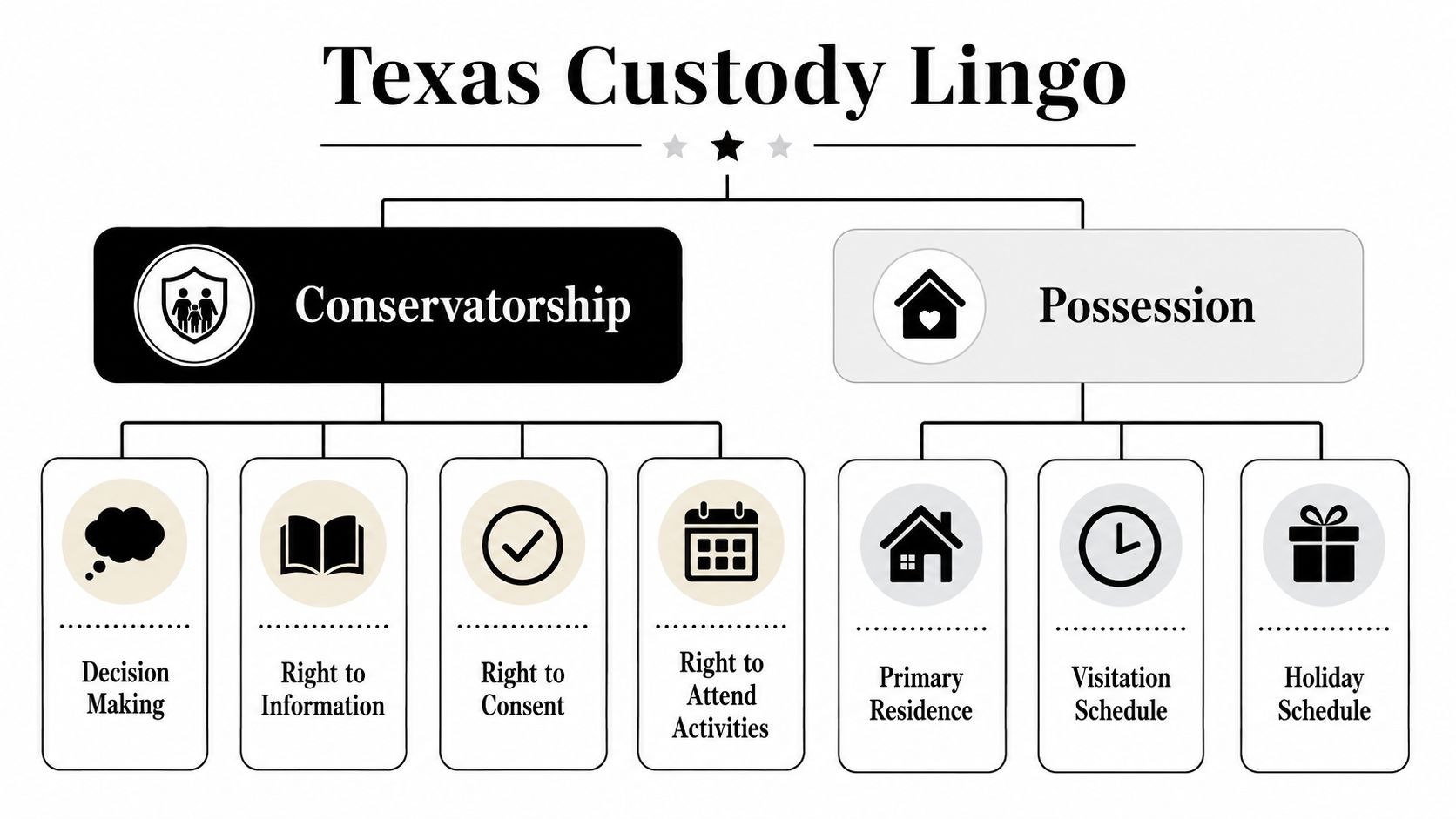
What helps is turning uncertainty into understanding. In Texas, “custody” usually means two separate ideas. One is conservatorship, which covers parental rights and decision-making. The other is possession and access, which covers when the child is with each parent. Those terms matter because parents often use one word, “custody,” to describe several different legal issues.
A custody case is rarely about who loves the child more. It is about what arrangement gives the child the healthiest, safest, and most stable life.
That's why everyday parenting becomes legal evidence. A calm home matters. Reliable routines matter. Respectful co-parenting matters. If you've been trying to keep life steady for your child while your own world feels uncertain, that effort matters too.
Understanding Texas Custody Lingo Conservatorship and Possession
Texas uses words that can sound formal at first, but the ideas are easier than they seem. Think of a custody order like a house. Conservatorship is the blueprint for rights and duties. Possession and access is the calendar that shows when the child is with each parent.
What conservatorship means
In plain English, conservatorship is about decision-making. It covers issues like school, medical care, access to records, and other important rights and duties connected to raising a child. If you want a deeper look at this concept, this guide on conservatorship in Texas breaks down the basics in more detail.
Texas law starts from an important presumption. In Texas, custody determinations are legally governed by the best interest of the child standard, with a statutory presumption under the Texas Family Code that both parents should serve as joint managing conservators unless evidence proves it would harm the child's physical health or emotional well-being, as explained in this discussion of how child custody is decided in Texas divorce cases.
That brings us to joint managing conservatorship. It usually means both parents share certain rights and duties. It does not automatically mean equal time with the child. The resource on Joint Managing Conservatorship in Texas discusses that presumption and what it means in practice.
What possession and access mean
Possession is the time each parent has the child. Access includes the ability to communicate with or visit the child according to the court order. This is the part many parents think of when they say “custody schedule.”
A Texas order may also name one parent as the person who decides the child's primary residence. That parent is often called the primary managing conservator in everyday conversation, even when both parents are joint managing conservators.
Here's a simple way to separate the terms:
| Term | Plain-English meaning |
|---|---|
| Conservatorship | Who makes important decisions for the child |
| Possession | When the child is physically with each parent |
| Access | Visitation and communication rights |
| Primary residence | Which parent chooses where the child mainly lives |
Why this distinction confuses parents
Parents often hear “joint custody” and assume it means a perfect split in parenting time. Texas doesn't treat those ideas as identical. A parent can share major rights and still have a schedule that isn't exactly equal.
Practical rule: If you're reviewing a proposed order, don't stop at the word “joint.” Read the decision-making rights and the parenting schedule separately.
That one habit can prevent a lot of confusion later.
The Heart of the Matter The Best Interest of the Child
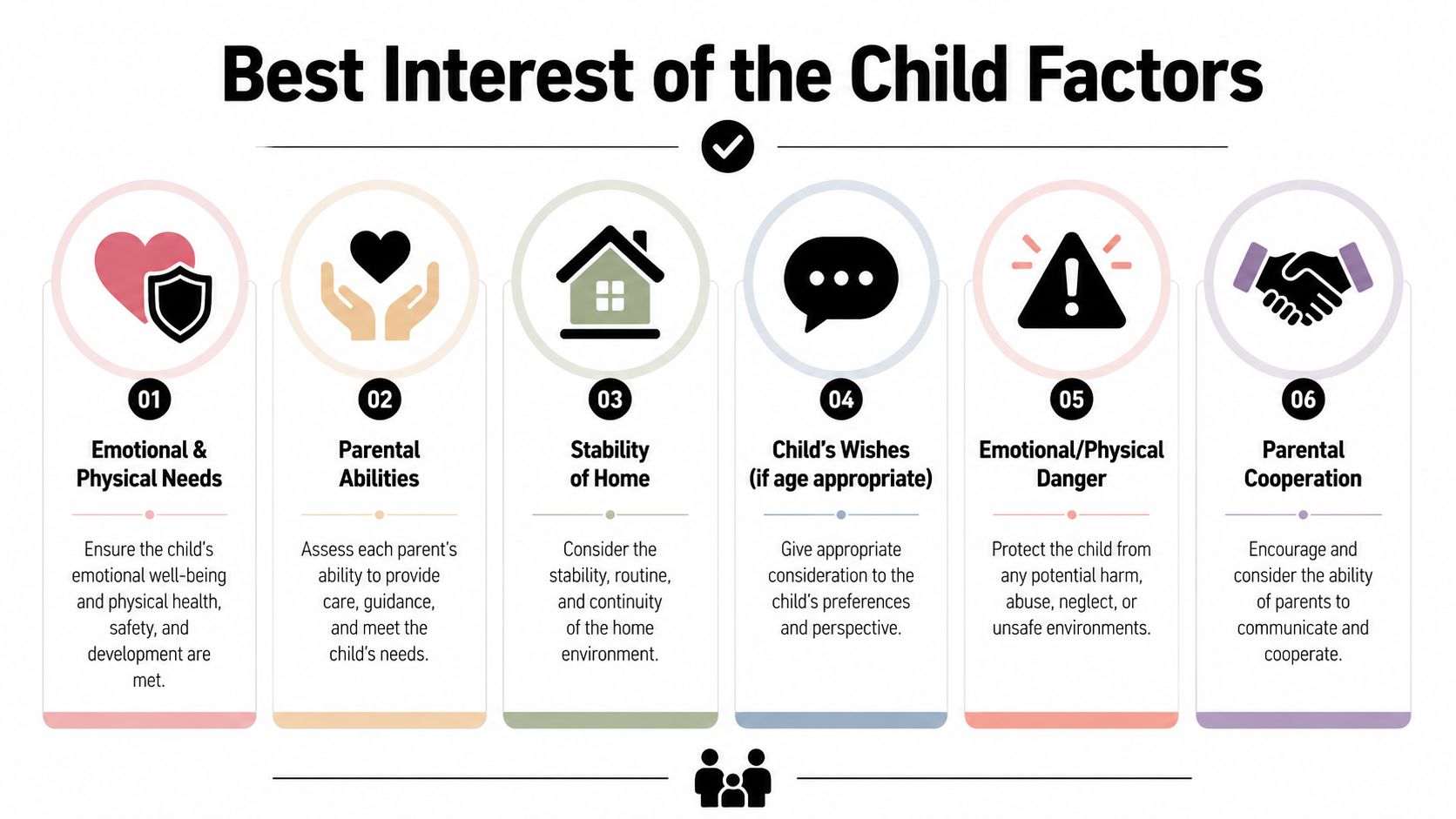
When parents ask how is custody determined in Texas, this is the center of the answer. Texas courts use the best interest of the child standard. That standard is guided by the Holley factors, which include the child's desires, emotional and physical needs, and potential danger, and Texas Family Code requires courts to interview children aged 12 and older to learn their preference, as explained by Texas Law Help's overview of the best-interest standard.
This topic is also explored in understanding Texas custody and the Holley factors what parents need to know, which focuses on how courts use those factors in real cases.
Before looking at the details, it helps to see the big picture.
What the Holley factors look like in daily life
The The Best-Interest Standard and the Holley Factors resource describes the factors Texas courts use to decide custody. In real life, those factors often show up through ordinary parenting behavior.
- Child's desires: If a child is old enough, the court may want to understand the child's preference. That doesn't mean the child gets to choose freely, and it doesn't mean the judge follows the child's wishes without question.
- Emotional and physical needs: Judges look for parents who understand the child's routine, health, school demands, and emotional needs.
- Potential danger: Safety concerns carry serious weight. A history of abuse or domestic violence can change the entire custody analysis.
- Parental abilities: This includes practical parenting. Helping with homework, attending medical appointments, handling meals, bedtime, discipline, and transportation all matter.
- Programs or support available: A parent who makes use of school support, counseling, or community resources may show stronger follow-through.
- Plans for the child: Courts notice whether a parent has a realistic plan for school, activities, childcare, and stability.
- Stability of the home: A calm, dependable home usually helps a parent's position.
- Acts or omissions: Judges may look at conduct that affects the child's well-being.
- Excuses for those acts or omissions: Context matters, but repeated poor decisions are hard to explain away.
What judges often want to know
A judge is often trying to answer a practical set of questions:
- Who has been doing the parenting work consistently?
- Which home gives the child more stability?
- Can these parents support the child without exposing the child to conflict?
- Is the child safe in each environment?
- What schedule fits the child's actual life?
That's why school involvement matters. Knowing the teacher's name, attending conferences, and responding to school issues can help show active parenting. Medical involvement matters for the same reason. A parent who can explain medications, appointments, and treatment history often appears more engaged and informed.
Here's a helpful overview for parents who want to hear this concept explained another way:
The age 12 question
Parents ask about this all the time. Texas law makes a clear distinction. A child under 12 cannot legally determine which parent to live with. Once a child is 12 or older, the court may interview the child in chambers to hear the child's preference. That preference matters, but it is still only one part of the larger best-interest analysis.
A child's voice can be important without being the final word.
That point often relieves parents. Judges don't expect children to carry the full weight of the decision.
How Texas Courts Make Custody Decisions
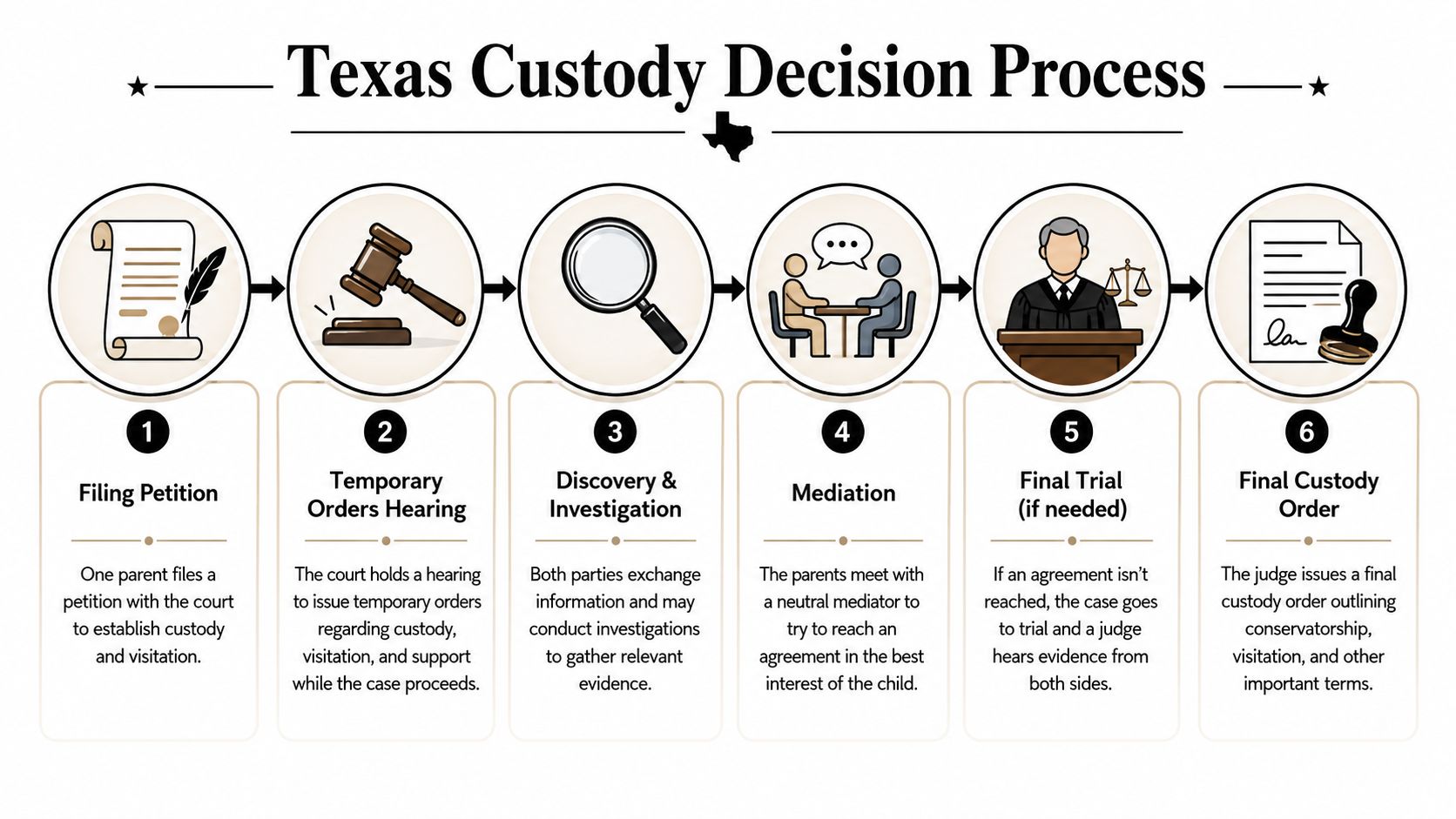
A custody case is not just a debate between two parents. It is a process for gathering information, testing claims, and building a record the judge can rely on. Knowing how that process works can make the courtroom feel less intimidating.
What evidence usually matters
In many cases, the court learns about your family through documents, testimony, and patterns of behavior. This article on how judges make custody decisions in Texas is useful if you want a closer look at that process.
Evidence may include:
- School records: attendance issues, report cards, teacher communication
- Medical records: appointments, diagnoses, treatment follow-up
- Messages between parents: especially if they show cooperation or conflict
- Photos and calendars: these can show routines, activities, and involvement
- Witness testimony: teachers, relatives, counselors, coaches, or others with firsthand knowledge
Judges usually care less about dramatic accusations and more about steady proof. Organized records are often more persuasive than emotional claims.
Other people the court may involve
Some cases involve neutral professionals who help the court gather facts. Parents are often surprised by this, but it's common when concerns are serious or the facts are disputed.
A social study may involve interviews, home visits, and review of family circumstances. The person conducting it is trying to understand how each home functions and what arrangement appears healthiest for the child.
An amicus attorney or attorney ad litem may also be appointed in some cases. Their role can differ, but generally they help the court evaluate the child's interests and the family situation.
Bring the same calm honesty to every meeting that you would want a judge to see in the courtroom.
The path many cases follow
Not every custody case goes all the way to trial. Many move through a sequence like this:
| Stage | What it usually involves |
|---|---|
| Filing | One party asks the court for custody-related orders |
| Temporary orders | Short-term rules while the case is pending |
| Discovery | Exchange of records and information |
| Investigation | Social study, interviews, or other fact gathering |
| Mediation | A structured effort to reach agreement |
| Trial | The judge decides unresolved issues |
| Final order | The written custody ruling |
Mediation is often where practical solutions emerge. Parents who stay child-focused and flexible usually give themselves more room to shape the outcome.
Special Custody Situations in Texas
Some custody issues don't fit the standard pattern. Unmarried parents, military families, and parents facing relocation questions often have extra legal steps to address.
Unmarried parents and paternity
For unmarried fathers, the first issue is often not the schedule. It's legal parentage. Until paternity is established, a father may face obstacles when trying to enforce rights related to conservatorship or possession.

Once paternity is addressed, the case shifts back to the same child-focused standards discussed above. Fathers are not legally disfavored because of gender. Texas courts must focus on the child's best interest rather than a mother-versus-father preference.
If you're dealing with that issue, resources about fathers' rights and paternity can help clarify the first steps before a custody schedule is even discussed.
Military service and parenting plans
Military parents face a different challenge. Service obligations can affect possession schedules, travel, and communication. The law still centers on the child's stability, but a good parenting plan may need to account for training, deployment, or temporary duty changes.
That often means building in practical details such as:
- Communication plans: video calls, phone calls, and regular contact
- Backup arrangements: who helps when the military parent is unavailable
- Transition planning: how the child returns to a regular routine after an absence
Relocation and geographic limits
Relocation disputes can become emotional quickly. One parent may have a job opportunity, family support in another city, or a need to move. The other parent may worry that distance will weaken the parent-child relationship.
Texas custody orders often address where the child's primary residence can be located. If a move would affect the existing order, a parent usually needs court approval or a formal agreement.
This is one area where legal guidance matters early. The Law Office of Bryan Fagan, PLLC handles matters involving paternity, visitation, relocation, and military-related custody concerns, which are often more fact-specific than they first appear. Parents can also review the firm's parenting plans in Texas custody cases resource for a practical sense of what a parenting plan should address.
Changing or Enforcing Your Custody Order
A final order isn't the end of family life. Children grow. Jobs change. People move. Sometimes the actual problem isn't that life changed. It's that one parent won't follow the order already in place.
When you need a modification
A modification asks the court to change an existing order. Under Texas law, to modify an existing custody order, the law requires a material and substantial change in circumstances, and although Texas presumes joint conservatorship is best, that doesn't guarantee equal physical possession, as explained in this overview of Texas child custody questions.
In plain English, that means the court won't rewrite an order just because one parent is unhappy. There has to be a meaningful reason. A major change in the child's needs, a serious shift in a parent's circumstances, or a situation affecting stability may justify going back to court.
If life has changed in a way that affects your child's daily well-being, it may be time to ask whether the current order still fits reality.
When you need enforcement
An enforcement case is different. You're not asking the court to change the rules. You're asking the court to require compliance with the rules that already exist.
Examples often include:
- Denied visitation: one parent refuses scheduled possession
- Missed exchanges: a parent repeatedly ignores pickup or return terms
- Violation of decision-making terms: a parent acts without the authority required by the order
A simple way to tell the difference
| Problem | Likely legal path |
|---|---|
| The current order no longer fits the family's life | Modification |
| The order is fine, but one parent isn't following it | Enforcement |
Before filing either kind of case, gather records. Save messages. Keep a calendar. Write down missed exchanges, late pickups, and important incidents while they are fresh.
Practical Steps to Prepare for Your Custody Case
Parents often feel powerless at the start of a custody case. They aren't. Good preparation can make your parenting easier to understand and easier to prove.
Build evidence from ordinary life
Start with a parenting journal. Keep it simple and factual. Note school pickups, homework help, doctor visits, extracurricular activities, and time spent caring for your child when plans change. You are not trying to write a dramatic story. You are building a reliable timeline.
Gather the records that reflect your role in your child's life:
- School documents: report cards, attendance notes, parent portal records
- Medical information: appointment summaries, prescription information, provider contact details
- Activity records: sports schedules, recital notices, volunteer sign-ups
- Communication records: respectful texts or emails that show cooperation and follow-through
A judge may never care that you “always do everything.” A judge may care very much that you can show a pattern of involvement with dates, records, and examples.
Think like a court would
Ask yourself these questions:
- Does my home feel stable and child-centered?
- Do my messages to the other parent sound reasonable if read in court?
- Am I protecting my child from adult conflict?
- Can I explain my parenting routine clearly and calmly?
Those questions can change how you prepare. They can also change how you communicate.
Keep your communication brief, polite, and focused on the child. If a message wouldn't help your case in a courtroom, don't send it.
What to avoid
Preparation is not only about what to do. It's also about what to stop doing.
- Don't coach your child: pressure about what to say can backfire and can harm the child.
- Don't attack the other parent online: social media posts can become evidence.
- Don't ignore temporary orders: even short-term court rules matter.
- Don't confuse anger with strategy: emotional reactions often create legal problems.
If you're working with an attorney, bring organized documents and a clear timeline. If you're still deciding whether to hire counsel, start collecting these materials now. They'll help either way.
Frequently Asked Questions About Texas Custody
Do Texas courts favor mothers over fathers
No. Texas courts are not supposed to decide custody based on gender. The legal focus is the child's best interest. Fathers and mothers are measured by the same standard. What matters is parenting, stability, safety, and the child's needs.
That's important for both parents to remember. A father shouldn't assume he starts behind. A mother shouldn't assume the court will accept concerns without proof. Evidence matters more than assumptions.
At what age can my child decide where to live
A child cannot choose and make it final. Under Texas law, children under 12 cannot legally determine which parent they live with. Once a child reaches age 12, the court may interview the child and consider that preference as part of the custody decision.
The child's view can matter a great deal, but it does not replace the court's duty to decide what is in the child's best interest.
What is a Standard Possession Order
A Standard Possession Order is a court-ordered schedule that sets out when each parent has possession of the child. It deals with weekends, holidays, and other parenting time details.
Parents often ask if that means a perfect 50/50 split. Not necessarily. In Texas, conservatorship and possession are related but separate ideas. A parent may share decision-making rights without having exactly equal time.
Can grandparents seek rights in a custody case
In some situations, yes. Grandparents may have a role in cases involving visitation or conservatorship, especially when they have been important caregivers or when a child's well-being is at issue. These cases are very fact-specific, so the legal path depends on the family's circumstances.
What helps a parent most in a custody dispute
The strongest approach is usually the simplest one. Be consistent. Stay child-focused. Document your involvement. Follow court orders. Communicate in a way that shows maturity and restraint.
Parents sometimes think the case will turn on one dramatic moment. More often, it turns on patterns. Courts notice who creates stability, who protects the child from conflict, and who shows up again and again.
Key Takeaway
If you remember one thing, remember this: Texas custody decisions are built around your child's best interest, and judges often measure that through everyday parenting behavior. Your consistency, judgment, communication, and ability to support your child's routine matter.
If you're preparing for a custody case, a modification, or an enforcement action, start with facts. Organize records. Protect your child from conflict. Learn the difference between conservatorship and possession. If your situation involves paternity, relocation, military service, or a child who is old enough for the court to hear their preference, get specific legal advice before making assumptions.
If you need help understanding how custody is determined in Texas, or you're facing a dispute over conservatorship, visitation, or modification, a personalized legal strategy can make a real difference. You can schedule a free consultation with Law Office of Bryan Fagan, PLLC to discuss your family's circumstances and your options under Texas law.
If you need help with a child custody or visitation case in Texas, our experienced attorneys can guide you every step of the way. Contact The Law Office of Bryan Fagan, PLLC today for a free consultation.