
When your child's future is on the line, understanding your rights matters most.
You may be reading this after a hard conversation, a tense pickup, or a court paper that uses words you've never had to think about before. You want to know one thing above all else: Will I still have a real voice in my child's life?
That fear is real. So is the confusion. Texas custody law uses terms like “conservatorship,” “possession,” and “best interest of the child,” and those terms can feel cold when your family is hurting. But once you translate them into plain language, the picture becomes much clearer.
For many parents, Joint Managing Conservatorship is the starting point. It sounds technical, but it often means both parents continue to play an important role in major decisions affecting their child. That doesn't answer every question, and it doesn't erase conflict, but it does give you a framework for protecting your relationship with your child.
Navigating Custody When Your Child's Future Is at Stake
One parent sits at the kitchen table reading a proposed order. The words look formal and intimidating. “Joint Managing Conservators.” “Primary residence.” “Possession and access.” The parent's first reaction is often panic: Am I losing time with my child? Am I about to become a visitor in my own child's life?
That reaction is common, and it doesn't mean you're overreacting. It means you care.

In Texas, custody cases are rarely just about labels. They're about who makes important choices, where the child lives most of the time, how parents share time, and how the child stays secure through change. A mother may worry that “joint” means she has to agree to everything instantly. A father may worry that “joint” sounds fair on paper but won't give him meaningful involvement. A grandparent or caregiver may feel caught in the middle, trying to support a child while adults sort out legal rights.
Why this feels so personal
A custody case touches daily life in very practical ways:
- School decisions: Who talks to teachers, signs forms, and handles educational planning.
- Medical care: Who can access records, speak with doctors, and make urgent decisions.
- Home stability: Which home becomes the child's primary residence.
- Parent-child connection: How each parent stays involved consistently, not just occasionally.
Practical rule: The first step in a custody case isn't winning an argument. It's understanding what the legal terms actually mean for your child's routine and your rights as a parent.
If you're trying to understand joint managing conservatorship in Texas, you don't need more stress. You need a clear explanation of what the law says, where parents often get tripped up, and what this arrangement can look like in real life.
What Joint Managing Conservatorship Really Means in Texas
Joint Managing Conservatorship, often shortened to JMC, is about shared legal rights and responsibilities. In plain English, it usually means both parents remain involved in major decisions about the child's life.
Texas starts from a presumption that appointing both parents as joint managing conservators is in the child's best interest, unless that arrangement would impair the child's physical or emotional health under Texas conservatorship rules summarized here. The same summary explains that when a court orders JMC, it must designate one parent with the exclusive right to determine the child's primary residence.
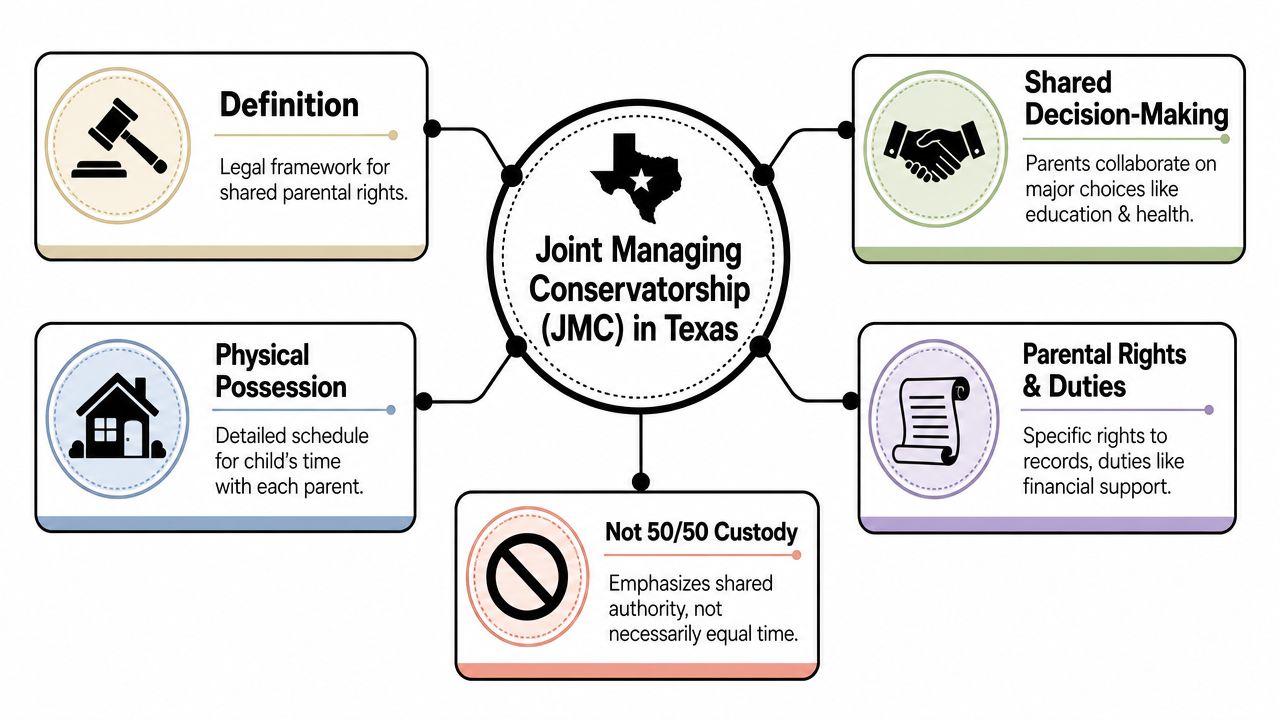
That point matters because many parents hear the word “joint” and assume it means equal time. It doesn't. JMC and possession time are related, but they are not the same thing.
JMC is about authority, not automatic equal time
Think of JMC like two parents serving on the same team for major life decisions. They may both have a say in big-picture issues such as health, education, and welfare. But the child still needs a practical schedule. The court handles that through a separate possession and access order.
Here's the simplest way to understand this:
- Conservatorship answers, “Who has legal rights and duties?”
- Possession and access answers, “When is the child with each parent?”
- Primary residence answers, “Which parent decides where the child mainly lives?”
That's why a parent can be a joint managing conservator and still not have a half-and-half schedule.
Why one parent is named for primary residence
Parents often feel unsettled by this part. If the arrangement is joint, why does one parent get the exclusive right to determine primary residence?
Because children need a clear legal anchor. School enrollment, many day-to-day logistics, and geographic stability often depend on one parent having that authority. The court can still preserve meaningful involvement for the other parent. Shared conservatorship doesn't disappear just because one parent has the primary residence right.
For a focused explanation of the presumption favoring joint conservatorship and what it means in practice, see Joint Managing Conservatorship in Texas.
Joint managing conservatorship in Texas usually means shared decision-making, not a guarantee of equal possession time.
Joint vs Sole Conservatorship What Is the Difference
Parents often compare JMC with Sole Managing Conservatorship, or SMC. The difference comes down to how much decision-making authority is shared and whether one parent receives broader exclusive rights.
JMC is the common starting point. SMC is more like an exception used when shared authority isn't workable or safe for the child.
Side-by-side comparison
| Feature | Joint Managing Conservatorship (JMC) | Sole Managing Conservatorship (SMC) |
|---|---|---|
| Major decision-making | Parents share major rights and duties, though the court may give one parent certain exclusive rights | One parent holds broader exclusive authority over major decisions |
| Primary residence | One parent may receive the exclusive right to determine the child's primary residence | The sole managing conservator typically has this authority |
| Access to information | Both parents often retain important rights to information about the child | The non-managing parent may still have rights, but authority is more limited |
| Day-to-day role | Both parents remain legal conservators | One parent has the primary legal management role |
| When courts use it | Often used when parents can share legal responsibility | Used when shared management isn't in the child's best interest |
When courts move away from JMC
Texas courts can limit the usual presumption in favor of joint conservatorship when serious concerns are present. These situations may include family violence, abuse, or circumstances showing that the parents can't place the child's welfare first.
That doesn't mean every disagreement leads to sole conservatorship. Many parents argue. Many co-parents communicate poorly at first. Courts know that separation is stressful. What matters is whether the conflict rises to a level that makes shared legal decision-making unsafe or unworkable.
A practical way to think about it
If JMC is like shared management of your child's major life decisions, SMC is more like one parent being given the lead role because the court believes shared management would harm stability, safety, or the child's well-being.
For example:
- Ordinary conflict: Parents disagree about routines but can still exchange information. JMC may still work.
- Safety concerns: One parent presents a danger or repeatedly undermines the child's welfare. The court may consider giving one parent stronger exclusive rights.
- Extreme communication breakdown: If parents can't make necessary decisions without chaos or harm to the child, the court may narrow shared authority.
A label matters, but the details in the order matter more. Two JMC orders can look very different depending on how rights are divided.
Your Rights and Duties Under a JMC Order
Once a court signs a JMC order, life becomes less about theory and more about daily responsibilities. Parents need to know what they can do, what they must do, and what they should document.
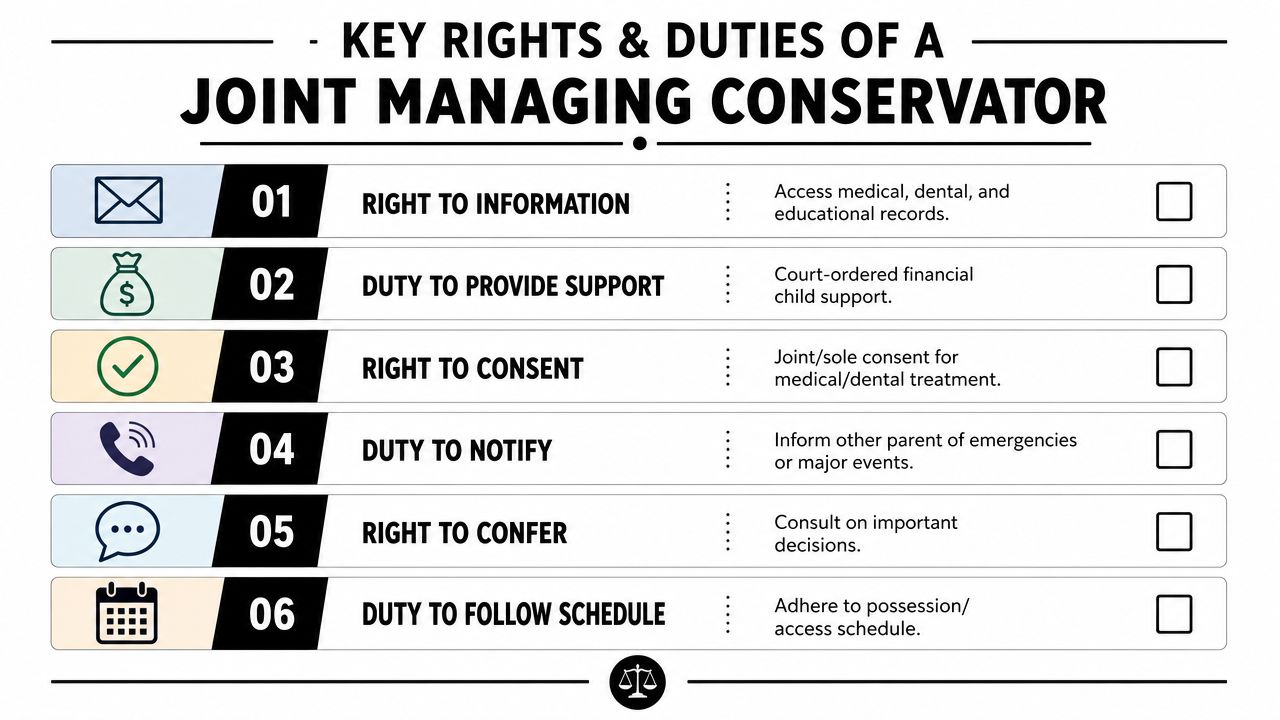
Texas law gives joint managing conservators certain non-exclusive rights at all times, including the right to receive information about the child's health, education, and welfare and the right to access medical and educational records, as described by Texas Access on JMC rights and responsibilities.
Rights you usually keep at all times
These rights help both parents stay informed and involved, even if the child primarily lives with the other parent.
- Access to important information: You can usually receive information about your child's health, education, and welfare.
- Access to records: Medical and school records are often available to both conservators.
- Ability to consult professionals: Parents may be able to communicate with doctors, school officials, and others involved in the child's care.
- Emergency medical authority: In an emergency involving immediate danger to the child's health, a conservator can consent to needed treatment.
These rights matter because involvement starts with information. If you don't know what's happening at school or with medical care, it becomes much harder to parent well.
Duties during your periods of possession
When the child is with you, your role isn't limited because the order says “joint.” During your possession time, you have real parental duties.
That typically includes care, control, protection, and reasonable discipline. It also includes providing the basics, such as clothing, food, shelter, and medical care that doesn't involve an invasive procedure.
A JMC order doesn't make either parent a bystander. Each parent has active responsibilities when the child is in their care.
Child support and possession are not the same issue
Many parents get confused here. They assume that if rights are shared, financial responsibility must be shared in the same exact way. Texas law doesn't work that straightforwardly.
A court may order one joint managing conservator to pay child support to the other. So even in a joint arrangement, one parent may have a support obligation while both remain conservators.
Read the order, not just the label
Your final order should spell out which rights are shared, which are independent, and which may be exclusive to one parent. That's why two people can both say they have JMC and still have very different practical authority.
If you're also trying to understand the other parent's role in a more limited rights arrangement, this explanation of what is a possessory conservator in Texas can help connect the terms.
The Best Interest of the Child Standard in Texas
Parents hear this phrase constantly: the best interest of the child. It can sound broad or even subjective. In practice, judges are looking for signs of safety, stability, responsible parenting, and a plan that serves the child rather than the adults' frustration.
Texas law presumes that joint managing conservatorship is in the child's best interest, but a court can restrict that presumption or give exclusive rights to one parent if there's evidence of domestic violence, abuse, or an inability to put the child's welfare first, as explained in this Texas custody overview from WomensLaw.
What judges usually look for
Judges don't decide custody based on who is more upset, louder, or more offended. They usually focus on practical questions like these:
- The child's needs: Who can meet the child's emotional, educational, and physical needs consistently?
- Parental judgment: Which parent shows sound decision-making and maturity?
- Home stability: Which home offers dependable routines and structure?
- Safety concerns: Is there any risk of abuse, violence, or harmful instability?
- Co-parenting ability: Can the parents support the child's relationship with the other parent when appropriate?
These ideas are often discussed through what lawyers call the Holley factors. You don't need to memorize that phrase. You do need to understand the judge is looking for evidence, patterns, and conduct that affect your child's real life.
What this means for mothers and fathers
For mothers, it may mean showing that you've provided stable care while also staying open to healthy involvement by the other parent when appropriate. For fathers, it may mean documenting your consistent role in school, healthcare, routines, and parenting decisions rather than assuming the court will know your importance.
For both parents, the strongest approach is usually the same:
- Stay child-focused: Keep your communication tied to the child's needs.
- Be organized: Save records, calendars, and messages that show involvement.
- Avoid retaliation: Judges notice when a parent uses the child to punish the other parent.
- Follow temporary orders: Courts often view compliance as a sign of reliability.
Key takeaway: Judges usually respond better to steady parenting than emotional accusations. Calm, documented facts carry more weight than anger.
If you want a fuller discussion of how courts evaluate custody questions, this guide to top considerations for determining the best interest of the child in Texas custody cases is a useful next read.
Steps to Establish or Modify Your Custody Order
You may be staring at two homes, two work schedules, school pickup questions, and a child who just wants to know what happens next. A custody case is the legal process for turning that uncertainty into a written plan people can follow.
Starting a new case
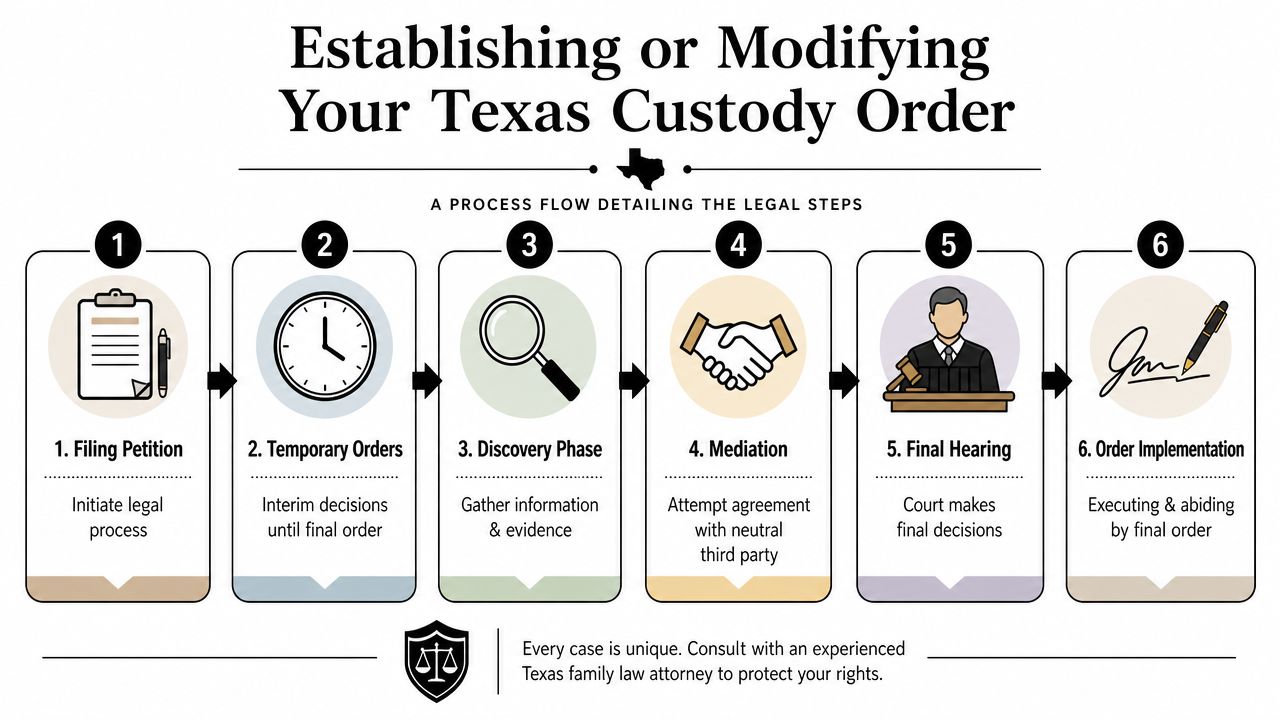
A new case usually begins when a parent files a request asking the court to set the rules for conservatorship, possession, and child support. In plain terms, you are asking the court to build the first operating manual for your family after separation.
If you and the other parent agree on the major terms, that agreement can often be written into a final order. If you disagree, the court steps in to decide the unresolved parts.
Temporary orders often come first. These are short-term rules that create stability while the case is still open. They may cover where the child stays, how exchanges work, who can make certain decisions, and how day-to-day conflict gets reduced.
Changing an existing order
A modification case starts from a different place. The court already has a written plan in effect, so the question is whether that plan still fits your child's life.
Texas courts usually want to see a meaningful change in circumstances and a proposed change that serves the child's best interest. That might involve a parent's relocation, a serious shift in the child's needs, repeated problems following the order, or changes in work and school routines that make the current schedule stop working.
If a move is part of the problem, this guide on relocating in Texas with joint custody and what you need to know can help you spot issues before they turn into larger disputes.
What usually happens between filing and a final order
Parents often assume the case is all about the final hearing. In many families, the middle of the case shapes the outcome just as much.
Here is what that middle stage often includes:
- Filing and response: One parent files the case, and the other parent gets a chance to respond.
- Temporary arrangements: The court may put early rules in place so the child has structure right away.
- Information exchange: Parents gather school records, medical information, calendars, messages, and other documents that show what family life looks like in practice.
- Negotiation or mediation: Many cases settle here, where parents work through details with lawyers or a neutral mediator.
- Final trial if needed: If key issues remain disputed, the judge hears evidence and signs a final order.
A good way to understand this process is to compare it to drafting a parenting map. The filing starts the map, temporary orders sketch the first roads, and the final order labels exactly who goes where, when, and with what authority.
The written order is what protects you
Parents sometimes leave a hearing feeling relieved because everyone shook hands and sounded reasonable. Relief is understandable, but the part that protects you is the signed order, not the hallway agreement.
The written language controls your rights and duties. If pickup times, decision-making rules, holiday schedules, or geographic limits are vague, conflict tends to grow later because each parent reads the gap differently.
That is why some parents speak with a family law firm such as Law Office of Bryan Fagan, PLLC about custody, support, modification, enforcement, and visitation issues. The goal is not just to get an order entered. The goal is to leave court with clear instructions you can live by and use to protect your relationship with your child.
Texas JMC FAQs for Parents
Parents living under a JMC order usually don't struggle with the label alone. They struggle with the everyday questions that come after the ink dries.
Does JMC mean a 50 50 schedule
No. Under Texas Family Code Section 153.134, JMC gives both parents shared rights to make major decisions regarding the child's health, education, and welfare, but it does not require a half-and-half possession split, as explained in this discussion of JMC and joint custody in Texas.
That means you can have joint managing conservatorship and still have a schedule where one parent has more overnights.
Can parents agree to a different possession schedule
Often, yes, if the agreement serves the child and the court approves it when approval is required. Some parents create highly customized schedules based on work hours, school needs, or distance between homes.
The key is making the schedule specific enough to prevent future conflict.
What if the other parent wants to move
Relocation can affect school, exchanges, and the child's ability to maintain consistent contact with both parents. If your order includes a geographic restriction or the move would disrupt the current arrangement, you may need court action before the move can lawfully reshape the custody plan.
Don't rely on assumptions in move-away situations. Read the order carefully and get legal advice promptly.
What if one parent is in the military
Military service can complicate schedules, travel, and communication, especially during deployment or reassignment. The central question usually remains the same: how to preserve the child's stability while respecting the parent-child relationship.
Practical planning helps. Parents often need clear temporary arrangements, communication plans, and detailed return provisions.
What happens if the other parent violates the order
Start by documenting the problem carefully. Keep records of missed exchanges, denied access, or repeated failures to follow the written order. If the problem continues, enforcement may become necessary.
A court can only enforce what the order clearly says. Vague language creates real problems later.
Can grandparents or other caregivers play a role
Sometimes they can, especially when they've been central to the child's routine or safety. But their rights depend on the facts and the legal posture of the case. These situations are often very fact-specific, so direct legal advice is important.
Next steps
If you're dealing with joint managing conservatorship in Texas, focus on three things first:
- Read every line of your order: The details control more than the label.
- Track your involvement: Keep records of parenting time, school contact, and medical issues.
- Stay child-centered: Courts respond to parents who protect stability and put the child first.
The most useful custody strategy is usually the most grounded one. Learn the terms. Understand the written order. Act consistently.
If you need help with a child custody or visitation case in Texas, our experienced attorneys can guide you every step of the way. Contact The Law Office of Bryan Fagan, PLLC today for a free consultation.