Skip to content
When your child’s future is on the line, understanding your rights matters most. Navigating the legal system to secure your child's financial stability can feel overwhelming, but you don't have to do it alone. In Texas, child support is calculated using a specific formula designed to be fair and consistent, providing a predictable path forward for families during a difficult time. The process is based on the paying parent's income and the number of children they need to support, ensuring the focus remains on your child's well-being.
How Texas Determines Child Support
When you're facing a divorce or separation, your primary concern is ensuring your children are cared for. The Texas Family Code provides a structured framework for calculating child support to make this process as clear as possible. The entire system is built on one guiding principle: the “best interests of the child.” This isn't just a phrase—it's the legal standard a Texas judge uses for every decision, guaranteeing your child’s needs are the central focus.
The calculation follows a logical path, starting with the paying parent’s income and applying set percentages. This formula-based approach is designed to be fair to both mothers and fathers, creating a support amount that meets the child’s needs while being manageable for the paying parent.
The Foundation of the Formula: Net Resources
The entire calculation begins with determining the non-custodial parent's monthly net resources. This is a specific legal term for the amount of money a parent has available to pay support. It’s not just their take-home pay; it's calculated by adding up all sources of income and subtracting only a specific list of state-allowed deductions. Getting this number right is the most critical step.
Key features of the Texas child support system include:
- Guideline Percentages: The Texas Family Code provides a simple chart that applies a set percentage to the parent's net resources. This percentage increases based on the number of children requiring support.
- Focus on Net Income: Texas law is clear that support must be based on net resources, not gross income. This is a crucial distinction that prevents the final support order from being unfairly high.
- Predictable Outcomes: Because the system is formula-based, you and your attorney can often predict the likely outcome of a child support order. This predictability can help parents reach an agreement without a lengthy court battle. To learn more about the initial steps, you can read our guide on how to get child support in Texas.
At its heart, the Texas child support formula is designed to ensure your child receives financial support that reflects the family's reality. The law recognizes that both parents share the responsibility of raising their children, and this formula is the state's method for allocating that financial duty fairly.
This guide will walk you through each step, from calculating income to applying the correct percentages, so you can feel confident and informed. At The Law Office of Bryan Fagan, we are here to bring clarity to this process and empower you to protect your child's future.
Figuring Out Your Monthly Net Resources
When your family is going through a major life change, trying to wrap your head around the financial side of things can feel like a heavy weight. The entire foundation of a Texas child support calculation rests on a single, crucial number: your monthly net resources. This isn't just your take-home pay from your paycheck. It’s a specific figure defined by the Texas Family Code, and getting it right is the most important step in this whole process.
The calculation always starts with your gross income. Now, the state casts a very wide net here, pulling in just about every dollar you receive from any source. Of course, it includes your primary salary or wages, but it goes much, much further than that.
What Counts as Gross Income
Think of gross income as all the money flowing in before a single penny is taken out. This means a court is going to look at everything—from your regular paycheck to sources of income that might not seem so obvious at first glance.
You'll need to account for things like:
- Wages, salaries, commissions, and overtime pay
- Tips and bonuses
- Income from any business you own or operate (self-employment)
- Interest, dividends, and royalty income
- Net rental income from investment properties
- Severance pay
- Retirement benefits, pensions, and annuity payments
- Social Security benefits (but not Supplemental Security Income)
- Unemployment benefits
- Workers' compensation benefits
- Alimony or spousal maintenance you receive
Honestly, even income from one-off events like capital gains or significant gifts can be looped in by the court. The goal is to paint a complete, accurate picture of a parent's total financial capacity to support their child.
The path to a fair child support order in Texas is a clear one: it starts with understanding your income, moves through the state's formula, and ends with clarity for your family's future.
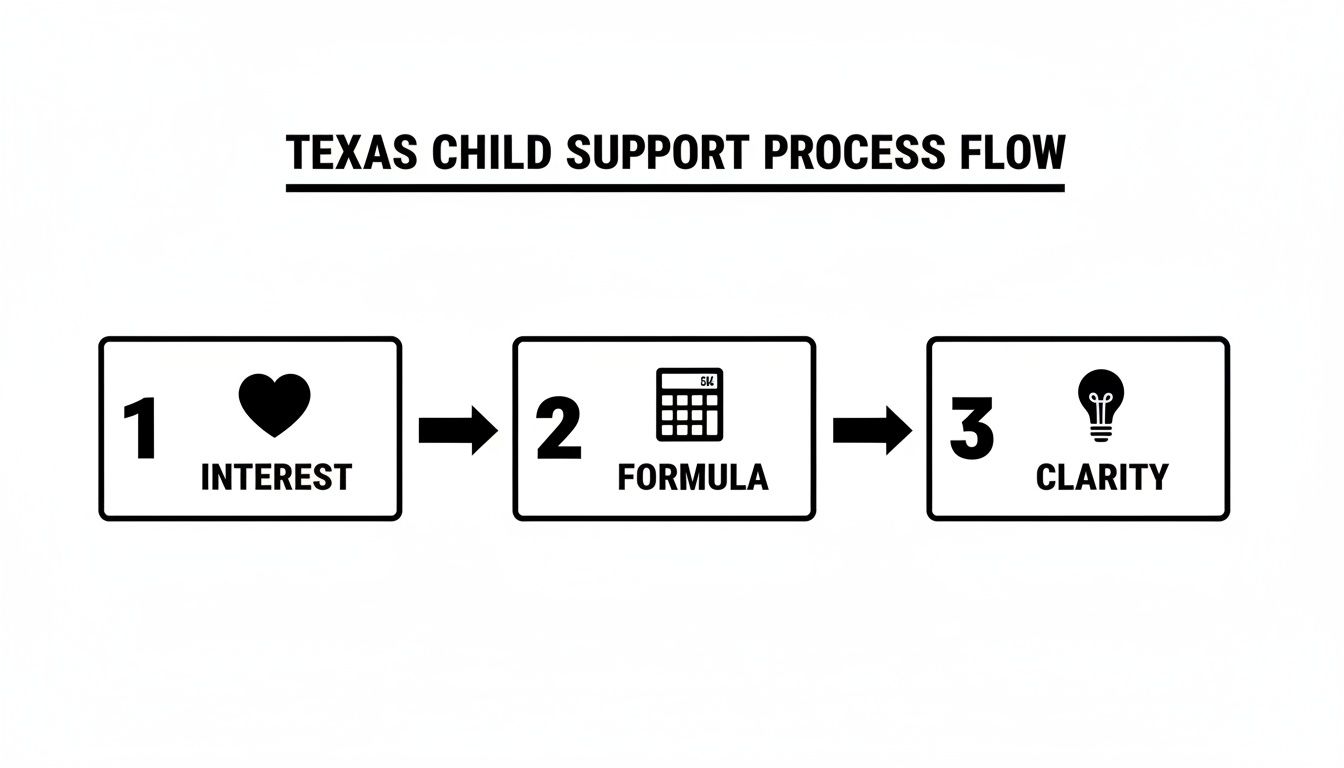
As you can see, the journey begins with what matters most—your child's best interests—before moving through a logical formula to create a clear path forward for everyone.
From Gross Income to Net Resources
Once every source of income is tallied up, the next job is to subtract only the deductions allowed by Texas law. This is a huge point of confusion for many parents I work with. You can't just use the net pay figure on your pay stub, because the court permits a completely different, and much shorter, list of deductions.
The Texas Family Code is incredibly specific about what can be taken out of your gross income. It’s critical to understand that common payroll deductions like 401(k) contributions, loan repayments, or charitable giving are not subtracted when calculating net resources for child support.
The legally permitted deductions are pretty limited. They boil down to:
- Federal income taxes (calculated based on the rate for a single person claiming one exemption)
- State income taxes (if you work in a state that has one, even if you live in Texas)
- Social Security taxes (FICA)
- Union dues, but only if they are mandatory for your job
- The cost of health and dental insurance for the child (or children) in the case
This distinction is absolutely vital. A court won't look at what's actually withheld from your check for taxes; instead, they will use standardized tax charts to figure out the correct deduction. Similarly, only the slice of your health insurance premium that covers your child is deductible at this stage.
To help clear things up, let's break down what typically goes into the calculation versus what gets taken out.
Breaking Down Monthly Net Resources Income vs Deductions
| Category | What Counts as Income (Examples) | What Can Be Deducted (Examples) |
|---|---|---|
| Employment | Salary, wages, overtime, tips, bonuses, commissions | Federal income tax (single, 1 exemption) |
| Self-Employment | Net income from a business or freelance work | Social Security and Medicare taxes (FICA) |
| Investments | Interest, dividends, capital gains, royalty income | Mandatory union dues |
| Benefits | Retirement, pension, social security, unemployment | Health & dental insurance premiums for the child |
| Other | Rental income, severance pay, alimony received | State income tax (if applicable) |
Getting these calculations right is everything. A simple miscalculation can lead to an incorrect child support order that could stick around for years, either meaning you pay more than you should or your child receives less than they need. And if a parent fails to pay court-ordered support, the consequences can be serious. In those situations, you might need to understand how to garnish wages in Texas to enforce the order.
By carefully documenting every bit of income and applying only the state-allowed deductions, you'll land on that final monthly net resources figure. This is the number the court will plug into the child support percentage guidelines, which we'll cover next.
Applying the Guideline Percentages
Once you’ve nailed down the monthly net resources, you’re at the heart of the Texas child support calculation. The state uses a straightforward, percentage-based system outlined right in the Texas Family Code. This is done to make support orders as consistent and predictable as possible for families, no matter what county they're in. It takes a lot of the guesswork out of the equation and gives parents a solid starting point for understanding their financial obligations.

The formula is pretty simple: a set percentage is applied to the paying parent's monthly net resources. That percentage goes up depending on how many children are involved in the case. It’s a tiered system designed to fairly scale the support amount to what the kids actually need.
The Guideline Percentages Explained
Texas law gives courts a clear schedule to use as a baseline for nearly every child support case. These percentages are applied directly to the non-custodial parent's monthly net resources. Here's how it breaks down:
- 1 Child: 20% of net resources
- 2 Children: 25% of net resources
- 3 Children: 30% of net resources
- 4 Children: 35% of net resources
- 5 Children: 40% of net resources
- 6 or More Children: At least 40% of net resources
Let's run a quick example. If a parent's monthly net resources come out to $5,000 and they have two children, the guideline child support amount would be $1,250 per month ($5,000 x 0.25). This predictable model helps both parents anticipate their financial responsibilities and plan for what's ahead.
What About the Statutory Cap on Income?
This is where a lot of parents get confused, especially when the paying parent is a high-income earner. Texas law addresses this by putting a "cap" on the amount of monthly net resources that the guideline percentages apply to. As of the latest update, that cap is $9,200 per month.
This means that for any income above $9,200 in net resources, the standard percentages don't automatically kick in. For example, if a parent nets $15,000 a month, the guideline calculation would typically only be applied to that first $9,200.
But here’s the important part: the cap doesn’t mean a high-earning parent will never pay more than the guideline amount on that $9,200. A judge has the discretion to order additional support if the child's proven needs justify it. The goal is to ensure the child continues to benefit from the standard of living they would have enjoyed if the family had stayed together.
A court might consider ordering extra support to cover expenses like:
- Private school tuition
- Expensive extracurriculars, like competitive sports or music lessons
- Specialized tutoring or educational programs
- Travel costs related to the child's activities
The parent requesting the additional support has to provide clear evidence of these needs. The court will then decide on a fair amount above the guideline to meet those specific, documented expenses, always keeping the child's best interests as the top priority. It's a balancing act—providing for the child's needs without creating an unfair burden.
Interestingly, the Texas model, which focuses solely on the paying parent's income, isn't the only way to do it. One of the most common methods used in other states and countries is the Income Shares Model. In that system, courts combine both parents' incomes and then split the child-rearing costs proportionally. You can explore how international child support models compare for more context on these different approaches.
Ultimately, whether your income is below or above the cap, the Texas guidelines provide the essential framework. They are the starting point from which all other adjustments—like credits for health insurance or other children you support—are made.
Adjusting for Health Insurance and Other Children
Once you've figured out the guideline percentage for child support, you might think you're done. But in the real world, the calculation rarely stops there. The Texas Family Code is smart enough to know that a simple percentage doesn’t capture the full financial picture of a family. To get to a fair and accurate number, the law requires adjustments for big-ticket items like health insurance and for parents who are also supporting other children.
These aren't just minor tweaks; they ensure the final child support amount truly reflects your child's needs and your actual ability to pay.

Accounting for Health and Dental Insurance
A child's health is a top priority, and Texas courts build health and dental insurance into every single custody order. The judge will order one parent to be responsible for maintaining the child's coverage. Whichever parent foots that bill gets a credit, which directly lowers their monthly child support payment.
Here’s how that credit actually works in practice: The court takes the monthly cost of the child's portion of the health and dental premium and subtracts it from the paying parent's gross income—before any taxes or other deductions are calculated. This lowers the net resource figure, and in turn, lowers the final child support amount. It's crucial to understand what a health insurance premium is to see how this impacts the bottom line.
Let's say a parent's gross monthly income is $6,000, and they pay $300 a month for their child's health insurance. That $300 is deducted right off the top, making the starting income for child support purposes $5,700. This makes sure the parent isn't paying twice—once for the premium itself and again through a higher, unadjusted support payment. If you have questions about this, our guide on court-ordered health insurance after divorce dives deeper into this topic.
The Credit for Other Children You Support
Life can be complicated. It’s very common for parents to have children from different relationships, all of whom they have a legal duty to support. The Texas Family Code acknowledges this reality by offering a credit to avoid financially overwhelming a parent who is juggling multiple households.
This isn’t something you get automatically. You must have a legal duty to support the other child, which means there's a previous court order in place or the child lives in your home. This credit works by reducing the percentage applied to your net resources.
The calculation for this credit is very specific. The court doesn't just guess; it uses a chart in the Texas Family Code to apply a slightly reduced percentage based on how many other children you support and how many children are in the current case. It's a structured way to acknowledge all of a parent's financial responsibilities.
Let’s walk through a quick example:
- Parent’s Net Resources: $4,000 per month
- Children in This Case: 2
- Other Children Legally Supported: 1
Normally, the guideline for two children is 25%, which would be a $1,000 monthly payment ($4,000 x 0.25). But since this parent supports another child, the court turns to the special chart. For this specific scenario, the percentage drops to 22.5%.
The new child support amount is now $900 per month ($4,000 x 0.225), giving the parent a $100 credit for supporting their other child.
Here at The Law Office of Bryan Fagan, PLLC, we handle these specific Texas rules every day. We know how to navigate the formulas and apply the right credits to ensure the final child support order is fair and accurate for your family's unique situation.
When a Court Can Deviate from the Guidelines
While the Texas child support formula gives us a solid, predictable starting point, it’s not always the final word. The law gets it: no two families are the same. What works on paper for one family might be completely unfair for another. This is why a Texas judge has the authority to order a support amount that’s either higher or lower than what the guidelines suggest, but only if the evidence shows it’s in the child's best interest.
This isn't a decision a judge makes lightly. The Texas Family Code lays out a specific list of factors a judge has to consider before going "off-guideline." If you want to argue for an amount that's different from the standard calculation, you need to understand these factors inside and out. It’s your key to advocating for an outcome that truly fits your family’s unique circumstances.
Factors a Judge Can Consider
A judge won't change the support amount on a whim. They need compelling reasons backed by solid evidence. The parent asking for the deviation—whether it's for more or less support—has the burden of proving exactly why it's necessary.
Here are some of the key factors a court will look at:
- The age and needs of the child: This is a broad but powerful factor. Think about a child with significant special needs. They might require costly medical treatments, specialized therapy, or adaptive equipment that goes far beyond what guideline support could ever cover.
- The financial resources of both parents: The court can look at the complete financial picture. If the parent receiving support has a very high income and the parent paying has a modest one, the court might find that a lower support amount is appropriate.
- The amount of time the child spends with each parent: Let's say the non-custodial parent has a possession schedule that is significantly more than the standard order. The court may reduce their support obligation to reflect the increased costs of caring for the child during that extra time.
- Child care expenses: If one parent is shouldering an unusually high cost for childcare that's necessary for them to work, this can be a solid reason to adjust the support amount.
- Extraordinary travel costs: For parents who live far apart, the cost of travel for visitation can be substantial. A judge can lower the support obligation to help the non-custodial parent afford flights or long drives, ensuring they can maintain their relationship with the child.
A Real-World Example of Deviation
Let's walk through a real-world scenario. Imagine a child has a severe medical condition that requires weekly physical therapy and specialized tutoring, costing an extra $800 per month. The guideline child support calculation comes out to $1,000 per month, which just isn't enough to cover these proven needs.
In this situation, the custodial parent could present evidence of these expenses—invoices from the therapist, receipts for tutoring, letters from doctors—and ask the judge to order support above the guidelines. The judge could then add a portion or all of that $800 to the monthly support order to ensure the child’s needs are met.
The core principle is always the "best interests of the child." A judge will only deviate from the guidelines when they are convinced that the standard formula would be unjust or inappropriate for the child in that specific case.
It’s all about making sure the final order is fair, just, and tailored to the reality of your child’s life. Knowing how to calculate child support is the first step, but understanding when and why a court can adjust that number is just as important.
At The Law Office of Bryan Fagan, we can help you gather the necessary evidence and present a compelling case to the court if your situation warrants a deviation from the standard guidelines.
Common Questions About Child Support in Texas
Once you get past the basic child support guidelines, the real-life questions start popping up. The Texas framework gives us a solid starting point, but every family's situation has its own unique wrinkles. Here, we'll tackle some of the most common concerns we hear from parents, offering straightforward guidance based on Texas law and our experience helping families just like yours find a clear path forward.
How Is Income Handled for Self-Employed Parents?
Figuring out child support for a self-employed parent isn't as simple as glancing at a pay stub. When there’s a business involved, the court has to dig deeper to determine the "gross income" available for support.
It's a two-step process: first, the court looks at the business's total receipts. Then, it subtracts all ordinary and necessary business expenses. The goal is to find the actual profit—the money that's truly available to support a child. This means meticulous and transparent record-keeping is non-negotiable. You'll need to present a clear financial picture using documents like:
- Federal tax returns (especially Schedule C)
- Detailed profit-and-loss statements
- Business bank records
A judge will scrutinize these documents carefully to ensure claimed expenses are legitimate business costs, not personal spending disguised to lower the parent's income.
What Happens If a Parent Is Intentionally Unemployed?
This is a big one. Texas courts operate on a core principle: a child has the right to receive support from both parents. Because of this, a judge can order child support based on a parent's earning potential, not just their current paycheck. It's a critical protection for kids.
If the court believes a parent is intentionally unemployed or underemployed just to dodge or shrink their support obligation, it has the power to act. A judge can "impute" income, which is a fancy way of saying they'll calculate child support based on what that parent could and should be earning. They'll look at factors like skills, education, work history, and the local job market. This ensures a parent can't simply quit a good job or take a low-paying one without a valid reason to sidestep their responsibilities.
How Long Does a Parent Have to Pay Child Support?
This is probably one of the most frequent questions we get, and thankfully, the answer is usually straightforward. In Texas, the legal duty to pay child support typically continues until one of two things happens:
- The child turns 18 years old.
- The child graduates from high school.
The obligation lasts until whichever of these events occurs later. For instance, if your child turns 18 in January of their senior year, your support payments will continue until they walk across that graduation stage in May or June.
There is a major exception to this rule for children with disabilities. If a child is physically or mentally disabled and unable to support themselves, a court can order that the support obligation continue indefinitely. This ensures they receive the care they need long past the age of 18.
As you sort through the financial side of child support, it's smart to keep an eye on the bigger picture. Divorce and custody orders ripple through every part of your finances. It's often helpful to learn more about how major life changes impact your taxes, marriage, and divorce to make sure you're fully prepared.
Getting a handle on these common scenarios helps you anticipate issues and advocate for a fair outcome that truly serves your child’s best interests. Knowing your rights—and what a court can do—is the first step toward making informed decisions for your family's future.
Key Takeaways and Your Next Steps
Navigating child support in Texas doesn't have to be a source of stress and confusion. By understanding the core principles, you can approach the process with confidence and advocate effectively for your child's well-being.
Here are the essential points to remember:
- It Starts with Net Resources: The calculation is based on the paying parent's monthly net resources, which is their total income minus a specific list of state-allowed deductions.
- Guideline Percentages Are the Standard: Texas uses a set percentage of net resources based on the number of children needing support. This formula provides a predictable starting point.
- Adjustments Are Common: Credits for providing health insurance and supporting other children are factored in to create a fair final amount.
- The Best Interest of the Child is Key: A judge can deviate from the guidelines if there is clear proof that doing so is necessary to meet the child's specific needs.
Your next step is to gather your financial information and understand how these rules apply to your unique situation. Feeling empowered with knowledge is the best way to secure a stable future for your child.
If you need help with a child custody or visitation case in Texas, our experienced attorneys can guide you every step of the way. Contact The Law Office of Bryan Fagan, PLLC today for a free consultation.