
When your child's future is on the line, understanding your rights matters most.
If you're searching for how to file for custody in Texas without a lawyer, you're probably not doing it from a calm, comfortable place. Most parents start this process while juggling fear, anger, confusion, or exhaustion. You may be worried the other parent will move first, keep the child from you, or use the legal system in a way you don't understand.
The good news is that Texas custody law has a structure. Once you know the basic rules, the process becomes less mysterious. Filing on your own can work in the right case, but it works best when you stay organized, follow procedure carefully, and keep your focus on what the court cares about most, your child's best interests.
Understanding Your Rights and Texas Custody Law
A lot of parents walk into a custody case thinking the court will choose the “better” parent. That isn't how Texas courts approach these cases. Judges are looking for stability, safety, and a workable plan for the child.
In Texas, the legal word for custody is usually conservatorship. Possession and access refers to the schedule for when each parent spends time with the child. If you hear people say “visitation,” they usually mean possession and access. Those terms matter because the forms and court orders will use them.
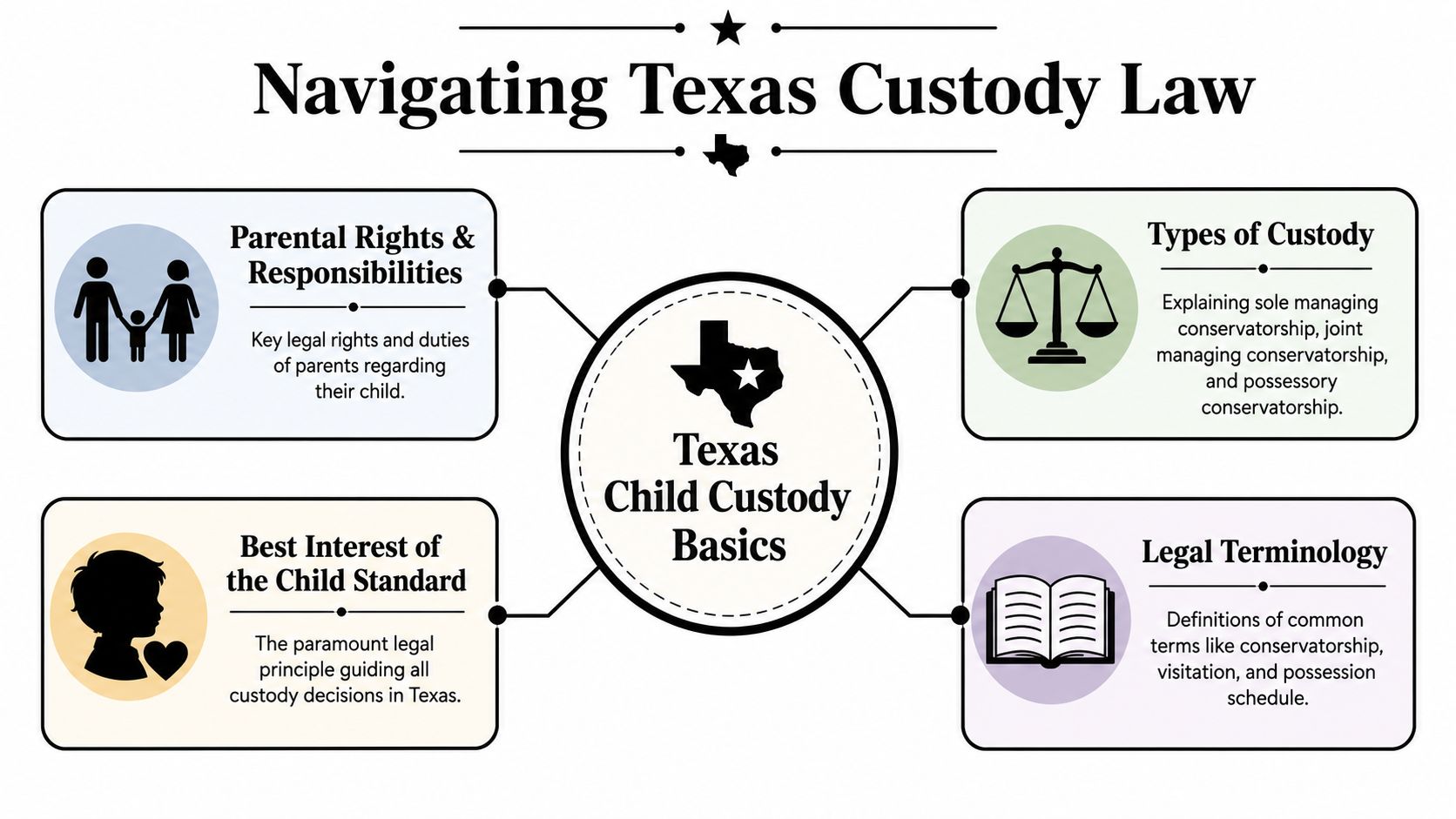
What best interests of the child really means
The phrase best interests of the child can sound vague, but in practice it asks a simple question: what arrangement helps this child live safely, consistently, and with the support they need?
That includes practical issues such as who gets the child to school, who handles medical care, how each parent communicates, whether each home is stable, and whether a parent encourages a healthy relationship with the other parent when it's appropriate. A judge isn't looking for a perfect parent. Judges know real families are messy. They are looking for responsible decision-making and a child-centered plan.
Practical rule: If your argument is mostly about what feels unfair to you as an adult, it probably needs work. If your argument shows how your request helps your child day to day, you're speaking the court's language.
Parents often make the mistake of filing for custody before they understand what they're asking the court to order. That leads to forms that are incomplete, inconsistent, or unrealistic.
Joint managing conservatorship in plain English
Under Texas child custody and support guidance, Texas Family Code Chapter 153, Subchapter C presumes that both parents should be named joint managing conservators unless evidence shows it is not in the child's best interest. In plain English, that means Texas usually starts from the idea that both parents should share important decision-making responsibilities, even if the child doesn't spend equal time with each parent.
That point surprises many mothers and fathers. Shared legal rights don't automatically mean a perfectly equal schedule. One parent may still have the exclusive right to decide the child's primary residence, while both parents share other major rights and duties.
Here's a simple way to look at it:
| Term | Plain-English meaning |
|---|---|
| Joint managing conservatorship | Both parents usually share major decision-making rights |
| Sole managing conservatorship | One parent has most major decision-making authority |
| Possessory conservator | A parent has rights of access and possession, but not the same level of decision-making authority |
| Possession schedule | The calendar for when the child is with each parent |
If you're trying to understand the rights that can be allocated in a Texas custody order, this overview of parental rights in Texas helps explain how courts divide authority between parents.
Common emotional mistakes before filing
The first human error many parents make isn't legal. It's emotional. They file from panic. They ask for everything. They assume the judge will sort out the details later.
That approach usually creates problems. Courts respond better to parents who show they've thought through school, exchanges, routines, medical decisions, and communication. If your case involves questions about parenting ability, mental health concerns, or family dynamics across cultures and systems, resources like this comprehensive guide for immigration attorneys can help you understand how parenting assessments may be viewed in more complex cases.
The parent who sounds calm, prepared, and focused on the child usually comes across stronger than the parent who sounds the angriest.
For grandparents and caregivers, the same principle applies. Your concern has to be tied to the child's needs, not only to family conflict. For fathers, especially unmarried fathers, rights often depend on legal steps being completed first. For mothers, it's important not to assume current caregiving automatically answers every legal question. Texas family law still requires a proper case, proper pleadings, and proper orders.
Preparing and Choosing the Correct Custody Petition
A lot of parents get stuck here for a simple reason. They are trying to write legal paperwork while upset, sleep-deprived, and worried about their child. That is usually when avoidable mistakes happen.
The petition is not just a form. It sets the frame for your case. If you choose the wrong case type, leave out a parentage issue, or ask for relief that does not match your legal posture, you can lose time, pay another filing fee, or walk into a hearing with a case the judge cannot fully address.
The lawsuit used for custody orders in Texas is usually a Suit Affecting the Parent-Child Relationship, or SAPCR.
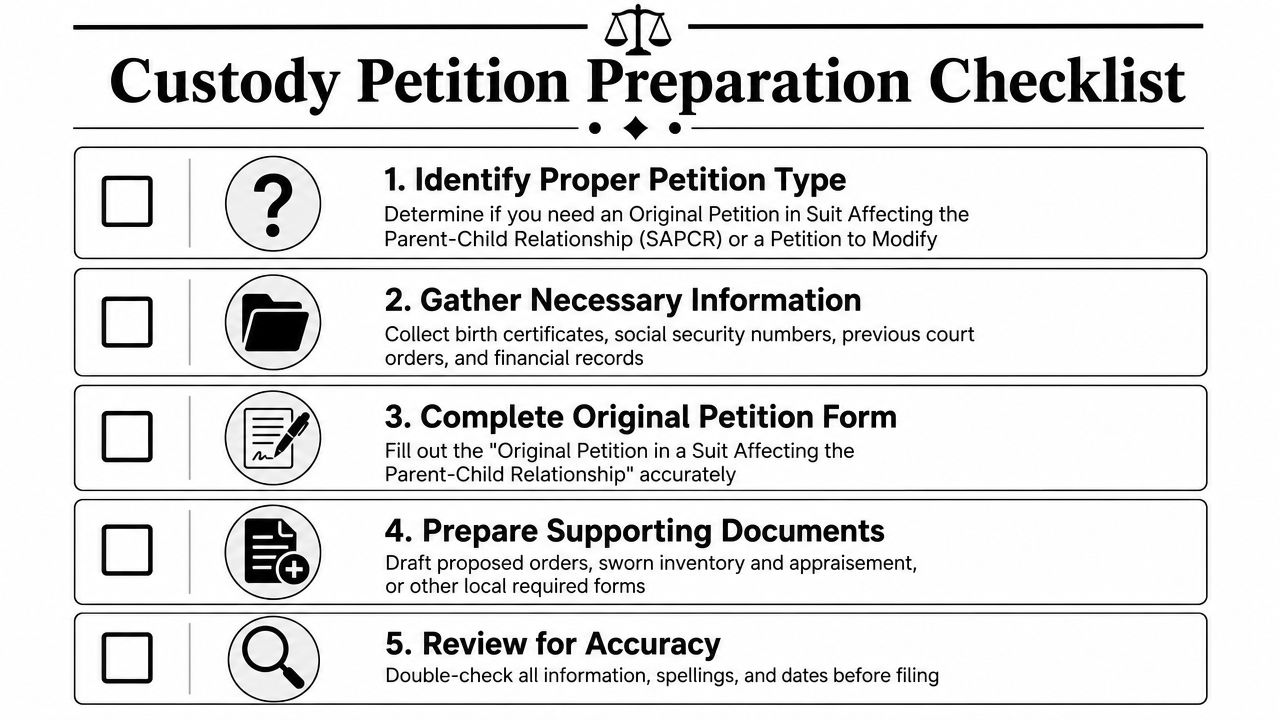
Choose the right petition before you start filling blanks
One of the most common pro se errors is filing the case you wish you had, instead of the case the court record supports.
If there has never been a custody order, you are usually looking at an original SAPCR. If a court already signed orders about conservatorship, possession, child support, or divorce, you may need a modification instead. Parents miss this all the time, especially when an older order was signed in a divorce they have not looked at in years.
That is why it helps to review a form-specific explanation like this guide to the SAPCR form in Texas. The wording in your opening paperwork matters more than many parents expect.
Before you draft anything, check these points:
- Prior orders: Look for any divorce decree, paternity order, child support order, or prior custody order.
- Correct parties: Make sure the legal names of both parents and the child match prior court records and vital records.
- Relief requested: Be clear about what you are asking for, such as conservatorship, possession, child support, medical support, or geographic restrictions.
- Supporting details: Gather addresses, the child's residence history, school information, and any documents you may need to reference later.
Parents often want to ask for everything at once. Judges usually respond better to pleadings that are specific and realistic. A focused request reads as prepared. An oversized request can read as reactive.
Paternity has to be handled first if it is not already established
For unmarried fathers, this is often the issue that changes everything. If legal fatherhood has not been established, a custody filing may be premature.
Texas courts need a legal basis to treat someone as a parent in a custody case. That can come from an Acknowledgment of Paternity, an adjudication of parentage, or another legally recognized route. The Texas Attorney General's information about establishing paternity explains the basic process and why it matters before custody and support issues are fully addressed.
I have seen parents waste weeks preparing a custody petition, only to learn that fixing parentage was the first step. That is frustrating, but it is fixable.
If you are the father and there is any uncertainty about paternity, your name on records, or whether a prior acknowledgment was properly completed, pause and confirm the legal status first. If you are the mother, do not assume the court will clean up a parentage problem automatically just because custody is disputed. The pleadings still have to match the legal issues in front of the court.
A rushed filing can make a parent feel productive for a week and leave the case stalled for months.
Include child support and fee issues carefully
Many parents filing for custody also need child support orders. That does not mean every case should be drafted broadly from the start. Add support requests carefully and make sure the petition matches what you are asking the court to decide.
Money worries also cause people to delay filing longer than they should. If you cannot afford court costs, you may be able to file a Statement of Inability to Afford Payment of Court Costs. Ask the clerk what local forms or procedures apply in your county and read every page before signing. Small paperwork errors, especially missing attachments or incomplete financial information, can create delays that feel much bigger when you are already under stress.
Some parents can handle this stage on their own with careful preparation. Others reach this point and realize the case involves old orders, contested paternity, safety concerns, or facts that are harder to present cleanly without help. That is usually the moment to stop guessing and get legal advice, even if you are only paying for limited-scope help with the petition.
A Step-by-Step Guide to Filing and Serving Papers
Walking into the courthouse for the first time can feel intimidating. The process itself is straightforward when you break it into pieces and don't rush.
Texas requires a custody case to be filed in the county where the child has resided for at least six months. Filing in the wrong jurisdiction can delay the case indefinitely, which is why reviewing county-specific guidance such as these essential steps for filing in the correct Texas county matters before you hand over your paperwork.
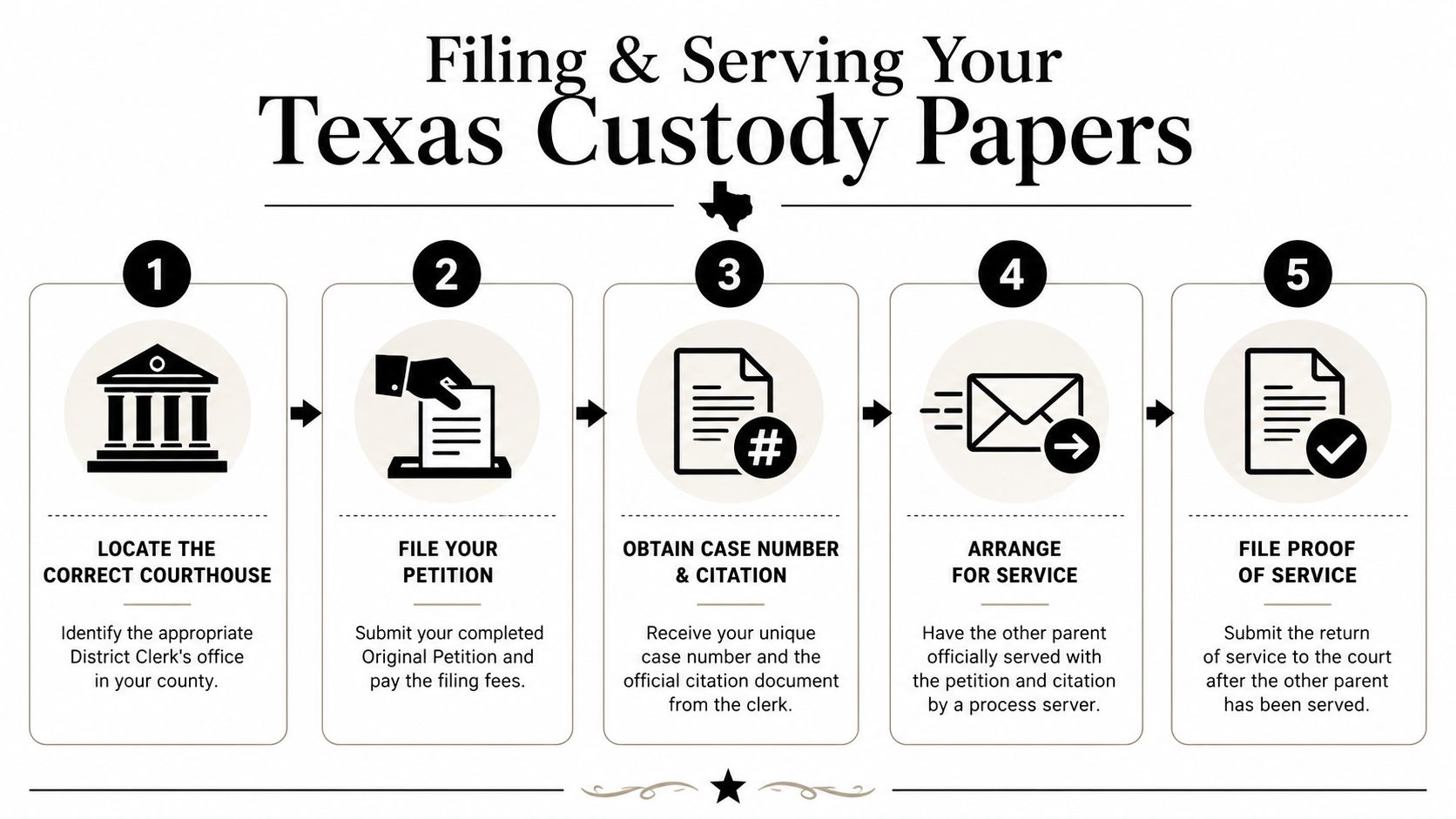
What to do at the clerk's office
Bring your completed petition and the copies the clerk requires. If you're asking for a fee waiver, include your Statement of Inability to Afford Payment of Court Costs with the filing packet.
Ask the clerk whether there are local standing orders, special cover sheets, or court-specific procedures. That question alone can save a self-represented parent from a rejected filing or a delayed hearing.
A simple filing sequence looks like this:
- Go to the correct district clerk's office: Use the county where the child has lived long enough for the court to exercise jurisdiction.
- File your petition: Hand in the petition and supporting documents.
- Get a file-stamped copy and case number: Keep these organized from day one.
- Ask about citation and service: Don't assume service happens automatically.
- Calendar every deadline immediately: Memory is not a case management system.
Service is not just mailing papers yourself
Fulfilling Texas's requirement for proper notice to the other parent often stalls many pro se custody cases. According to the verified TexasLawHelp guidance, a critical technical step involves explicitly requesting in-person service of the other parent by the clerk, which requires a sheriff, constable, or private process server to deliver the initial papers directly to the opposing parent through the TexasLawHelp SAPCR guide.
If you don't request the correct service method, or if service isn't completed the way the court requires, your case can sit still even though you believe you “filed everything.”
Service reminder: The court can't move your case forward fairly if the other parent was never properly brought into it.
In some situations, certified mail may be used if the other parent consents. But don't improvise. Improper service creates avoidable delay.
Here's a brief visual walkthrough if seeing the process helps more than reading it:
What works and what usually doesn't
Parents who do well without a lawyer usually do three things consistently. They follow clerk instructions carefully, keep copies of everything, and confirm that proof of service is filed with the court.
What usually doesn't work is relying on verbal understandings with the other parent, assuming the clerk gives legal advice, or sending text messages that say “you know about the case anyway.” Notice and proof matter. Family court runs on paperwork.
What to Expect After You File Your Custody Case
You file the case, feel a wave of relief, and then your phone starts buzzing. The other parent is angry. A hearing notice arrives. School is still starting at 7:45 a.m. and your child still needs dinner, homework help, and a bedtime routine. That is the part many parents do not expect. Filing is the start of the court process, not the finish line.
Once the case is filed and service is complete, the court usually moves into decisions about short-term structure, information gathering, possible settlement, and a final order. Parents who understand that rhythm tend to make fewer fear-based mistakes. They stop treating every message like a crisis and start building a clear record of how they parent.

Temporary orders often shape daily life
In many Texas custody cases, the first hearing that really affects your child is the temporary orders hearing. The judge may set rules for where the child stays, how exchanges happen, who handles school decisions, and whether support will be paid while the case is pending.
These orders are temporary on paper, but they often shape the routine for months. They also give the judge an early look at which parent is organized, child-focused, and realistic.
A parent usually helps their case by showing up with a calendar, school information, work hours, childcare details, and a schedule that fits the child's actual life. A parent who spends the hearing listing insults about the other side often loses credibility fast. Judges hear conflict every day. What they want is a workable plan.
Temporary orders can cover:
- Parenting time: Where the child stays on weekdays, weekends, holidays, and school breaks
- Exchange details: Pickup locations, transportation, and timing
- Decision-making: How medical, school, or activity choices will be handled while the case is open
- Financial issues: Child support or related expenses if those requests are part of the case
If support is part of your SAPCR, expect paperwork about income and possibly withholding from wages. Get those documents organized early instead of scrambling the night before a hearing.
Mediation and evidence matter more than frustration
Many parents walk into mediation expecting another fight. Good mediation is usually more practical than that. It gives both sides a chance to solve scheduling, exchange, and decision-making problems without asking a judge to decide every detail.
Preparation changes the outcome. Bring a proposed schedule, your child's school and activity calendar, notes about medical needs, and a short list of your highest priorities. Parents who ask for every possible advantage often stall the process. Parents who know where they can bend and where they need structure usually reach better agreements.
Bring proof, not just feelings. School records, calendars, medical information, and saved communication often say more than a frustrated speech in court.
If the case does not settle right away, you may move into discovery. That is the stage where each side gathers and exchanges information. In custody cases, that may include texts, emails, attendance records, report cards, medical records, photos, and evidence showing who has handled day-to-day parenting.
Organization matters here. Label documents by subject and date. Build a timeline. Add one sentence to explain why each record matters. A judge can follow a clean set of exhibits. A disorganized stack of screenshots usually weakens your point, even if the facts are on your side.
The emotional part is real, and it affects your case
Parents representing themselves often make their biggest mistakes after filing, not before. They get rattled by a rude text. They overreact to a normal delay. They assume one bad hearing means they have already lost. I have seen good parents hurt their own cases because they let fear run the next decision.
The court notices patterns. A parent who stays polite, follows the temporary schedule, and communicates clearly tends to look reliable. A parent who uses the child to pass messages, sends long angry texts, or turns every disagreement into a threat creates evidence the judge may not like.
A calmer approach usually looks like this:
| Situation | Better response |
|---|---|
| The other parent sends a rude message | Reply briefly, stay focused on the child, and skip personal attacks |
| You disagree on pickup times | Propose one or two specific alternatives in writing |
| You feel buried by paperwork | Use dated folders and a checklist for hearings, filings, and school records |
| Mediation feels impossible | Identify your firmest boundaries before you attend |
Keep your expectations realistic. Filing for custody does not usually produce immediate closure. It produces a process. If you treat that process like a series of manageable tasks, you give yourself a much better chance of reaching an order you can live with and follow.
Common Mistakes and When to Ask for Help
Representing yourself in family court takes patience, organization, and emotional control. It also takes honesty about what you can realistically handle.
The most common mistakes aren't always dramatic. Sometimes they're simple, quiet errors that slowly damage a case. A missed deadline. A filing in the wrong county. A parent who assumes the other side “already knows” about the hearing. A text message sent in anger that later gets printed and handed to the judge.
The errors that hurt cases most
One major deadline can't be ignored. Texas law requires a 20-day waiting period plus the next Monday at 10:00 a.m. for the other parent to file an answer after being served. If they don't respond by that deadline, the case may proceed by default without their participation, as explained in this Texas custody filing overview. If you're the filing parent, you need to track that date carefully. If you're the responding parent, ignoring service can cost you your voice in the case.
Other mistakes show up in patterns:
- Filing from emotion instead of planning: Parents ask for extreme relief they can't support with facts.
- Ignoring local procedure: County-specific standing orders and clerk requirements get overlooked.
- Treating communication like a personal fight: Judges often see the messages parents hoped no one would read.
- Expecting fairness to speak for itself: Court decisions depend on admissible facts, procedure, and proof.
When self-representation stops being wise
Some custody cases are manageable without full representation. Others aren't.
You should strongly consider getting legal help if the other parent already has a lawyer, if there are allegations of abuse, if you're dealing with substance use concerns, if a child has special medical or educational needs, or if relocation is part of the dispute. The same is true when paternity, grandparents' rights, or emergency orders become part of the case. Those issues can change the legal and factual situation quickly.
This is also where managing expectations matters. Going to court won't erase every hurt feeling between parents. It won't make a difficult co-parent easy. What it can do is create enforceable rules and protect your relationship with your child.
Asking for help isn't giving up control. In many cases, it's how parents protect the parts of the case that matter most.
Key takeaway
If you want to learn how to file for custody in Texas without a lawyer, start with the fundamentals. Know what conservatorship means. Use the correct petition. Make sure paternity is addressed when necessary. File in the correct county. Follow service rules exactly. Track deadlines like your case depends on them, because it does.
Just as important, keep your conduct child-focused. Courts respond to parents who are steady, organized, and realistic. They are less persuaded by anger, blame, or sweeping accusations with no proof.
You don't have to know every answer on day one. You do need to know when a mistake could affect your child's future and when it's time to get guidance before that happens.
If you need help with a child custody or visitation case in Texas, our experienced attorneys can guide you every step of the way. Contact The Law Office of Bryan Fagan, PLLC today for a free consultation.