
When your child's future is on the line, understanding your rights matters most.
You may be looking at two homes, two work schedules, school pickup, soccer practice, and a child who just wants to know where they'll sleep next Sunday. For many Texas parents, a week on week off custody schedule sounds like the cleanest answer. It feels fair. It looks simple on a calendar. It promises equal time.
But equal time and the right schedule aren't always the same thing.
A week on week off custody schedule in Texas can work very well for some families. It can also create stress when parents overlook how Texas courts treat custom possession schedules, how younger children handle long separations, and how fast informal arrangements can turn into legal conflict. The key is to look past the 50/50 label and focus on what best supports your child.
Navigating Co-Parenting with a Balanced Schedule
Parents often come into custody discussions wanting one thing above all else. Stability.
A common situation looks like this. Both parents have stayed involved. Both want meaningful time. Neither wants the child to feel like a visitor. A week on week off rotation seems like a reasonable middle ground because each parent gets a full week to handle homework, bedtime, meals, and normal life instead of only short visits.
That instinct makes sense. Children usually do better when the adults around them create predictable routines and reduce unnecessary conflict. A balanced schedule can help with that, but only if the schedule fits the child rather than the parents' sense of fairness.
A parenting schedule works best when it matches the child's daily reality, not just the parents' ideal division of time.
Texas courts focus on the best interests of the child. In plain English, that means the judge looks at what arrangement supports your child's emotional needs, physical care, routine, and long-term stability. Mothers, fathers, grandparents, and other caregivers should all keep that standard in mind from the beginning.
What Is a Week On Week Off Custody Schedule
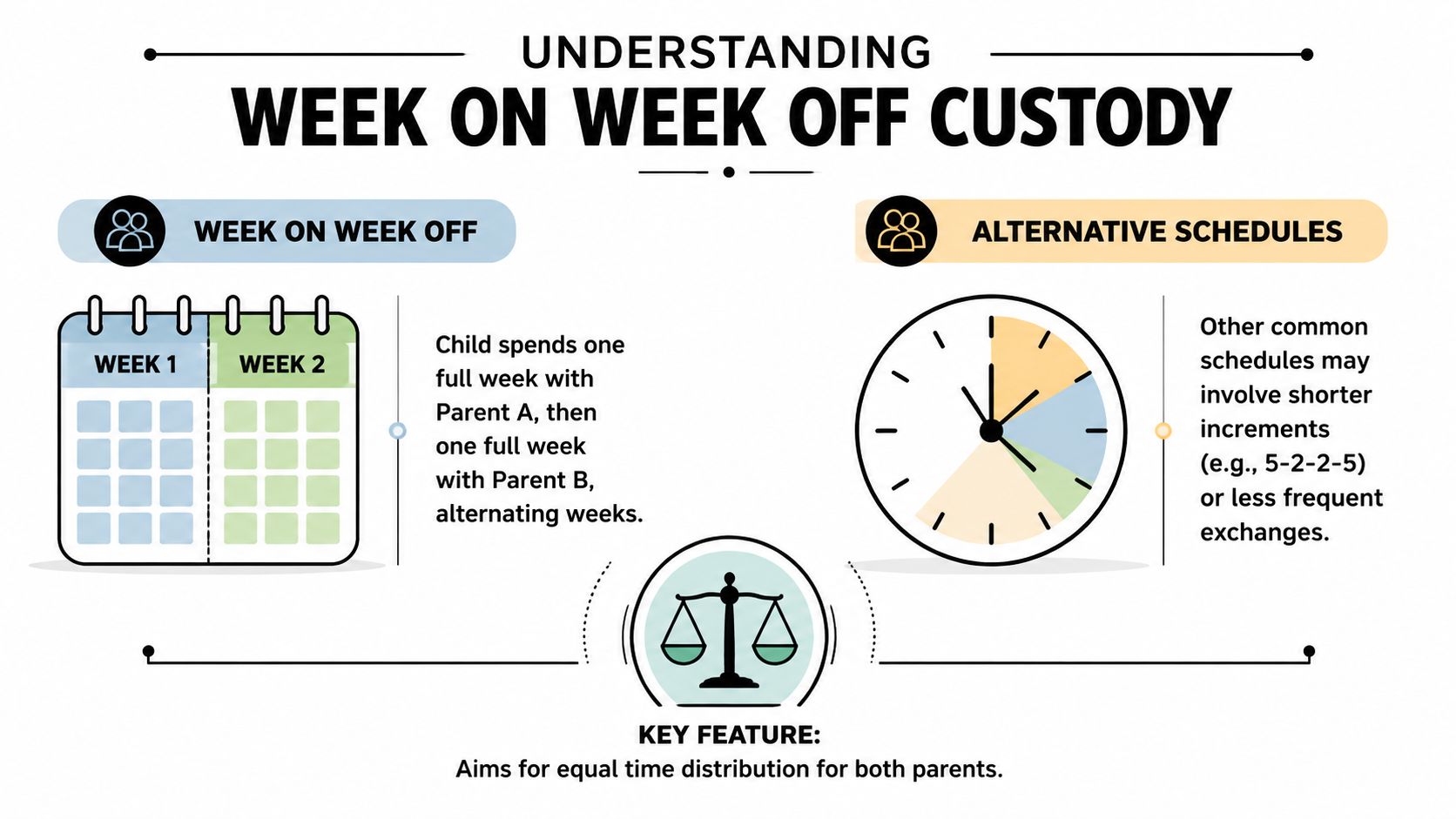
A week on week off custody schedule means the child lives with one parent for a full week, then with the other parent for the next full week, repeating that pattern on an ongoing basis. In Texas, it's a 50/50 possession model where children spend one full week with one parent and the next full week with the other, and it is different from the court Standard Possession Order, which typically gives the noncustodial parent the 1st, 3rd, and 5th weekends of the month plus a weekly Thursday visit, as explained in this discussion of Texas possession schedules.
How the rotation usually works
Many parents set exchanges at the same time and place every week. Sunday evening is common because it gives the child a clean start for the school week, but families sometimes use Friday after school or Monday morning if that better fits school and work routines.
A workable calendar should answer basic questions clearly:
- Exchange day: Which day starts the new parenting week?
- Exchange time: Is pickup at school dismissal, after dinner, or another fixed time?
- Exchange location: School, daycare, one parent's home, or a public location?
- Missed exchanges: What happens if a parent is late or unavailable?
- School items and medication: Who sends what, and when?
For many families, it helps to compare sample layouts before drafting language. A few Texas visitation schedule examples can make the practical differences much easier to see.
How it differs from the Texas default
The biggest mistake parents make is assuming 50/50 time is automatic. It isn't. Texas courts start from a standard framework unless parents agree to something else and the court signs off on it.
Here is the simple contrast:
| Schedule | Typical structure |
|---|---|
| Week on week off | Child alternates full weeks between each parent |
| Standard Possession Order | One parent has set weekends and a weekly visit rather than equal time |
If you're building a custom schedule, a written parenting plan matters. Parenting Plans in Texas Custody Cases addresses what a Texas parenting plan must cover, including the details that often prevent later disputes.
Practical rule: If a term matters in daily life, put it in writing. Parents remember conversations differently when conflict starts.
The Legal Framework for Texas Custody Schedules
Texas custody law uses words that can sound intimidating, but the ideas are manageable once they're translated into plain English.
Conservatorship means the legal rights and duties of a parent. That includes decision-making about school, medical care, and other important issues. Possession and access means the actual parenting time schedule. Parents often confuse these concepts, but they are not the same thing. A parent can share major decision-making and still have a different possession schedule.
Joint managing conservatorship and best interests
In many Texas cases, parents are named Joint Managing Conservators. That usually means both parents keep significant rights and responsibilities. It does not automatically mean equal time.
The controlling standard is the best interests of the child. In daily terms, that asks questions such as:
- Which arrangement supports the child's routine?
- Which parent can meet day-to-day needs consistently?
- How well do the parents communicate?
- Does the schedule fit the child's age, schooling, and emotional needs?
- Will each parent support the child's relationship with the other parent?
A court may believe both parents are good, loving, capable parents and still decide that one particular schedule is better than another.
Why court approval matters
Texas law has a default schedule when parents can't agree. Texas Family Code §153.312 makes the Standard Possession Order the default, and a week on week off schedule is an agreed modification that requires court approval because it departs from that presumption and is more common for children age 10 and older, as outlined by Texas Access on the Standard Possession Order.
That legal point matters because many parents walk into a case thinking they only need to request equal weeks to receive them. A judge will want to know why this specific schedule serves this specific child.
For a fuller look at the default structure, see how the Standard Possession Order works in Texas.
Judges don't approve custom schedules just because they sound fair. They approve them when the details fit the child's life.
If you're dealing with conservatorship, possession, or access issues under Chapter 153, a Texas Child Custody Lawyer handles those legal questions directly.
Pros Cons and Child Development Considerations
A week on week off arrangement has real strengths. It also has real pressure points. Parents should look at both before treating 50/50 as the obvious answer.
When this schedule often works well
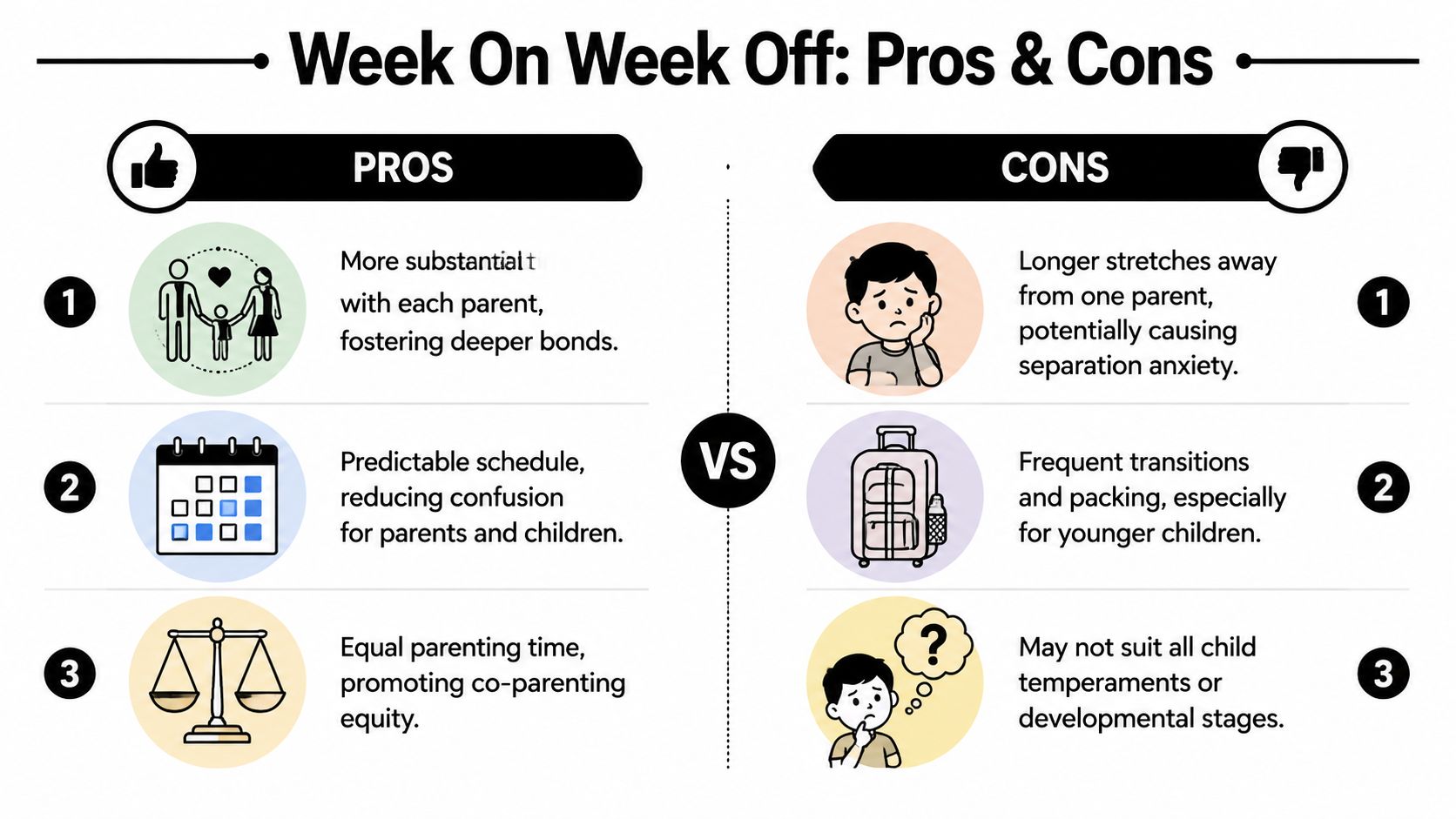
Older children often handle longer blocks of time better because they can keep track of the schedule, communicate more easily with the other parent, and tolerate transitions with less anxiety. For some families, the weekly rotation also reduces conflict because parents exchange less often.
Common advantages include:
- Longer uninterrupted parenting time: Each parent gets a full week to parent, not just entertain.
- Fewer handoffs: Less frequent exchanges can mean fewer opportunities for arguments in parking lots or at the door.
- Clear routine: Many children like knowing that one whole week belongs to one household rhythm.
- Balanced involvement: Both parents can participate in school mornings, homework, meals, and weekend activities.
This schedule can be especially practical when parents live close to each other, use similar household routines, and communicate reliably about school and medical issues.
When it may create problems
A full week can feel very long to a small child. A full week away from either parent may cause separation anxiety, particularly in younger children, and national child psychology research indicates that children under age 6 can experience significantly higher distress with 7-day alternations compared to more frequent exchanges, according to OurFamilyWizard's discussion of alternating weeks.
That doesn't mean younger children can never do well in two homes. It means parents should be careful about assuming a calendar that looks neat will feel stable to a toddler or preschooler.
A few warning signs deserve attention:
- Young child distress: Trouble sleeping, clinginess, emotional outbursts, or acting much younger after exchanges.
- Too much distance: Long drives make school, daycare, and activities harder to manage.
- Major differences between homes: Different rules, bedtimes, or discipline styles can leave children feeling unsettled.
- High conflict: A 50/50 model usually needs strong communication. If every text becomes an argument, the schedule may break down fast.
To evaluate whether a schedule matches your child's stage, parents often benefit from reviewing key child development milestones and then applying those benchmarks to sleep, attachment, communication, and school readiness.
A better question than is it equal
Instead of asking, “Is this fair to both parents?” ask, “Can my child handle this well every week?”
That shift helps mothers and fathers alike. Texas courts don't start from the idea that one parent matters more. They also don't treat equality as the only goal. The child's functioning comes first.
Creating a Practical Week On Week Off Calendar
A good custody calendar leaves very little to guesswork. Most possession disputes don't start because parents hate the overall idea. They start because the details were vague.

Build the weekly exchange first
Start with the basic handoff rule and make it exact. “Every Sunday” is not enough. “Every Sunday at 6:00 p.m. at Parent A's residence” is much better because everyone knows who drives, where the child goes, and when the week changes.
Your written schedule should pin down:
The transfer point
School pickup works well for many families because it reduces face-to-face conflict.Responsibility for transportation
Decide whether the receiving parent picks up or the current parent drops off.School and activity communication
Spell out how both parents receive report cards, practice schedules, and medical notices.What travels with the child
Clothing, medication, homework, sports gear, electronics, and comfort items should be addressed.
Handle holidays and breaks separately
A weekly rotation alone is not enough. Holidays, spring break, and summer often need their own rules because they interrupt the normal cycle.
Common approaches include:
- Alternating major holidays: One parent has Thanksgiving in one year, the other has it the next.
- Splitting school breaks: Parents divide longer school breaks into clearly defined blocks.
- Creating summer terms: Some families continue the same alternating weeks in summer because it keeps the routine simple.
Texas default schedules have special summer rules, but parents using a custom equal-time plan often choose a different arrangement if both agree and the order states it clearly.
Children do better when the adults settle holiday questions before the holiday arrives.
Keep the schedule readable
Use plain language. If a grandparent, babysitter, or school administrator reads the order, they should understand it without decoding legal jargon.
A strong calendar is usually:
- Specific enough to enforce
- Simple enough to follow
- Flexible only where needed
Parents who need to cooperate on a detailed possession calendar often use mediation, shared parenting apps, or attorney-drafted language so the final order is precise and realistic.
How to Propose or Modify a Custody Order in Texas
If you want a week on week off arrangement, the safest path is a formal one. Good intentions are not enough when custody rights are involved.
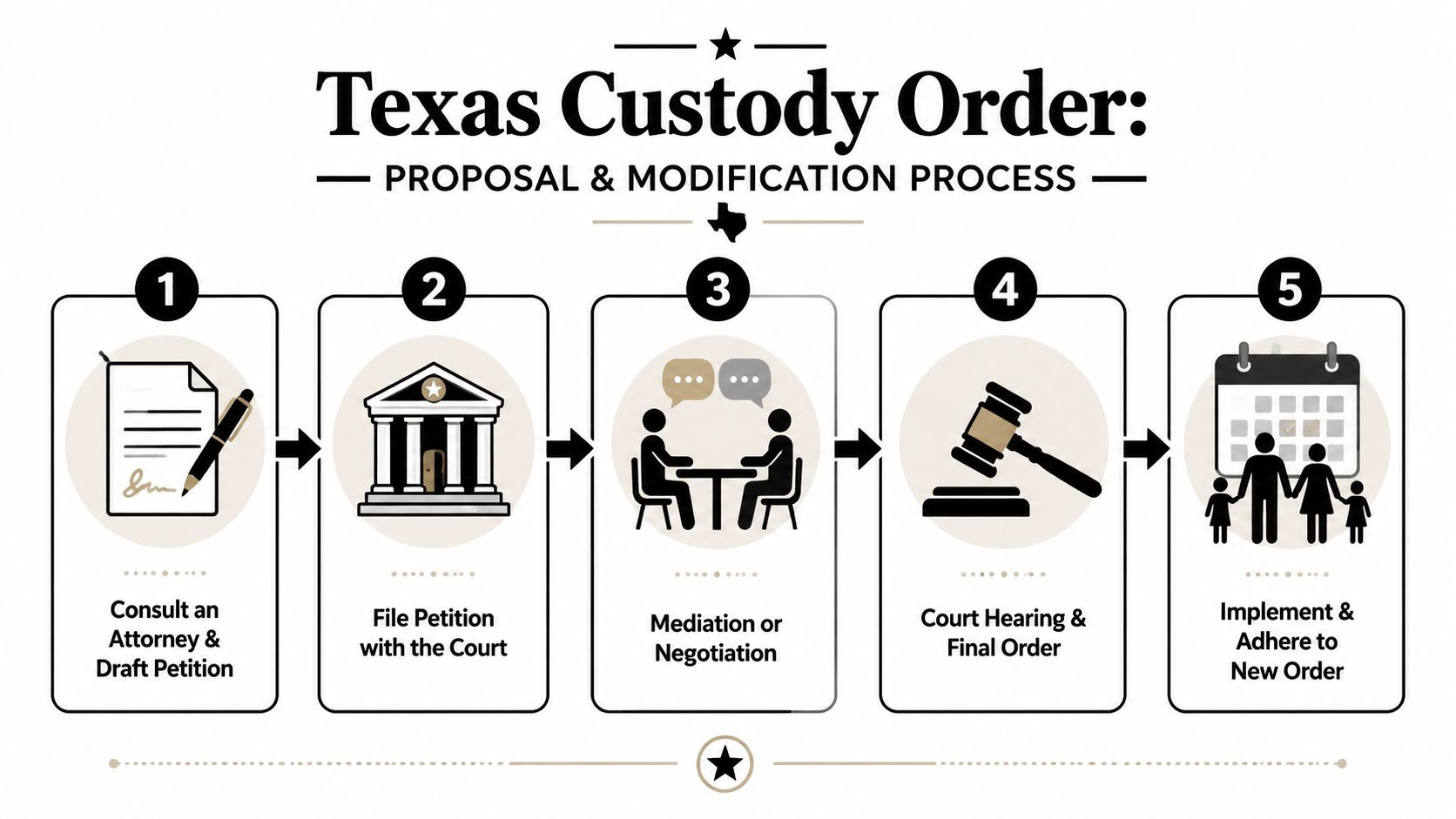
A practical first look at the process appears below.
Start with agreement if possible
When parents can still communicate, negotiation or mediation often gives them the best chance to build a schedule that fits school, work, and the child's routine. The proposed order should include all possession terms in writing and then be submitted for court approval.
That approach works for mothers and fathers alike. If you're trying to show that equal time makes sense, specific facts matter more than broad statements. School distance, exchange logistics, your work flexibility, and the child's needs all matter.
This video gives a useful overview of what that process can involve:
If there is already an order
Changing an existing order usually requires a formal modification case. The court will look for a material and substantial change in circumstances and then decide whether the requested change serves the child's best interests.
That change might involve a different school situation, a parent's relocation, a shift in work schedule, or the child reaching a developmental stage where a different schedule now makes more sense. The court won't treat a casual family arrangement as a substitute for a signed order.
For a closer look at the legal process, review how to modify custody in Texas.
Never rely on a handshake deal
This is one of the most overlooked risks. Making informal changes to your custody schedule in Texas, even if both parents agree at the time, can create significant legal issues. Without a formal court order, those unwritten agreements are unenforceable and can jeopardize a parent's legal standing if a dispute arises later, as explained in this discussion of informal custody changes in Texas.
That warning matters because week on week off arrangements often begin informally. One parent changes jobs, the other starts helping more, and the temporary routine becomes normal. Then conflict starts. At that point, each parent may describe the “real agreement” differently.
Courtroom reality: Judges enforce signed orders. They do not enforce memories of what the parents meant six months ago.
If you need a formal plan drafted, negotiated, or presented to the court, the Law Office of Bryan Fagan, PLLC handles custody, visitation, modification, and enforcement matters in Texas.
Handling Disputes and Special Circumstances
Even a well-written order can run into trouble when life changes. A missed exchange, a move, a deployment, or repeated refusal to return the child can quickly turn a manageable schedule into a crisis.
When the other parent won't follow the order
If the other parent stops following the schedule, your first step is usually to document the problem carefully. Keep records of missed exchanges, late pickups, denied possession, and written communications. Stay calm in your messages. Angry texts rarely help.
You may need to pursue enforcement through the court if the problem continues. In plain terms, enforcement asks the judge to require compliance with the signed order. That can be important for either parent. Fathers often worry their time won't be respected. Mothers often worry that inconsistency is harming the child's routine. Both concerns are legitimate.
A few practical rules help:
- Follow your own order first: Don't give the other side an easy argument that you also ignored the schedule.
- Use written communication: Clear, neutral messages create a record.
- Focus on the child's schedule: Judges respond better to stability concerns than personal attacks.
Military service and relocation issues
Military families often face sudden changes that ordinary schedules don't address well. Training, deployment, and reassignment can all affect possession. A week on week off plan may need built-in backup terms so the child's routine doesn't collapse when one parent is unavailable.
Relocation creates a different problem. Equal weekly exchanges usually become much harder when parents live far apart. School attendance, commute times, and extracurricular commitments can all push the case toward a different possession structure. A parent who plans to move should get legal advice before acting, not after.
Special circumstances don't erase parental rights. They do require a schedule that matches real-world logistics.
Grandparents and other caregivers may also become part of the conversation when a parent needs support with transportation, after-school care, or temporary caregiving. The legal answer depends on the existing order and the family's circumstances, but the guiding principle remains the same. Protect the child's stability and keep the terms enforceable.
Key Takeaways and Your Next Steps
A week on week off custody schedule in Texas can be a strong option, but it isn't automatic and it isn't right for every child.
Keep these points in mind:
- It's a custom schedule: Texas courts default to a different possession model when parents can't agree.
- The child comes first: Best interests always matter more than a simple 50/50 label.
- Age matters: Older children may handle full-week rotations better than very young children.
- Details matter: Exchange times, holidays, transportation, and school issues should be written clearly.
- Court orders matter: Informal arrangements can create serious problems later.
If you're considering this schedule, the smartest next step is to evaluate your child's needs, your co-parenting dynamic, and your legal options together, not separately.
If you need help with a child custody or visitation case in Texas, our experienced attorneys can guide you every step of the way. Contact The Law Office of Bryan Fagan, PLLC today for a free consultation.