
When your child says something that makes your stomach drop, or you see an injury that doesn’t make sense, the clock feels different. You’re not thinking about legal theory. You’re thinking about getting your child safe before the next exchange, the next overnight visit, or the next angry call.
That’s where an emergency ex parte custody order texas case comes in. It’s an emergency tool for a real crisis, not a routine shortcut in a custody fight. Texas courts do use urgent protective remedies often when facts justify fast action. From fiscal years 2021 through 2023, Texas courts issued an estimated total of 162,497 orders of emergency protection, TEXPOS, or final protective orders, with Harris County accounting for 32% of magistrate-level orders according to the Texas protective order report.
When Your Child’s Safety Can’t Wait
A parent usually lands here in a moment of panic. A child comes home and reports being left alone. A grandparent gets a call that the other parent is intoxicated with the child in the car. A caregiver notices bruising, fear, or a sudden change in behavior and realizes this isn’t a normal co-parenting dispute.

In those moments, the hardest part is separating fear from legal urgency. Texas courts can act quickly, but they expect facts, not just alarm. If your concern involves abuse, neglect, dangerous substance use, threats, or serious endangerment, immediate legal action may be necessary. If you’re trying to understand whether troubling behavior from relatives is part of a larger danger pattern, this resource on toxic family members can help you think clearly about unhealthy dynamics.
When concern becomes a legal emergency
The court wants to know whether your child faces a present danger, not whether the other parent is difficult, selfish, or unreliable. Those issues matter in family court, but an emergency filing is reserved for situations where waiting could expose a child to harm.
Parents often confuse a bad co-parenting situation with a true emergency. They’re not the same. A missed pickup or rude text message may support a future modification request. A child exposed to violence, severe neglect, or immediate risk is different.
Practical rule: If you’re worried something bad might happen later, that may be a modification case. If the facts show your child may be harmed now, that may be an emergency case.
For a closer look at what Texas courts may treat as danger to a child, review this guide on child endangerment and custody in Texas.
You are not powerless
Parents, grandparents, and caregivers often feel frozen because they don’t want to make the wrong move. That’s understandable. But waiting too long can also become a damaging choice if the risk is real.
An emergency order is not a final custody win. It is a short-term legal shield meant to create immediate safety while the court gathers both sides and decides what should happen next. Used correctly, it can stop a dangerous situation long enough for a judge to put structure around it.
The Legal Standard for an Emergency Order in Texas
Texas judges don’t grant emergency relief because one parent feels scared. They grant it when the evidence shows a child needs immediate protection.
Under Texas Family Code Section 83, a temporary ex parte order is valid for a period not to exceed 20 days, but in custody matters courts typically set a follow-up hearing within 14 days. To grant the order, a judge must find clear evidence of immediate danger, that the child cannot be protected otherwise, and that notifying the other parent could place the child at further risk, as stated in Texas Family Code § 83.
What immediate danger usually means
In plain English, immediate danger means a real, current threat to the child’s physical health or emotional welfare. Common examples include:
- Physical injury risk: The child has been hit, shoved, restrained, or exposed to violent conduct.
- Sexual harm concerns: The child reports sexual contact, grooming behavior, or inappropriate exposure.
- Severe neglect: The child lacks supervision, medication, food, or safe shelter.
- Serious emotional trauma: The child is being exposed to conduct so extreme that immediate court intervention is necessary.
A judge is looking for danger that is happening now, has just happened, or is credibly about to happen.
What usually does not qualify
A lot of painful family situations still won’t meet the emergency standard. Courts often deny requests based on complaints like these:
| Situation | Usually emergency | Usually not emergency |
|---|---|---|
| Child exposed to violence | Yes | |
| Parent abusing drugs while caring for child | Yes | |
| Threat to hide or remove child in dangerous circumstances | Yes | |
| Different bedtime, diet, or discipline style | Yes | |
| Parent is rude or uncooperative | Yes | |
| Child prefers one home over the other | Yes |
That doesn’t mean those non-emergency issues don’t matter. They may support a custody modification, enforcement action, or request for supervised visitation. They just usually don’t justify ex parte relief.
Why the court can act without notice
Ex parte means the judge can hear from one side first. That sounds extreme, and it is. Texas allows it only because some situations become more dangerous if the other parent is warned in advance.
For example, notice might trigger retaliation, concealment of the child, destruction of evidence, or an escalation in violence. If that risk exists, the court can issue a short-term order first and require a full hearing shortly after.
The court is balancing two serious interests at once: a child’s safety and the other parent’s right to be heard.
That’s why emergency orders are temporary by design. They aren’t meant to decide permanent conservatorship.
A few family law terms in plain English
If you’re new to Texas custody law, the language can feel cold. Here are a few terms that matter:
- Best interests of the child: This is the legal standard courts use when making custody decisions. It means the judge focuses on the child’s safety, stability, needs, and overall well-being.
- Joint managing conservatorship: This usually means both parents share important decision-making rights, even if one parent has the child more often.
- Possession schedule: This is the calendar for when each parent has the child. Many parents call it visitation, but Texas law often uses the term possession and access.
If the emergency involves another state or a recent move, this guide on when Texas can exercise emergency custody jurisdiction can help you understand where the case should be filed.
Gathering the Proof You Need to Protect Your Child
A strong emergency case is built on proof, not conclusions. Saying “my child is unsafe” won’t carry the day by itself. Showing the judge exactly what happened, when it happened, and how you know it happened is what moves an emergency request forward.

The evidence doesn’t have to be perfect. It does need to be specific, organized, and tied to the child’s immediate risk.
Start with a timeline
Before you file anything, build a simple chronology. List the key events in order. Include dates, times, locations, names, and what the child experienced.
A timeline does two things. First, it helps your lawyer or the court understand the pattern quickly. Second, it keeps you from writing an affidavit based on emotion alone.
Evidence that often matters most
Some forms of proof carry more weight because they are easier for a judge to verify. Gather what you can without breaking the law or putting the child in more danger.
- Messages and communications: Save texts, emails, voicemails, and social media posts that contain threats, admissions, intoxication, or plans to interfere with possession.
- Photos and videos: Document injuries, unsafe living conditions, damaged property, visible drug paraphernalia, or conditions showing neglect.
- Third-party records: Police reports, medical records, CPS records, school reports, and counseling records can support your account.
- Witness information: Teachers, neighbors, relatives, doctors, and childcare workers may have direct observations that matter.
If you have screenshots, don’t crop them so tightly that the date, time, or sender disappears. If you have photos, keep the originals when possible.
Build a sworn affidavit that sounds credible
The sworn affidavit is usually the center of the emergency request. It should read like a factual statement, not a closing argument.
A stronger affidavit says something like this: on a specific date, the child arrived with visible bruising, made a specific statement, and was seen by a named doctor. A weaker affidavit says the other parent is abusive and unstable without giving facts.
What works: “On Tuesday, my daughter told me her father drove after drinking. She described the route, and I later received text messages from him that appeared intoxicated.”
What fails: “He’s dangerous and always makes bad choices.”
Organize your evidence before you file
Judges in emergency settings move fast. Help them see the problem quickly.
Try this simple structure:
- Affidavit first with the key facts in order.
- Exhibits next labeled clearly, such as Exhibit A for photos, Exhibit B for medical records, and Exhibit C for texts.
- Short summary sheet for your lawyer with names, dates, and urgent concerns.
- Contact list for possible witnesses.
If a child tells you something alarming, write down the child’s exact words as soon as possible. Don’t coach. Don’t rehearse. Don’t pressure the child to repeat it for your case. Courts pay close attention to whether an adult influenced a child’s statement.
Common mistakes that weaken emergency requests
A lot of valid concerns get buried under bad presentation. These errors show up often:
- Vague language: Words like “unsafe,” “crazy,” or “abusive” mean little without facts behind them.
- Old events with no current risk: Past misconduct matters, but you still need to explain why the danger is immediate now.
- Retaliatory filing: If the timing looks connected to a routine custody dispute rather than new danger, the judge may be skeptical.
- Missing records: If police came, a doctor treated the child, or CPS was contacted, failing to include that proof can hurt your credibility.
If you can’t gather everything at once, don’t assume you have no case. Bring together the strongest facts you do have and act quickly.
How to File for an Emergency Ex Parte Custody Order
When the facts support urgent action, the filing process usually moves fast. In many cases, the court reviews the request the same day or soon after filing. Speed matters, but accuracy matters more.
This visual gives a quick overview of the path from crisis to court order.
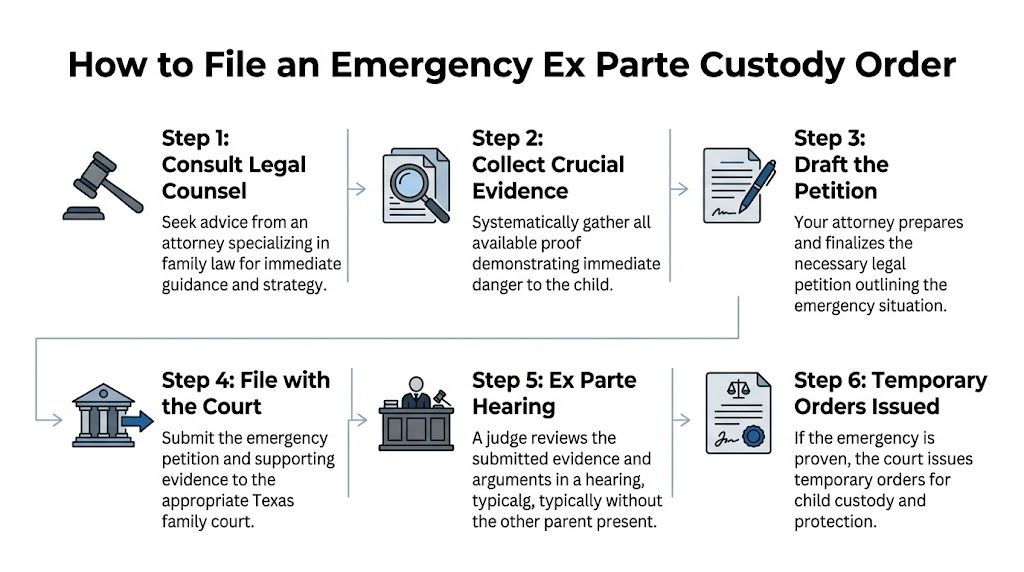
Step one is filing in the right court
Texas custody cases are often part of a SAPCR, which stands for Suit Affecting the Parent-Child Relationship. If there is already a custody order in place, the emergency request usually belongs in that same court. If there is no prior order, filing generally happens in the county where the child lives.
Filing in the wrong place can cost you time you don’t have. That’s one reason parents often seek immediate legal help rather than trying to piece this together during a crisis.
What documents are usually filed
An emergency filing often includes a combination of pleadings and supporting materials. The names may vary by case, but the package commonly includes:
- A petition or modification request asking the court to address conservatorship, possession, or both.
- A request for temporary emergency relief that explains what immediate protection you want.
- A sworn affidavit laying out the facts under oath.
- A proposed order for the judge to sign if relief is granted.
The heart of the filing is still the affidavit. According to this overview of emergency custody filings in Texas, the core of a successful emergency filing is a sworn affidavit detailing specific facts of immediate danger. After filing, the petitioner attends an ex parte hearing, often same-day. If the judge is convinced of imminent risk, the order is issued and must be served on the other parent, triggering a mandatory full hearing within 14 days. Incomplete affidavits lacking verifiable facts are a primary reason for denial.
How to write an affidavit that helps instead of hurts
A useful affidavit does three things well:
- It tells the story in chronological order.
- It uses specific facts instead of labels.
- It ties each fact to present danger.
Avoid packing the affidavit with every complaint you’ve ever had about the other parent. Focus on the urgent problem. Judges need to see the emergency clearly, not dig through unrelated history.
Here’s a better way to look at it:
| Weak approach | Strong approach |
|---|---|
| “She’s neglectful.” | “On Friday, the child reported being left alone overnight. The child’s teacher noted exhaustion the next morning.” |
| “He abuses substances.” | “He sent messages that appeared intoxicated before pickup, and the child reported he could not stay awake while supervising.” |
| “I’m terrified.” | “The child faces immediate risk because the conduct is ongoing and the next possession period is scheduled soon.” |
What happens at the ex parte hearing
The ex parte hearing is usually short. The other parent is not there yet. You or your attorney present the documents and explain why immediate action is necessary before notice can be given.
This hearing is not a full trial. It is a focused request for temporary protection. The judge may ask direct questions about timing, proof, prior orders, current location of the child, and whether less drastic options exist.
A short video can also help you understand the pace and seriousness of these hearings.
Practical filing choices in a real crisis
When families call during an emergency, the legal question is only part of the problem. The practical questions matter too:
- Who has the child right now
- Whether police or CPS are involved
- Whether there is an existing order
- Whether the other parent knows you’re seeking court intervention
- How quickly service can be completed if the order is granted
Some families hire private counsel immediately. Others seek help from local legal aid, county self-help resources, or trusted private firms. One option for representation in Texas custody emergencies is Law Office of Bryan Fagan, PLLC, which handles petitions, affidavits, and hearings involving emergency custody issues.
Bring your documents in one organized file, digital or paper. Judges and court staff respond better when they can follow your evidence without guessing.
After the Order Is Granted What Happens Next
Getting the judge’s signature often feels like the hardest part. It isn’t. The order protects your child for the moment, but the next hearing usually determines whether that protection will last in any meaningful form.

Service is not optional
Once the court signs the order, the other parent must be formally served. That usually happens through a constable, sheriff, or private process server. Texting a copy yourself is usually not enough.
If service is delayed, the case can lose momentum fast. The court wants the restrained parent to receive legal notice and an opportunity to appear at the follow-up hearing.
The full hearing changes the stakes
The initial ex parte order has a maximum duration of 14 days and automatically expires if a full hearing isn’t held. According to this discussion of filing for an emergency custody order in Texas, initial grant rates are high at about 85% with strong evidence, but only an estimated 40% to 60% survive the 14-day hearing intact because the proof standard becomes harder to satisfy. The same source notes that success often hinges on showing a material and substantial change in circumstances.
That shift matters. At the ex parte stage, the judge is deciding whether emergency protection is justified right now. At the full hearing, the judge hears both sides and looks more closely at what arrangement serves the child’s best interests moving forward.
What the judge may do after hearing both sides
The court has several options after the hearing:
- Let the emergency order expire if the evidence doesn’t support ongoing restrictions.
- Extend or modify the emergency relief if the danger remains supported by proof.
- Enter temporary orders that govern conservatorship, possession schedules, exchanges, decision-making, and sometimes child support while the case continues.
Temporary orders are often the most important practical result. They create structure for the months ahead, not just the days immediately after filing.
Prepare for the hearing like a contested case
At the full hearing, the other parent may deny everything, explain the events differently, or argue that you exaggerated the danger. That’s why your preparation after the ex parte order matters just as much as your original filing.
Focus on three things:
- Update your evidence file. Add any new incidents, records, or witness information.
- Prepare your testimony. Be factual, calm, and specific.
- Anticipate the defense. If the other parent will claim misunderstanding, retaliation, or coaching, be ready with documents and consistent facts.
A judge will notice if your story gets sharper with proof and weaker without it. Consistency matters.
What best interests means at this stage
Broader custody concepts then come into play. The judge is no longer asking only whether there was an emergency. The judge is weighing what arrangement protects the child and supports stability.
That may involve questions about:
- Who can provide a safer routine
- Whether supervised visitation is needed
- Which parent can meet school, medical, and emotional needs
- Whether joint managing conservatorship still makes sense
- How the possession schedule should change while the case proceeds
If you want a clearer picture of what happens when both sides appear in court, this guide on an emergency custody hearing in Texas is a useful next read.
Specific Strategies for Your Family Situation
The law applies to everyone, but the strategy should fit your role in the child’s life. A mother, father, grandparent, or military parent may all face the same emergency standard while needing very different proof and courtroom framing.
For mothers facing violence or threats
If the danger includes family violence, stalking, threats, or substance abuse, think beyond custody alone. A custody order can address possession and access. A protective order can add broader restraints, including no-contact provisions.
A key strategic issue is the difference between emergency custody orders, which are often framed around a 14-day period, and temporary ex parte protective orders for family violence, which can last up to 20 days under Section 83. This discussion of protective orders and emergency custody strategy explains that filing for a protective order first can provide a longer initial shield and broader no-contact provisions, especially in cases involving substance abuse or threats, and that dual filing is on the rise.
For fathers seeking to be seen as the protective parent
Fathers sometimes worry the court will assume the mother is the default safe parent. The answer isn’t to argue about fairness. The answer is to bring disciplined proof.
Show your involvement with the child’s daily life. Bring school records, doctor information, communication history, exchange logs, and evidence that you acted quickly for safety, not for an advantage. Courts respond well when fathers present as organized caregivers, not reactive litigants.
For grandparents stepping into a crisis
Grandparents often call only after the situation has been dangerous for a while. If you’re the adult who has been feeding, housing, transporting, or emotionally stabilizing the child, document that role carefully.
Grandparents should gather records that show regular caregiving, contact with the child, and knowledge of the emergency facts. The court will want to understand not just what the parents did wrong, but also why your involvement is necessary for the child’s immediate protection.
For military families dealing with distance and disruption
Military parents face a special challenge. Emergencies don’t wait for leave schedules, deployment dates, or transfer orders. If your family is dealing with relocation, temporary absences, or fast-changing residence issues, keep your records current and make your filing venue analysis early.
Military families also need a plan for hearings, service, and possession logistics if one parent is out of area. Judges want practical solutions. If you can propose a safe temporary structure with transportation, communication access, and a realistic possession plan, your request becomes easier to implement.
The strongest emergency filings don’t just identify danger. They give the judge a workable short-term path to keep the child safe.
Your Next Steps to Protect Your Child
If your child is in immediate danger, don’t wait for the situation to get clearer on its own. Start documenting. Preserve messages and records. Get legal advice quickly. The right emergency filing can create breathing room and protect your child while the court examines the facts.
If the situation is less urgent but still serious, that doesn’t mean you’re out of options. It may mean a modification, enforcement case, or protective order is the better fit. What matters is choosing the tool that matches the facts.
You do not have to figure this out alone while your family is in crisis. Clear action, strong evidence, and the right legal strategy can make a real difference.
If you need help with a child custody or visitation case in Texas, our experienced attorneys can guide you every step of the way. Contact The Law Office of Bryan Fagan, PLLC today for a free consultation.