Skip to content
When your child’s future is on the line, understanding your rights matters most.
A lot of parents search for mental illness and child custody texas because they’re scared. Maybe your ex brought up your depression in an argument. Maybe you’ve been in therapy for anxiety and now you’re worried that getting help will be used against you. Maybe you’re a grandparent or caregiver trying to understand whether a parent’s mental health crisis could change custody or visitation.
That fear is real. But Texas law is more grounded than many people expect. Family courts don’t decide custody by attaching a label to a parent and stopping there. They look at parenting, safety, stability, and the child’s needs.
Your Guide to Mental Health and Texas Custody Battles
If you’re lying awake wondering whether a diagnosis could cost you time with your child, start with this: a diagnosis by itself is not an automatic bar to custody in Texas. Courts are required to look deeper than the name of a condition.

That matters because you’re not alone. The Meadows Mental Health Policy Institute estimates 350,000 Texas children yearly contend with serious emotional or behavioral disorders, which helps explain why Texas courts regularly handle family cases involving mental health and tend to focus on stability and care rather than diagnosis alone, as noted in the Texas Children’s Commission round table report.
Why parents get confused
Many people assume custody cases work like this:
- Diagnosis equals danger
- Therapy records equal proof of instability
- Any past crisis equals permanent loss of rights
That isn’t how Texas courts are supposed to analyze these cases.
The pertinent question is much narrower and more practical. Can you meet your child’s daily needs, make sound decisions, provide a stable home, and protect your child’s physical and emotional well-being?
Practical rule: Courts care far more about how a parent functions than what diagnosis appears in a medical chart.
A parent who consistently attends treatment, follows medical advice, keeps routines, and shows good judgment may present much better than a parent with no diagnosis who behaves unpredictably. That shift in mindset is important. Managed health can support your case because it shows responsibility, insight, and follow-through.
What this means for you right now
If your mental health has become part of a custody dispute, don’t assume the case is already lost. Start thinking in terms of evidence, daily parenting, and steady habits. Judges look for patterns.
For mothers, fathers, grandparents, and military families, the path forward is usually the same. Show the court what your child’s life looks like with you, and show that your health is being handled responsibly.
How Texas Law Views Mental Health in Custody Cases
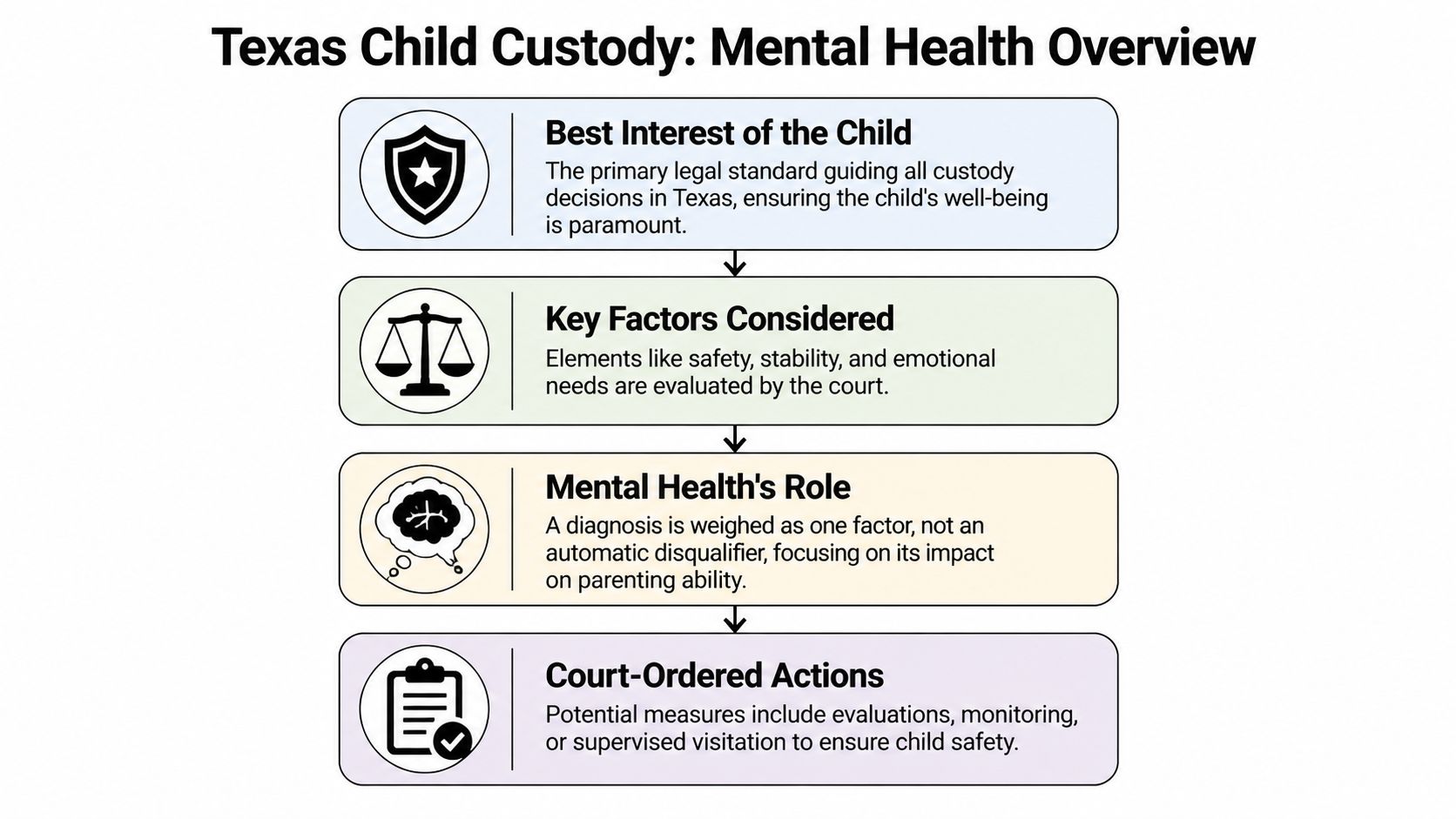
Texas custody law centers on the best interest of the child. In plain English, that means the judge asks what arrangement best protects the child’s safety, emotional development, and long-term stability.
What best interest means in plain English
Texas courts often look to the Holley factors, which are common guideposts in custody cases. Those factors help a judge examine issues such as:
- The child’s emotional and physical needs
- The child’s present and future safety
- Each parent’s abilities
- The stability of each home
- Acts or omissions that may affect the child
- Plans for the child’s future
Mental health can fit into several of those categories, but it is still only one part of the larger picture. A diagnosis matters only to the extent it affects parenting ability and the child’s well-being.
What courts are not supposed to do
Texas law does not tell judges to deny custody because a parent has depression, bipolar disorder, PTSD, anxiety, or another diagnosis. The legal focus is whether the condition creates a real parenting problem.
In the foundational case Lewelling v. Lewelling, the Texas Supreme Court ruled that a parent’s mental illness alone is insufficient to deny custody, and courts must have clear evidence that the condition negatively impacts parenting ability and poses a substantial risk to the child, as discussed in this summary of mental health in custody cases.
That case matters because it shifted the focus from labels to functional impact. The question isn’t “Does this parent have a diagnosis?” It’s “What does this mean for the child’s actual day-to-day life?”
If you’re facing allegations that your condition makes you an unsafe parent, it also helps to understand how Texas courts analyze claims about an unfit parent in custody cases.
How a judge may view common situations
A court may see these situations very differently:
| Situation | Likely court concern |
|---|---|
| A parent attends therapy, follows treatment, and keeps a stable routine | Whether the parent continues to provide safe, consistent care |
| A parent has frequent untreated symptoms that interfere with supervision or judgment | Whether the child faces emotional or physical risk |
| A parent’s condition contributes to neglect, unsafe housing, or erratic behavior | Whether custody limits or protective measures are needed |
Many parents feel relief. A mental health condition that is being managed is not viewed the same way as a condition that repeatedly disrupts the child’s safety or basic care.
Here’s a short explanation from a Texas family law video that may help frame the issue:
Legal terms parents hear in custody cases
A few terms often come up:
- Joint managing conservatorship means both parents usually share important decision-making rights for the child, even if one parent has more time.
- Possession schedule means the court-ordered calendar for when each parent has the child.
- Visitation is the older term many people still use for possession or parenting time.
- Conservatorship is the Texas legal term that covers custody rights and duties.
A parent can struggle with mental health and still be named a conservator if the evidence shows the child is safe and cared for.
The court’s job is not to punish a parent for having a condition. It is to protect the child while preserving healthy parent-child relationships whenever possible.
The Role of Evidence and Expert Testimony
Fear often grows in the gap between what people think matters and what persuades a judge. In mental health custody cases, evidence beats accusation.
The strongest evidence usually comes from neutral professionals
Courts often place significant weight on a psychological evaluation or custody evaluation when mental health is at issue. These are not casual conversations. They are formal assessments performed for litigation purposes, and they usually focus on parenting capacity, functioning, judgment, and the child’s needs.
A therapist’s records can matter, but they serve a different role. Therapy notes may show treatment history and compliance. A forensic-style evaluation is often more directly tied to the legal question the court has to answer.
Here’s the practical difference:
| Type of evidence | What it tends to show |
|---|---|
| Psychological evaluation | Overall functioning, parenting capacity, concerns, and recommendations |
| Medical records | Diagnosis, treatment history, appointments, medication management |
| Testimony from teachers or caregivers | What the child experiences in daily life |
| Parent’s calendar, journal, or communications | Routine, involvement, follow-through, missed exchanges, conflict patterns |
What a judge wants to see
Judges usually respond best to evidence that answers concrete questions:
- Is the parent stable in daily life?
- Does the parent attend treatment consistently?
- Does the child appear safe, clean, supervised, and emotionally supported?
- Are concerns recent and documented, or exaggerated and vague?
A parent who says, “I’m fine,” may not get far. A parent who brings records showing treatment attendance, medication management, school involvement, and reliable exchanges gives the court something far more useful.
Witnesses can help if they actually know your parenting
Not every witness carries the same weight. A friend who testifies only that you’re a good person may have limited value. A daycare provider, teacher, pediatric provider, family member who regularly sees exchanges, or another adult who has observed your parenting firsthand can be more persuasive.
Good witness testimony usually describes behavior, not conclusions. For example:
- Helpful: “She brings the child to school on time, communicates with staff, and follows up when the child is sick.”
- Less helpful: “She’s mentally healthy and should win custody.”
Courts want facts they can test, compare, and connect to the child’s experience.
Your own documentation matters more than many parents realize
Parents often overlook the evidence they can create themselves. Keep records that are calm, organized, and factual. That may include a parenting journal, school pickup records, attendance at counseling appointments for the child, and messages showing respectful communication with the other parent.
This isn’t about building a dramatic file against your co-parent. It’s about showing a pattern of responsible parenting over time.
A parent who documents treatment, school involvement, meal routines, appointments, and consistent contact with the child often presents as credible and prepared. In family court, that can matter a great deal.
Understanding CPS Involvement and Medical Records
Few issues create more panic than hearing “CPS” or worrying that private counseling records will be pulled into court. Both topics feel personal because they are personal. But the process becomes easier to handle once you know what the court is looking for.
When CPS may become involved
CPS does not step in solely because a parent has a mental health diagnosis. In most situations, involvement happens when someone claims the child has been neglected, endangered, left unsupervised, exposed to unsafe behavior, or affected by a serious parenting breakdown tied to untreated symptoms.
That distinction matters. The legal concern is child safety, not the existence of therapy, medication, or a diagnosis.
If CPS contacts you, keep these points in mind:
- Stay calm and cooperative. Anger and panic can make the situation harder.
- Ask what the concern is. You need to know whether the allegation involves supervision, home conditions, school issues, or something else.
- Gather records early. Treatment confirmation, medication management records, school attendance, and childcare arrangements may all matter.
- Avoid guessing or overexplaining. Give accurate information, not emotional speeches.
- Get legal guidance quickly. CPS investigations can affect later custody disputes even if the original report was exaggerated.
How medical records are handled in court
Mental health records are private, but privacy is not absolute in a custody case. If the court finds that your mental health is relevant to parenting capacity, certain records may be requested through legal process.
That doesn’t mean every private thought from therapy automatically becomes open court material. Judges generally focus on information tied to issues such as diagnosis, treatment compliance, medication management, crisis history, and functional impact on parenting.
A few legal tools may come up:
- Waiver means a party signs permission allowing records to be released.
- Subpoena is a court-backed demand for records or testimony.
- Court order may limit what must be produced and how it can be used.
What parents often misunderstand
Parents sometimes make one of two mistakes. They either hand over everything without review, or they try to hide records that would help them.
If you’re in treatment and doing well, those records may support your case. They can show insight, consistency, and responsible care. On the other hand, if there are records that need legal context, your attorney can help frame them properly instead of letting the other side define the story.
Private treatment is not the enemy in a custody case. Unexplained instability is usually the bigger problem.
The court is trying to answer a parenting question. Keep your focus there.
Emergency Custody Orders and Custody Modifications
Sometimes a custody issue unfolds slowly. Other times it changes fast. A parent may have a sudden crisis, stop taking medication, disappear, make unsafe decisions, or create a situation where the child cannot safely remain in the current arrangement. In those moments, the law provides emergency tools.
When an emergency order may be appropriate
Texas courts can enter emergency relief when a child faces immediate risk. That might involve temporarily limiting possession, requiring supervision, or changing where the child stays until a hearing can be held.
Emergency requests are serious. Judges usually want more than fear, suspicion, or old arguments between co-parents. They look for specific facts, recent events, and evidence that the child may be in danger right now.
If you need to understand the legal process for urgent relief, this guide on an emergency ex parte custody order in Texas explains the basic framework.
Graduated restrictions are common
Texas courts often try to protect the child without cutting off the parent-child relationship unless that becomes necessary. That’s why you may see graduated restrictions instead of an all-or-nothing ruling.
A court may move through options like these:
| Court response | Why a judge might use it |
|---|---|
| Supervised visitation | To preserve contact while safety concerns are evaluated |
| Required counseling or treatment | To address the condition affecting parenting |
| Temporary reduction in possession | To stabilize a crisis |
| Review hearing after compliance | To reassess progress and possible expansion of parenting time |
One verified data point is especially important here. Texas courts can impose restrictions like supervised visitation if a condition impairs decision-making, but compliance with court-ordered programs such as intensive outpatient therapy leads to restoration of full possession in 65% of cases within 6 months, according to the verified summary tied to this Texas custody video source.
That should matter to any parent who feels trapped by a temporary order. Restriction is not always the end of the story. In many cases, documented compliance changes the outcome.
Modification can work in both directions
A custody modification asks the court to change an existing order because circumstances have materially changed. Mental health often becomes part of modification cases in two ways.
First, a parent may seek more time after a period of recovery, consistent treatment, and restored stability. Second, a parent may ask for more protection after the other parent’s condition worsens and begins affecting the child.
This creates an important point of hope. A difficult period doesn’t have to define your entire future as a parent. If you can show sustained improvement, compliance, and safe parenting, the court can reconsider earlier limits.
For mothers and fathers, that often means presenting a before-and-after picture. For grandparents and caregivers, it may mean documenting changes in the child’s functioning, missed exchanges, or unsafe incidents with precision rather than emotion.
A Proactive Guide to Protecting Your Parental Rights
The strongest custody cases are often built long before a hearing. If your mental health may become part of the case, don’t wait for the other side to define you. Show the court who you are as a parent through habits, records, and steady action.
What proactive parenting looks like
Think in terms of consistency. Judges notice parents who create routines, solve problems, and respond responsibly under stress.
Some parents benefit from learning more about treatment settings that recognize the link between trauma, addiction, and mental health. If co-occurring conditions are part of your story, this overview of trauma care in addiction settings can help you understand why courts often respond well to organized, integrated treatment rather than fragmented care.
If the court has ordered limits on your time, it also helps to understand how supervised visitation in Texas works and what parents can do to move toward less restrictive arrangements.
Parental Fitness Checklist
| Action Item | Why It Matters | How to Document |
|---|---|---|
| Follow your treatment plan | Shows responsibility and insight | Appointment confirmations, medication logs, provider letters |
| Keep a stable routine for the child | Demonstrates reliable parenting | School records, pickup logs, calendars, childcare records |
| Communicate calmly with the co-parent | Reduces conflict and shows judgment | Written messages, co-parenting app records |
| Track your parenting involvement | Helps prove your daily role | Journal entries, activity schedules, photos tied to dates |
| Build a support network | Shows the child has backup care and stability | Contact list, affidavits, emergency plans |
| Complete court-ordered services | Shows compliance and progress | Completion certificates, attendance reports |
A few practical moves matter a lot
- Stick with treatment even during litigation. Stopping therapy or medication just to avoid scrutiny often backfires.
- Write things down close to the event. A simple dated note about school pickups, meals, homework, and bedtime routines can be useful later.
- Use respectful messages. Judges often read texts and emails. Short, child-focused communication can help your credibility.
- Prepare for questions about hard moments. If you had a crisis, be honest about what happened and what changed afterward.
- Get legal guidance early. A family law attorney can help decide what records to present, what evaluations to request, and how to address unfair allegations. The Law Office of Bryan Fagan, PLLC handles Texas custody matters involving conservatorship, visitation, emergency orders, and modifications.
Managed health can become part of your proof of fitness when it shows accountability, structure, and follow-through.
A diagnosis doesn’t tell the whole story. Your actions do.
Common Myths About Mental Illness and Child Custody
Parents often walk into custody disputes carrying shame that doesn’t belong there. A few myths create more panic than they should.
Myth one says any diagnosis means you’ll lose custody
That’s false. Texas courts focus on how a condition affects parenting and the child’s safety. A parent receiving treatment and functioning well is not in the same position as a parent whose symptoms repeatedly create instability.
Myth two says therapy makes you look worse
Usually, hiding problems creates more damage than responsibly addressing them. Therapy can show self-awareness, effort, and a willingness to protect the child’s well-being. Those are strengths.
A judge may have concerns about untreated behavior, missed responsibilities, or unsafe decisions. The fact that a parent sought help is often far less troubling than the fact that a parent avoided it.
Myth three says your ex can twist every counseling session into evidence
The court process doesn’t work that loosely. Mental health information usually matters only when it connects to parenting capacity or child safety. Context matters, and so does the difference between a rough period and a present danger.
Myth four says it’s better to hide co-occurring mental health and substance issues
That strategy can collapse quickly. Courts do give extra scrutiny to cases involving both mental illness and substance abuse. But they also recognize the value of integrated treatment. According to the verified data tied to this discussion of Texas custody cases involving diagnoses, documenting progress in a dual-diagnosis program can be powerful evidence of a parent’s commitment to stability and can support modifying restrictive orders over time.
Myth five says a bad chapter defines the rest of the case
It doesn’t have to. Courts can and do look at change. If a parent takes responsibility, follows treatment, complies with court requirements, and rebuilds stability, that progress matters.
Don’t let fear push you into secrecy. In many custody cases, honest documentation is stronger than defensive silence.
Your Next Steps for a Secure Future
If you remember only a few things, remember these.
Texas courts do not automatically deny custody because of mental illness. They look at the child’s best interests. They ask how a condition affects parenting in real life. They pay attention to safety, consistency, judgment, and follow-through.
That means your next steps matter. If you’re in treatment, stay with it. If you’ve had a setback, document your recovery. If your co-parent is raising concerns, answer them with records, structure, and calm facts. If the other parent’s condition is putting your child at risk, document specific incidents and get legal advice quickly.
For parents, grandparents, and caregivers, this area of law can feel personal because it is. But it’s also manageable when you approach it with a clear strategy. Courts are not supposed to decide these cases based on stigma. They are supposed to decide them based on evidence and the child’s needs.
You don’t have to guess your way through that process. You can prepare for it.
If you need help with a child custody or visitation case in Texas, our experienced attorneys can guide you every step of the way. Contact The Law Office of Bryan Fagan, PLLC today for a free consultation.