
When your child’s future is on the line, understanding your rights matters most.
You may be reading this right after opening court papers that describe you as dangerous, unstable, neglectful, or abusive. Your hands shake. Your stomach drops. You reread the same sentence three times because it doesn’t sound like your life. It sounds like someone else’s story, and yet your name is on every page.
That reaction is normal. False allegations in a custody fight can make even a steady parent feel panicked and powerless. But panic is not a plan. Facts are. In Texas, judges care about the best interests of the child, which means the court looks at what protects a child’s safety, stability, health, and long-term well-being. That standard can feel broad, but it also gives honest parents a way to fight back with evidence, consistency, and strategy.
Under Texas Family Code Chapter 153, custody issues usually involve conservatorship and possession and access. Conservatorship is the legal term for decision-making rights and duties. Possession and access is the schedule for when each parent spends time with the child. Many parents are named joint managing conservators, which usually means both parents share important rights and duties, even if one parent has the exclusive right to decide the child’s primary residence. When false accusations enter the case, those decisions can shift quickly at temporary hearings unless you respond the right way.
The Unthinkable Moment You're Falsely Accused
A lot of parents describe the same moment. A process server appears. A deputy calls. A Child Protective Services investigator leaves a voicemail. Or the other parent suddenly refuses an exchange and says there are “serious concerns” about the child’s safety.
The details vary, but the fear is the same. You’re not just defending your reputation. You’re trying to protect bedtime routines, school pickups, doctor visits, holidays, and the ordinary moments that make up a parent-child bond.
A 2021 article discussed in The Silver Bullet Method and false allegations in divorce and custody cases states that false abuse allegations appear in 2% to 35% of all cases involving children. That same discussion describes the “Silver Bullet Method”, where unsubstantiated allegations are used to gain an immediate advantage in divorce or custody proceedings, sometimes resulting in temporary separation from a parent even when the claims are later disproven.
Why this hits so hard
A false allegation changes the emotional temperature of the entire case overnight. Friends may pull back. Teachers may become cautious. Police, CPS, and the court may all need to respond because no one can afford to ignore a claim involving a child.
That doesn’t mean the allegation wins. It means the system stops and looks.
Practical rule: Your first job is to stop reacting emotionally and start preserving evidence.
Parents often make the same early mistake. They send angry texts, post online, demand answers, or try to force a face-to-face confrontation. Those moves usually create new evidence for the other side.
If the accusation is spilling into social media, group chats, or community gossip, it also helps to understand expert strategies against online defamation, especially when false statements are affecting your work, reputation, or extended family relationships.
There is a path forward
Texas courts don’t decide custody based on the loudest accusation. They look for credibility, patterns, and evidence that holds up over time. That’s why many parents eventually regain ground when they shift from denial to documentation.
If you’re trying to understand the risk to your parental rights, this guide on whether a parent can lose custody for false accusations gives useful context. The short version is this. A false allegation is serious, but it is not the final word.
Your Immediate Response Plan for the First 48 Hours
The first two days matter because they shape the evidence trail that follows. A calm response protects you. A rushed response can damage your case before your attorney has a chance to fix it.

What to do first
Start by getting control of the paperwork and the timeline.
- Read every document carefully. Look for hearing dates, restraining language, pickup restrictions, and whether a temporary orders hearing has already been set.
- Save everything in one place. Use a physical folder and a digital folder. Keep petitions, notices, text screenshots, call logs, emails, and voicemails together.
- Write down what happened. Create a private timeline while the details are still fresh. Include dates, times, exchanges, witnesses, and any unusual communication.
- Call a Texas family law attorney quickly. You need someone who handles custody litigation, emergency orders, and CPS-related family court issues.
If law enforcement or CPS contacts you, be respectful and measured. You don’t want to appear evasive. You also don’t want to start filling silence with nervous explanations.
What not to do
Some mistakes are easy to make because they feel human. They still hurt your case.
- Don’t argue with the other parent. Even one emotional message can be attached to a motion or shown in court.
- Don’t post on social media. A joke, photo, meme, or vague status update can be misread and reused against you.
- Don’t coach your child. Never tell a child what to say to a judge, counselor, investigator, or teacher.
- Don’t destroy anything. Deleting texts, photos, or location data can create bigger problems than the original accusation.
- Don’t violate any order. Even if the order feels unfair, breaking it hands the other side a cleaner argument than the original allegation.
The parent who looks calmer, more organized, and more child-focused often gains credibility early.
If CPS or police contact you
False allegations in custody case texas situations often overlap with reports to CPS or calls to police. That overlap scares parents because these investigations feel immediate and personal.
Use this basic approach:
| Situation | Better response | Risky response |
|---|---|---|
| CPS calls you | Confirm the investigator’s identity and ask to schedule with counsel involved if possible | Start talking for an hour without preparation |
| Police ask questions | Be polite and ask if you’re free to leave or if questioning should go through counsel | Try to “clear everything up” on the spot |
| Other parent texts accusations | Save the messages and respond only if necessary, briefly and calmly | Send a long emotional defense |
| Family asks what happened | Share very little and keep it private | Build a team of unofficial spokespeople |
Keep communication boring
That may sound strange, but boring is good. Boring reads well in court.
If you must respond to the other parent, stay short and child-centered. Confirm exchange details. Ask about school information. Address medical or schedule issues. Skip blame, sarcasm, and predictions about what the judge will do.
A strong message often sounds like this in practice: “I’ll follow the current order. Please confirm exchange at the usual location.” It doesn’t sound satisfying. It does sound responsible.
Protect your position before the first hearing
In many cases, the early hearing is about temporary arrangements, not the final outcome. Still, temporary rulings can shape the months that follow. Before that first court date, gather:
- Recent school information that shows attendance, involvement, or communication with teachers
- Medical records or appointment confirmations that show your participation in care
- Witness names and contact information for neutral adults who’ve seen your parenting
- Screenshots of communication that show your tone and attempts to cooperate
- A clean calendar showing when you had the child, requested time, or were denied access
The goal in the first 48 hours isn’t to prove your entire case. It’s to stop avoidable damage and preserve the evidence your attorney will need.
Building Your Defense with Bulletproof Documentation
Texas judges don’t have the luxury of living with your family for six months to figure out what’s true. They rely on proof. That’s why documentation matters so much.
Texas courts place more weight on consistency over time than on a single accusation, and judges look to documented patterns from credible third parties such as schools and counselors. That’s why building a forensic paper trail is such an important defense in these cases, as discussed in this explanation of false allegations in Texas custody cases.
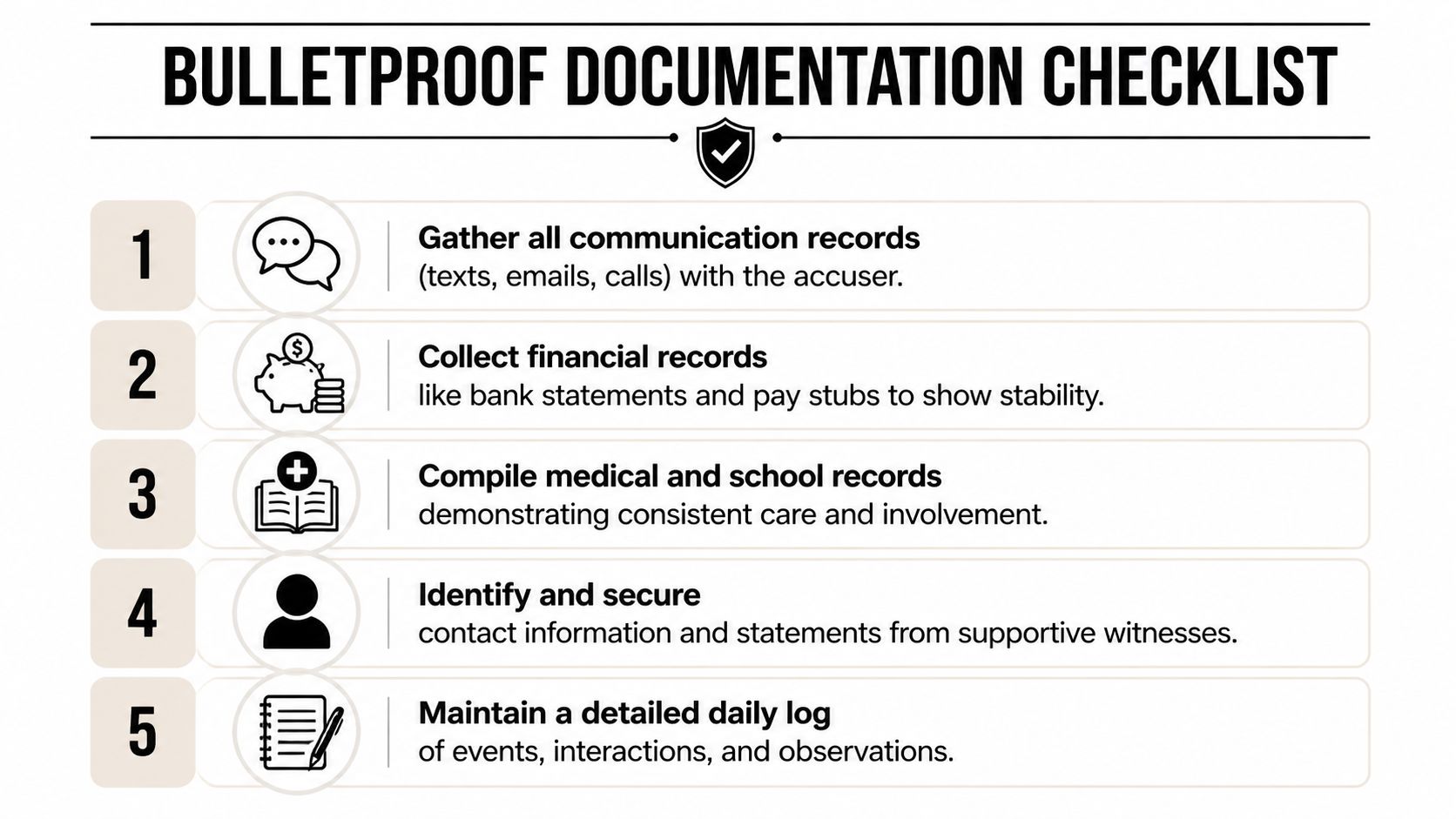
What a forensic paper trail actually looks like
This isn’t just a stack of screenshots. It’s a system.
Create one master folder with subfolders for texts, emails, school, medical, calendar records, photos, witness information, and court documents. Name files in a way that makes sense later. “2025-04-18 pediatrician visit” is much better than “IMG_4418.”
Your documentation should answer simple questions clearly:
- Were you involved?
- Were you available?
- Were you cooperative?
- Does your behavior match your words?
- Does the other parent’s story stay consistent?
Evidence that often helps
Different cases call for different proof. Still, several categories tend to matter in almost every false allegations in custody case texas dispute.
Communication records
Save texts, emails, parenting app messages, and voicemail logs. Don’t just save the dramatic messages. Save the ordinary ones too. Routine communication often shows who coordinates school, meals, medicine, transportation, and activities.School and medical records
Attendance records, report cards, teacher emails, doctor visit summaries, therapy scheduling messages, and vaccination records can show stable involvement. Third-party records carry weight because they weren’t created for litigation.A daily log
Keep a running log with dates, times, exchanges, cancellations, missed calls, unusual child statements, and behavior concerns. Be factual. Don’t editorialize. “Child arrived without inhaler” is stronger than “Other parent is careless and irresponsible.”Photos and videos with context
A photo is more useful when you can identify the date, event, and who was present. Random happy photos matter less than well-organized records that show a pattern of day-to-day parenting.Financial and practical stability records
Rent or mortgage records, pay stubs, daycare payments, grocery receipts, and proof of insurance can help show that your home environment is stable and that you meet the child’s needs.
Build a timeline that exposes inconsistency
A good timeline doesn’t rant. It lines up facts so contradictions become obvious.
For example, if the other parent claims you were absent, your timeline might show school pickup records, pediatric appointments, weekend photos with metadata, and text confirmations for exchanges during the same period. If they claim an incident happened on a certain date, your records may show you were somewhere else, with witnesses or digital records to confirm it.
That’s one reason attorneys often look at location history, device activity, and other online traces. Used carefully and legally, they can help confirm where people were and when communication happened. If you need help understanding how online activity can leave evidence behind, this guide on how to discover digital footprints is a practical starting point.
Important distinction: Good documentation doesn’t “win” because it is lengthy. It wins because it is organized, specific, and easy for a judge to trust.
Who can help prove your credibility
The strongest witnesses are usually not your closest friends. They are neutral adults with firsthand knowledge.
Consider whether these people may have useful information:
| Potential witness | Why the court may care |
|---|---|
| Teacher or school staff | They see attendance, parent involvement, and the child’s condition |
| Pediatric provider or office staff | They can confirm who attends appointments and follows up |
| Counselor or therapist | They may observe family dynamics within legal limits |
| Coach or activity leader | They can speak to consistency and participation |
| Childcare provider | They often see drop-offs, pickups, and parent communication |
Your attorney will decide who should testify, provide records, or submit information through proper channels. Don’t pressure people to “take your side.” Ask them to preserve what they observed.
What doesn’t work nearly as well
Parents often spend energy on the wrong things. These rarely carry much weight by themselves:
- Long written attacks on the other parent
- Character opinions from relatives who weren’t present
- Edited screenshots with missing context
- Dozens of repetitive photos with no dates or explanation
- Secret recordings without legal guidance
- A dramatic social media cleanup after the accusation
The better move is simple. Carefully collect, organize, and verify.
If alienation is also part of the conflict, this article on how to prove parental alienation in court may help you think about pattern-based evidence in a more structured way.
A practical system you can start tonight
Use this routine:
- Download and save current messages
- Create a dated event log
- Request copies of school and medical records through proper channels
- List neutral witnesses with phone numbers and what they personally observed
- Send everything to your attorney in labeled batches, not in a panic-filled stream
The Law Office of Bryan Fagan, PLLC handles custody, visitation, modification, and emergency family law matters in Texas, including cases where one parent needs help organizing records and building evidence to answer false claims. Whether you work with that firm or another Texas family lawyer, the important point is the same. Your attorney can only use the facts you preserve.
Navigating the Texas Legal System and CPS Investigations
False accusations feel chaotic because they often hit from several directions at once. Family court, temporary orders, possible CPS contact, and school or medical questions can all start moving before you’ve had time to process what happened.

The Texas custody terms that matter most
Texas doesn’t usually use the word “custody” in court orders. Instead, you’ll see terms that have specific meanings.
Conservatorship refers to parental rights and duties. A parent may be a joint managing conservator, which often means both parents share decision-making in major areas, or a sole managing conservator, where one parent has more exclusive authority because the facts justify it.
Possession and access refers to parenting time. Many families follow a possession schedule, which is the calendar for weekends, holidays, summer time, and exchanges.
Best interests of the child is the guiding standard behind all of it. Judges look at safety, stability, parenting history, the child’s needs, and each parent’s ability to make sound decisions.
A custody case is often filed as a Suit Affecting the Parent-Child Relationship, or SAPCR. That’s the legal vehicle the court uses to decide conservatorship, possession, support, and related rights involving a child.
Why false claims can have immediate impact
Texas family courts handled over 7.9 million filings in Fiscal Year 2024, according to the Texas Judiciary Annual Statistical Report. In a system carrying that level of volume, judges and investigators have to make quick calls at early stages, especially when someone raises abuse, neglect, or family violence concerns.
That creates a hard truth. Even weak allegations can trigger real disruption because the court must take child safety seriously.
Courts don’t have to believe an accusation to investigate it. They only need enough concern to pause and look closer.
What usually happens in a CPS investigation
CPS investigators are not your judge, but their involvement can influence the family court case. If a report has been made, the investigator may want interviews, home access, background information, or contact with the child and other adults.
That does not mean you should become combative. It means you should be careful, respectful, and prepared.
A few practical points help:
Be polite and organized
Provide requested basics through the proper process. Sloppy or hostile interactions can create avoidable concerns.Use counsel where possible
If you already have a family law attorney, involve that attorney early so communication stays focused and documented.Keep your home presentation simple and stable
The home doesn’t need to be perfect. It does need to reflect safety, routine, and attention to the child’s needs.Avoid coaching the child
Children often repeat pressure in ways adults don’t expect. Let the child speak without scripting.
For a broader look at how safety concerns affect custody decisions, this article on child endangerment and custody in Texas can help you understand how courts distinguish serious risk from accusation alone.
Temporary orders shape the middle of the case
Early hearings often address temporary possession, communication rules, counseling, exchange procedures, and other short-term measures while the case is pending. Parents sometimes underestimate these hearings because they aren’t the final trial. That’s a mistake.
Temporary orders often create the routine everyone lives under for months. If one parent enters that hearing with documents, a calm presentation, and a workable plan for the child, the judge has something concrete to use.
This video offers helpful background on what custody litigation can involve in Texas family court:
Why sanctions aren’t automatic
Many parents ask whether the court will punish a false accuser right away. Sometimes the answer is yes. Often, it’s not that simple.
Texas Rule of Civil Procedure 13 allows penalties for bad-faith filings, but proving malicious intent inside a fast-moving family case is difficult, especially early on. Most judges focus first on stabilizing the child’s circumstances. Accountability questions may come later, after more evidence is gathered.
That can feel unfair. It also explains why preparation matters so much. In the short term, the strongest move is usually to become the most credible adult in the room.
Courtroom Strategies to Disprove Lies and Protect Your Name
By the time you reach a major hearing or trial setting, simple denial won’t carry the day. The stronger strategy is to present a clear counter-narrative supported by records, neutral witnesses, and calm testimony.

The courtroom question is credibility
A judge often asks, directly or indirectly, a basic question. Which version of events makes more sense when compared against the documents, the timeline, and the behavior of the adults involved?
That means your attorney’s job is not only to attack the accusation. It is also to show the court who you are as a parent in your daily life.
Good strategy often includes:
Discovery that forces specifics
Requests for production, written questions, and depositions can pin down dates, witnesses, and supposed evidence. False stories usually weaken when the speaker must commit to details.Cross-checking the timeline
If the allegation shifts from hearing to hearing, or conflicts with texts, school records, or exchange logs, those inconsistencies matter.Using neutral witnesses wisely
A teacher, counselor, coach, doctor’s office staff member, or childcare provider may do more for your case than several relatives who simply say you’re a good parent.Showing your conduct under pressure
Calm compliance with orders, steady parenting, and child-focused communication often help more than outrage ever will.
Prepare your own testimony carefully
Parents sometimes hurt themselves by trying to “tell the whole story” in one answer. Court testimony works better when it is disciplined.
Answer the question asked. Stop. Don’t guess. Don’t exaggerate. Don’t call the other parent names from the witness stand.
A judge notices how a parent handles stress. If you stay grounded while discussing hard facts, your testimony carries more weight.
Say what you know. Don’t fill gaps. Don’t volunteer theories as facts.
Should you ask for a guardian ad litem or evaluation
Sometimes the child needs an independent voice in the case. In some disputes, a guardian ad litem or another court-appointed professional may help the judge assess the child’s circumstances more fully. In other cases, a psychological evaluation may become part of the litigation strategy.
These tools are not automatic and they are not right for every case. They can add time, expense, and complexity. But when allegations are severe and the facts are strongly contested, they may help move the case away from pure accusation and toward independent assessment.
Sanctions can matter, but don’t build your whole case around them
Texas law does allow consequences in some situations involving knowingly false reports or bad-faith litigation conduct. The practical problem is enforcement. Family law practitioners have noted a lack of consequences for proven false claims, and sanctions such as attorney’s fees or other penalties are not applied consistently, as discussed in this analysis of false allegations in custody battles.
That reality changes strategy. You should pursue accountability when the facts support it, but your primary goal should be to disprove the allegation and protect your conservatorship and possession rights.
A useful way to think about it is this:
| Goal | Better focus |
|---|---|
| Protect access to your child | Build credibility and present a stable parenting plan |
| Disprove the allegation | Use records, discovery, and witness testimony |
| Expose motive | Let facts reveal it through timing and inconsistency |
| Seek sanctions | Treat this as a secondary objective, not the whole case |
What works better than revenge
Judges usually respond better to a parent who is solution-focused than one who appears consumed by payback. That doesn’t mean you stay passive. It means you stay strategic.
Ask for relief that protects the child and reduces future conflict. That may include:
- a more detailed possession schedule
- neutral exchange locations
- communication through a parenting app
- counseling provisions if appropriate
- make-up parenting time when access was wrongly denied
- customized orders that reduce opportunities for repeat false claims
In the courtroom, the parent who sounds most reasonable often becomes the parent the judge trusts to make future decisions.
Next Steps and Proactive Practices for Texas Families
Once the immediate crisis settles, your focus should shift from reaction to protection. Families in high-conflict custody cases need systems, not just good intentions.
For parents, that often means using structured communication, keeping exchanges public and calm, and staying involved in school, medical care, and daily routines. The more your life shows reliable parenting, the harder it becomes for someone to paint a false picture of you.
Habits that lower future risk
A few practices can make a real difference over time.
Use written communication tools
Parenting apps and email often create cleaner records than verbal conversations.Confirm important details in writing
Exchanges, doctor visits, schedule changes, and school events should be documented.Choose safe exchange settings
Public locations, school pickups, or other neutral settings can reduce friction.Stay visible in your child’s world
Teachers, coaches, counselors, and doctors notice who shows up consistently.Keep your own conduct steady
Avoid retaliatory behavior, even when the other parent seems to be baiting you.
Guidance for mothers and fathers
Mothers and fathers often face different assumptions in custody litigation, but the practical advice is the same. Be consistent. Be child-focused. Be document-driven.
If you’re a father, don’t assume the court will automatically see through a false allegation without strong evidence. If you’re a mother, don’t assume your history as the primary caregiver alone will neutralize a serious accusation. Courts respond best to proof, preparation, and credible conduct.
Guidance for grandparents and extended family
Grandparents often feel helpless when conflict between parents spills over onto them. But they can play an important role if they stay measured.
Grandparents seeking to counter false allegations involving their grandchildren face unique hurdles. Their strongest position usually comes from showing a stable environment and documenting a long-standing, positive relationship with the child, which can support the child’s best interest analysis in court, as noted in this discussion of grandparent responses to false accusations in custody matters.
That means grandparents should:
- preserve texts, photos, and visitation history
- avoid inflaming the conflict
- support the child without coaching
- be ready to testify about firsthand observations only
- coordinate with the parent’s attorney before stepping into the dispute
The most helpful family member is usually the one who brings facts, not extra drama.
Key takeaway
If you’re facing false allegations in custody case texas litigation, don’t try to “win” with outrage. Win with structure. Preserve evidence. Learn the order. Follow the order. Show the court that your behavior matches your words and that your focus stays on your child’s well-being.
You may not be able to stop the accusation from being made. You can control how well you answer it.
If you need help with a child custody or visitation case in Texas, our experienced attorneys can guide you every step of the way. Contact The Law Office of Bryan Fagan, PLLC today for a free consultation.