
When your child’s future is on the line, understanding your rights matters most. For military families, a divorce involves a unique set of rules that civilian families just don’t face, adding layers of complexity to an already emotional process. These challenges can range from figuring out which state even has the authority to hear your case to creating a parenting plan that can actually withstand deployments and relocations.
Navigating Your Rights in a Texas Military Divorce
When you serve our country, the last thing you should have to worry about is a confusing legal battle on the home front. A military divorce brings its own set of challenges, but you have rights and protections specifically designed to ensure a fair outcome for you and your children. Getting a handle on these unique factors from the very beginning is the first step toward building a stable, secure future for your family.
The journey through a military divorce and child custody case requires a solid understanding of both Texas family law and the federal regulations that sit on top of it. While the heart of the process is the same for every parent—protecting your relationship with your kids—the legal steps look quite different.
A few key issues pop up again and again:
- Jurisdiction: Deciding which state court has the legal authority to handle your divorce and custody matters.
- Federal Protections: Understanding how laws like the Servicemembers Civil Relief Act (SCRA) can press pause on your case.
- Parenting Plans: Crafting possession schedules that are flexible enough for deployments and training but firm enough to provide stability, especially when facing Permanent Change of Station (PCS) orders.
The Realities Facing Military Families
Let’s be honest: the pressures of military life can take a toll on a marriage. While military divorce rates are often similar to civilian ones, certain factors ramp up the risk. Deployments can increase the likelihood of divorce by as much as 30%, and the strain of frequent relocations adds another 25%.
With so many military divorces happening during prime parenting years, these numbers underscore just how critical it is for families stationed at Texas bases like Fort Cavazos and Joint Base San Antonio to have reliable legal guidance. You can explore more data on how military service impacts divorce rates.
Think of this guide as your go-to resource, built to give you straightforward answers and practical strategies. We'll walk you through the essential first steps, explain your rights in plain English, and offer real-world advice on protecting your relationship with your children. Our goal is to empower you with the knowledge you need to make confident decisions, reduce conflict, and ensure your kids’ well-being—even when military life throws a curveball.
For a deeper dive into the process, you can learn more about Texas divorce laws for military members in our detailed article.
How Texas Determines Where to File a Military Divorce
One of the very first hurdles in a military divorce is figuring out which state has the legal power—the jurisdiction—to handle your case. This isn't just about picking a location on a map; it's a critical choice that determines which state's laws will govern everything from how your property is divided to, most importantly, the future of your child custody arrangements. For military families, who often have connections to multiple states, this decision can feel incredibly complicated right from the start.
But the good news is, you usually have a few clear options. The best one for your family hinges on your specific situation, and making a smart, strategic choice early on can set a much smoother course for the entire process.
Where Can You Legally File for Divorce?
For military families, the divorce petition can typically be filed in one of three places. Let's break down each one so you and your attorney can figure out the best path forward.
The State Where the Service Member is Stationed: If the service member is stationed in Texas—say, at Fort Cavazos or Joint Base San Antonio—you can often file here. The key is meeting the residency requirements. For a Texas court to take your case, at least one spouse must have lived in the state for a minimum of six months and in the specific county where you're filing for at least 90 days.
The State Where the Non-Military Spouse Resides: The civilian spouse can also file for divorce in the state where they live, as long as they meet that state's own residency rules. This is a very common choice, especially if the non-military spouse has already put down new roots and built a support system there.
The Service Member’s "Home of Record" or Domicile: This is the state the service member considers their permanent legal home, even if they're stationed thousands of miles away. It’s often the state they lived in when they first enlisted. A service member always retains the right to file for divorce in their state of legal residence, no matter where the military has sent them.
This decision tree can help you visualize the initial questions you and your spouse will need to answer when considering a divorce in Texas.
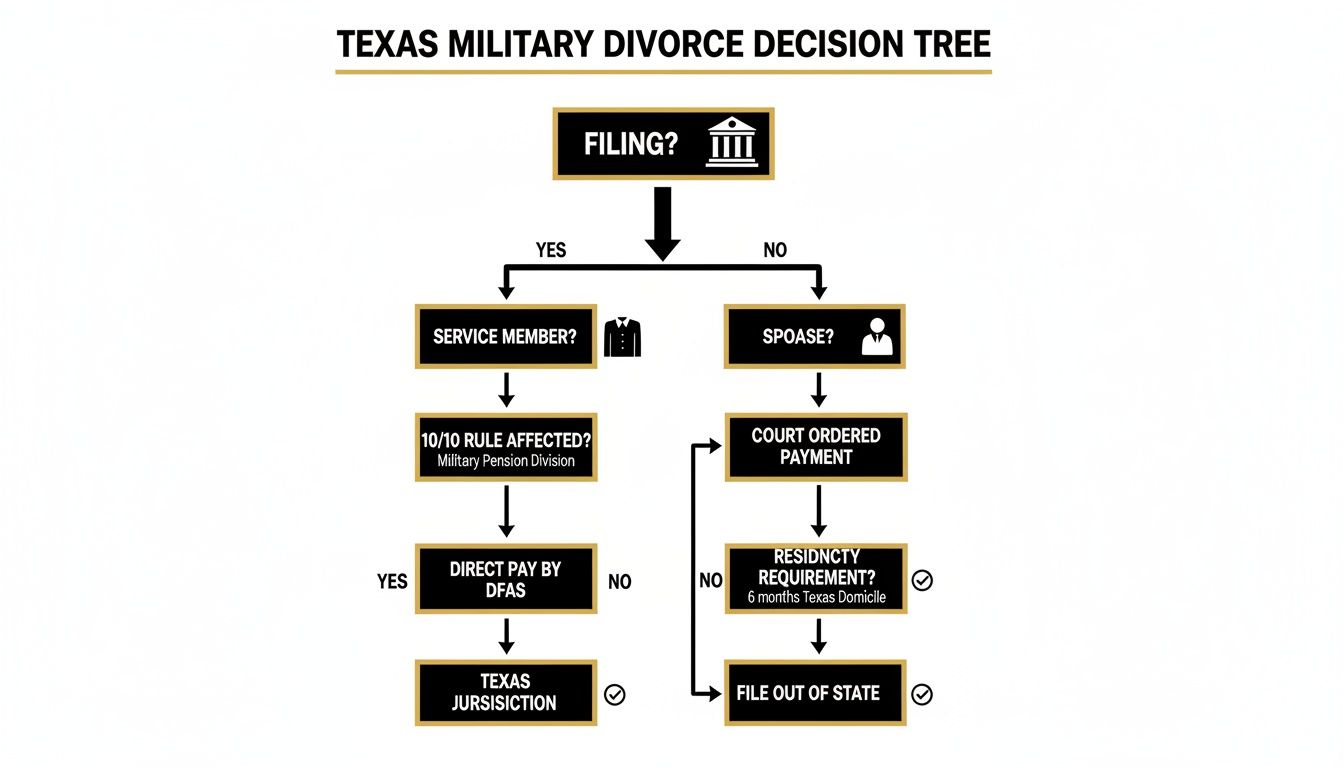
As you can see, the right path often depends on who files first and where each of you can legally establish residency.
The Deciding Factor for Child Custody Jurisdiction
While you have some flexibility on where to file for the divorce itself, the rules for child custody are much more rigid. The authority to make custody decisions is governed by a federal law called the Uniform Child Custody Jurisdiction and Enforcement Act (UCCJEA), which is fully integrated into the Texas Family Code.
The whole point of the UCCJEA is to prevent parents from "forum shopping"—that is, trying to find a state with laws they think will be more favorable to them. It ensures only one state can make the initial custody decision, which creates consistency and stability for the child.
Under the UCCJEA, the state with the power to decide custody is almost always the child’s “home state.” A child's home state is defined as the state where they have lived with a parent for at least six consecutive months right before the custody case is filed.
Let’s put that into a real-world scenario. Imagine a service member is stationed in Texas. Eight months ago, their spouse and child moved back to Florida to be closer to grandparents. Even if the service member files for the divorce in Texas, a Texas judge would likely have to defer to Florida on all child custody matters. Why? Because Florida is now the child's established home state. The Texas court could grant the divorce, but the Florida court would be the one making the custody orders.
Getting this distinction right from the very beginning is absolutely essential to protecting your parental rights in a military divorce.
Understanding Protections Under the SCRA
When you’re serving on active duty, the idea of trying to fight a legal battle back home can feel completely overwhelming. It’s hard enough to focus on your mission without worrying about what’s happening in a courtroom hundreds or thousands of miles away. This is exactly why a critical federal law exists to protect you.
The Servicemembers Civil Relief Act (SCRA) is your shield—not a sword. It’s a federal law designed to make sure your military service doesn't put you at a legal disadvantage in a civilian court case, and that absolutely includes a divorce or custody dispute.
Think of the SCRA as a legal "pause button." It recognizes that service members can't just drop everything to respond to lawsuits, attend hearings, or participate in their own defense when they're deployed, in training, or stationed far from home. The SCRA allows you to focus on your duties without the constant fear that a default judgment will be entered against you.
But here's a key point many people miss: this protection isn't automatic. You or your attorney must proactively request it from the court.
How the SCRA Pauses Your Case
The main protection the SCRA offers in a family law case is the ability to request a “stay,” which is a legal term for temporarily halting all proceedings. If your military duties materially affect—meaning, significantly interfere with—your ability to show up in court or respond to a lawsuit, you can ask for a stay for a minimum of 90 days.
To get this stay, you or your lawyer will need to provide the court with a letter or affidavit that clearly explains a few things:
- How your current military duties physically prevent you from participating in the case.
- When you expect to become available.
- A statement from your commanding officer confirming that your duties prevent you from appearing and that military leave is not authorized at this time.
This simple but powerful tool ensures that life-altering decisions about your children and your property aren't made without you in the room.
The SCRA provides crucial safeguards for service members, but it’s important for both spouses to understand what these protections mean in a practical sense. Below is a table that breaks down the key provisions and their impact on each party during a Texas divorce.
Table: SCRA Protections in a Texas Divorce
| SCRA Protection | What It Means for the Service Member | What It Means for the Non-Military Spouse |
|---|---|---|
| Stay of Proceedings (90+ Days) | You can request to pause the divorce or custody case if your military duties prevent you from participating. This prevents default judgments. | The case will be temporarily delayed. You cannot force the case forward until the service member is available or the stay expires. |
| Protection from Default Judgment | A court cannot enter a final judgment against you for failing to appear or respond without first appointing an attorney to represent your interests. | You must file an affidavit stating whether the other party is in the military. If they are, the court will take extra steps to ensure their rights are protected before proceeding. |
| Reopening a Judgment | If a default judgment was entered against you while on active duty (or within 60 days after), you may have the right to reopen the case if your service prejudiced your defense. | A final order might not be truly "final" if the service member can prove they were unable to defend themselves due to their military obligations. |
| Lower Interest Rates | This applies to pre-service debts (like credit cards or mortgages) but can indirectly impact the division of community debt by lowering monthly payments. | The community estate may benefit from reduced interest on joint debts, potentially freeing up funds or reducing the overall debt to be divided. |
Understanding these rules helps set realistic expectations for the timeline of a military divorce. It’s not about giving one side an unfair advantage, but ensuring the process is fair to everyone involved.
Clearing Up Common SCRA Myths
It's crucial for both service members and civilian spouses to understand what the SCRA does—and just as importantly, what it doesn't do. A lot of frustration and conflict in these cases comes from simple misunderstandings.
The purpose of the SCRA is to ensure fairness by postponing legal action, not to prevent it indefinitely. It levels the playing field so that a service member has the same opportunity to participate in their case as a civilian would.
Let’s bust a few common myths we hear all the time in a military divorce and child custody case:
Myth: The SCRA can stop a divorce from ever happening.
- Fact: Not true. The SCRA only provides a temporary delay. As soon as the service member is available, the divorce and custody proceedings will move forward. It’s a postponement, not a permanent dismissal.
Myth: The SCRA only protects the service member.
- Fact: While the protections are granted to the service member, the law ultimately promotes fairness for the entire family. By making sure both parents can participate, it helps the court make decisions that are truly in the best interests of the child. A civilian spouse’s attorney can also work to ensure the case moves forward promptly once the service member becomes available.
Getting a handle on these protections is a huge first step for both parents. It helps set realistic expectations and can even encourage a more cooperative approach, despite the challenges of military life. By acknowledging these rights from the start, families can work with their attorneys to create a timeline that respects military duty while still moving everyone toward a resolution.
How Deployments and Relocations Impact Child Custody
For a military family, "goodbye" is a word you know all too well. When your child’s future is on the line, the thought of a deployment or a Permanent Change of Station (PCS) order can feel completely overwhelming. These events are the defining realities of military life, and they directly and profoundly impact military divorce and child custody arrangements.
The good news is that Texas law recognizes these unique challenges. It provides specific protections designed to keep your parent-child bond strong, no matter the distance. A core principle in Texas family law is that your military service should never be used as a weapon to take away your parental rights.
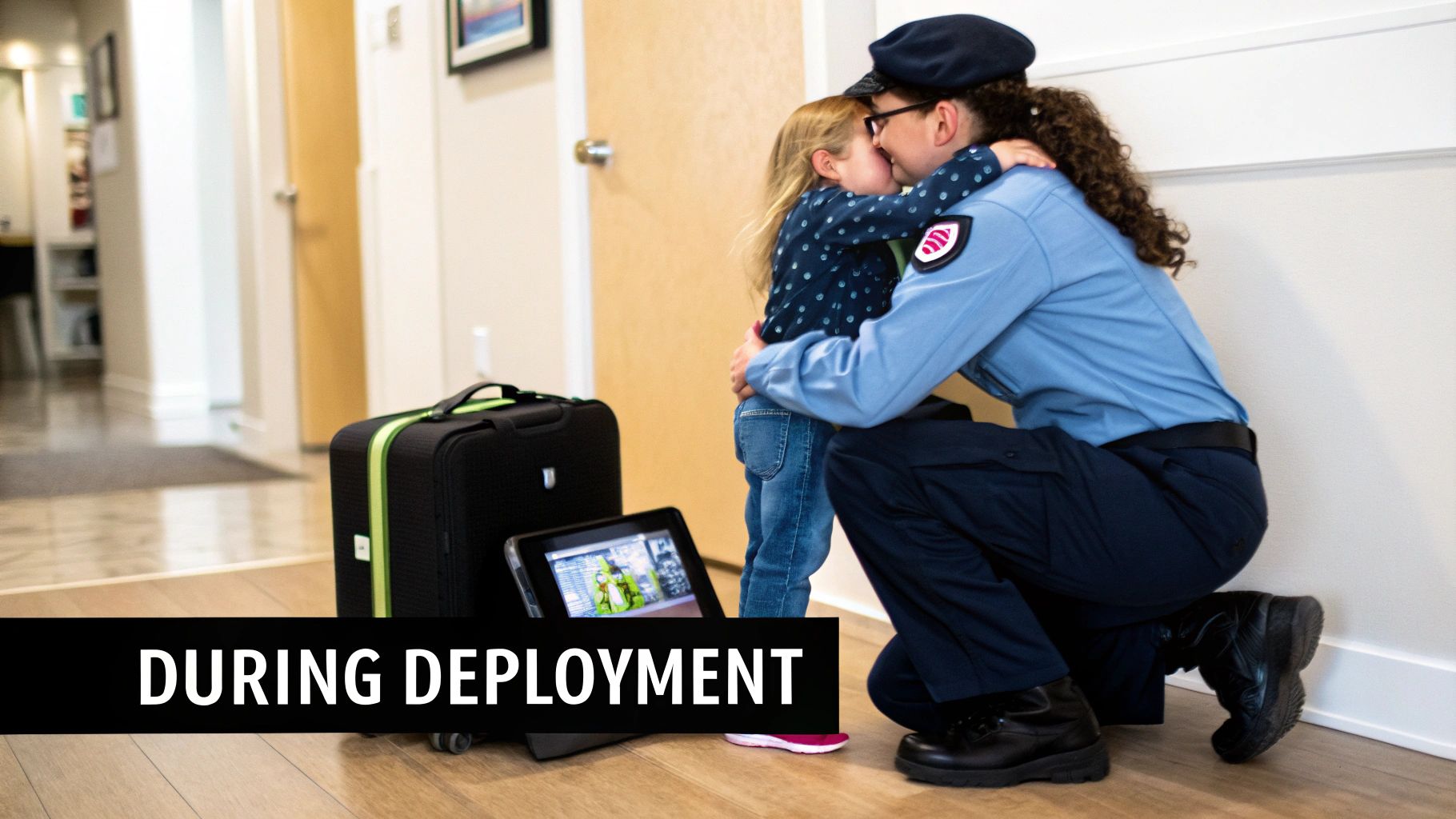
Handling Custody During Deployments
When a parent receives deployment orders, the immediate question is: what happens to the kids? It’s a moment filled with anxiety for both the deploying parent and the parent at home. A standard possession schedule often becomes impossible to follow.
This is where the Texas Family Code offers a powerful solution. Instead of forcing a permanent, life-altering change, the court can issue temporary orders that last only for the duration of the deployment. This approach provides stability for your child while protecting the deploying parent’s fundamental rights.
A key provision in the Texas Family Code states that a parent's military deployment cannot be the sole reason for a court to permanently modify a custody order. This is a critical safeguard that preserves your legal rights while you are away serving our country.
These temporary orders can be creatively structured to serve the best interest of the child. For example, a judge can:
- Designate a family member for visitation: The deploying parent can name a trusted person, like a grandparent or a stepparent, to exercise their possession time while they are gone. This keeps the child connected to their extended family network.
- Create a detailed communication plan: The orders can require regular and frequent video calls, emails, and other forms of contact between the deployed parent and the child, ensuring the bond remains strong.
Once the service member returns home, the temporary orders simply expire, and the original custody arrangement snaps back into place.
Navigating PCS Orders and Relocations
Permanent Change of Station (PCS) orders present a different, but equally complex, challenge. When one parent is ordered to move to a new duty station—often in another state or even another country—the existing parenting plan may no longer work. This situation almost always requires a formal custody modification.
The parent wishing to move with the child must prove to the court that the relocation is in the child’s best interest. A judge will carefully weigh many factors, including:
- The reasons for the move and the opportunities it provides for the child.
- The impact on the child's relationship with the other parent.
- The stability and support system available in the new location.
- Each parent's ability to foster a positive relationship between the child and the other parent.
The emotional toll of these situations is significant. Child custody battles in military divorces are uniquely challenging, and deployment-related stress is a major contributor. In fact, some studies show a 30% increased risk of divorce linked to deployment. Additionally, the mental health of service members, including conditions like post-traumatic stress disorder (PTSD), can become a factor that courts must weigh when making 'best interest' determinations.
If the court approves the move, the next step is creating a new, long-distance possession schedule. We offer more specific guidance on this topic, and you can learn more about military relocation and child custody in our detailed article. This new plan needs to be practical and detailed, covering travel arrangements, holiday schedules, and how technology will be used to keep the non-custodial parent actively involved in the child’s life. With thoughtful planning, you can protect your parental rights and maintain a strong, loving relationship with your child, regardless of geography.
Crafting a Military-Ready Parenting Plan
When your child’s future is on the line, stability is everything. For military families, though, a standard Texas possession order often feels like trying to fit a square peg into a round hole. The realities of deployments, unpredictable training schedules, and sudden relocations just don’t mesh with a cookie-cutter custody schedule.
This is exactly why building a customized, military-ready parenting plan isn't just a good idea—it’s absolutely essential for protecting your parental rights and giving your children the predictability they need to thrive.
Think of your parenting plan as the constitution for your co-parenting relationship. A thoughtfully drafted plan does more than just outline who gets the kids and when. It anticipates future challenges and creates a clear roadmap for how you'll solve them together. This proactive approach can prevent countless arguments down the road, saving you an incredible amount of emotional and financial stress.

From Legal Terms to Practical Tools
In Texas, the court’s entire focus is on creating an arrangement that is in the “best interests of the child.” This is the legal standard that guides every single decision a judge makes. In plain English, it means the court will prioritize whatever outcome best supports your child’s physical and emotional well-being.
Typically, this leads to parents being named Joint Managing Conservators. This legal term simply means that you and your co-parent share the rights and duties of making major decisions for your child—things like education, non-emergency medical care, and psychological treatment.
The possession schedule is the nitty-gritty part of your plan that details the specific days and times each parent will have the children. While a Standard Possession Order works for many Texas families, it’s often far too rigid for military life. Your attorney can help you build a custom schedule that accounts for the unique demands of your service.
Must-Have Provisions for Your Military Parenting Plan
A rock-solid military parenting plan is specific, detailed, and flexible. It should tackle the "what-ifs" head-on, so you aren't left scrambling when new orders come down.
Here are some critical elements every military family should include:
Detailed Deployment Procedures: Your plan must clearly state what happens when a parent deploys. This includes naming a designated person (like a grandparent or stepparent) who can step in to exercise visitation, outlining a plan for the children's care, and specifying the exact process for reinstating the original schedule when the service member returns.
Robust Communication Protocols: How will the deployed parent stay in touch? Your plan needs to require regular, consistent contact through video calls, emails, and phone calls. Get specific about the frequency and who is responsible for making sure the calls happen.
Clear Relocation (PCS) Rules: While a court must approve any major relocation, your parenting plan can set the ground rules. For instance, it can require a specific amount of notice (like 60 or 90 days) before a planned move and outline the steps for modifying the possession schedule. For more information, you can explore our guide on creating a long-distance parenting plan that works.
Flexible Holiday and Vacation Schedules: Your plan should acknowledge that a service member may not be home for every single holiday. It’s smart to include clauses that allow for make-up time or alternate holiday schedules based on when military leave is actually available.
Travel and Transportation Logistics: If parents live far apart, the plan must spell out who is responsible for travel costs, who will fly with the child, and how exchanges will be handled safely and efficiently.
A well-crafted parenting plan is the best tool you have to protect your relationship with your children through the uncertainties of military life. It transforms legal requirements into a practical, day-to-day guide for your family.
By investing the time to create a comprehensive plan now, you are building a foundation of stability for your children. You’re not just preparing for a divorce; you’re planning for a successful co-parenting future, no matter where military service takes you. This foresight helps ensure that both parents remain active, engaged, and central figures in their children’s lives.
Your Next Steps: Protecting Your Family's Future
Navigating a military divorce is tough, there’s no getting around it. But you have specific rights and protections under both Texas and federal law that can bring much-needed clarity and stability to your family’s future. The path forward might look complicated, but remember this: knowledge is your greatest asset right now. With the right legal strategy, you can protect your parental rights and make sure your kids have the support they need to thrive.
The journey really begins with understanding the fundamentals of your case. Taking proactive, informed steps today can prevent a world of confusion and conflict down the road, letting you focus on what truly matters most.
Key Takeaways
As you move forward, keep these critical points in mind. Think of each one as a cornerstone for building a successful strategy in a military divorce and child custody case here in Texas.
- Nail Down Jurisdiction Early: Figure out the correct state for your divorce and custody case based on residency and your child's "home state" under the UCCJEA. Getting this foundational step right prevents frustrating delays and legal battles over where the case should even be heard.
- Know Your SCRA Rights (And Limits): The Servicemembers Civil Relief Act gives you a temporary pause on legal proceedings, not a permanent stop sign. Use it strategically to make sure you can fairly participate in your case, but don't mistake it for a way to avoid the divorce entirely.
- Plan for Deployments Before They Happen: Use temporary orders to manage custody when a service member deploys. This is a smart way to protect the service member's rights while giving the child stability, often by letting a grandparent or stepparent step in for visitation.
- Build a Bulletproof Parenting Plan: A standard Texas possession order just won't cut it for most military families. Your parenting plan has to be customized to handle the realities of military life—think PCS moves, long-distance communication, and unpredictable schedules.
The goal isn't to "win" a battle against your co-parent. It's to build a stable, predictable, and loving environment for your children, even when you're states or countries apart. A thoughtful legal approach is what makes that possible.
You don't have to walk this path alone. The complexities of military family law demand an advocate who gets both the legal landscape and the emotional weight you're carrying.
If you need help with a child custody or visitation case in Texas, our experienced attorneys can guide you every step of the way. Contact The Law Office of Bryan Fagan, PLLC today for a free consultation.
Frequently Asked Questions About Military Custody
When your family is navigating a military divorce, it’s completely normal to feel like you have a million questions. The rules where Texas family law and federal military regulations overlap can feel like a maze, but getting clear answers is the first step toward regaining control. We’ve put together some of the most common questions we hear from military parents right here.
Can a Military Deployment Be Used to Permanently Change Custody?
Absolutely not. This is probably one of the most important protections a service member has. Under the Texas Family Code, your military service can't be the only reason a judge permanently changes your custody arrangement. You won't lose your parental rights just because you were deployed to serve our country.
What happens instead? Courts will issue temporary orders that are only in effect while you're deployed. These orders often let a family member you trust, like a grandparent, step in to handle visitation for you. Once you’re back, the original custody order is usually put right back in place, keeping your rights secure.
How Is Military Retirement Divided in a Texas Divorce?
In Texas, military retirement benefits and pay earned during the marriage are considered community property, which means they’re on the table for division in a divorce. The federal law that gives Texas courts the green light to do this is the Uniformed Services Former Spouses’ Protection Act (USFSPA). It allows state courts to treat disposable retired pay as a marital asset.
The actual division is typically worked out with a formula that looks at how many years your marriage and military service overlapped. It’s critical that your final divorce decree has very precise language to make sure this is calculated correctly. Getting this wrong can have a huge impact on your financial future.
What if My Ex and I Are Stationed in Different States?
This is an incredibly common situation in a military divorce and child custody case. There’s a law called the Uniform Child Custody Jurisdiction and Enforcement Act (UCCJEA) that figures out which state has the legal power to make custody decisions. As a general rule, that authority goes to the child's "home state"—which is wherever they lived for the six months right before the case was filed.
When parents live states apart, the parenting plan has to be rock-solid and detailed. It needs to spell out clear rules for things like:
- Long-distance travel, including who is responsible for the costs.
- Holiday and summer visitation schedules that account for the distance.
- How you’ll use virtual visitation, like video calls, to keep the parent-child bond strong no matter the miles.
If you need help with a child custody or visitation case in Texas, our experienced attorneys can guide you every step of the way. Contact The Law Office of Bryan Fagan, PLLC today for a free consultation.