Skip to content
When your child’s future is on the line, understanding your rights as a father matters most. For unmarried fathers in Texas, this journey begins with a crucial reality: biology alone does not grant you enforceable legal rights. In fact, until you take formal legal action, an unmarried father has no automatic right to custody or visitation, even if your name is on the birth certificate.
This can be a shocking and painful realization for a dedicated dad. But here is the good news: while your rights aren't automatic, they are absolutely achievable. The entire legal process is designed to formalize your role as a parent and give you the legal standing you need to be a consistent, loving presence in your child’s life. You just have to take the first step.
How Texas Law Views Unmarried Fathers
In Texas, the law distinguishes between a biological father and a legal father. While you are, without a doubt, your child’s dad, you don’t have legally recognized rights until a court officially says so. Without a court order establishing your legal rights, the child's mother is considered the sole legal guardian.
This means that until you take formal legal action, you don't have a guaranteed right to:
- Help make important decisions about your child's education or healthcare.
- Prevent the mother from moving out of state with your child.
- Enforce a consistent visitation schedule to see your child.
This legal reality can leave you feeling powerless, as the mother holds all the decision-making authority. This isn't about being adversarial; it’s simply the starting point under the Texas Family Code. The most important thing to understand is that the law provides a clear path forward.
Key Takeaway: Your parental rights aren't automatic, but they are absolutely achievable. The legal process is designed to formalize your role as a parent and give you the same rights and duties as any other parent—but you must be the one to initiate it.
From Biological Parent to Legal Parent
Think of establishing your legal rights like building a house. Establishing paternity is the concrete foundation. Without it, everything else—your time with your child, your say in their life—is built on shaky ground that can change at any moment. By getting a court order, you transform your biological connection into a legally protected relationship with enforceable rights.
This process ensures your involvement in your child's life is a right protected by law, not a privilege granted by the other parent. Throughout this process, the court's main focus is the “best interest of the child,” a legal standard that presumes having two active, involved parents is a good thing. By going to court, you’re showing that you're ready and willing to be that involved parent, legally and emotionally.
The table below breaks down exactly what changes when you take that crucial step.
Legal Rights Before vs After Establishing Paternity
For an unmarried father, the difference between having a court order and not having one is night and day. This table shows the dramatic shift in legal standing once paternity is formally established.
| Parental Right | Status Before Court Order (No Enforceable Rights) | Status After Court Order (Legally Established Rights) |
|---|---|---|
| Possession & Access | No guaranteed visitation; access is at the mother's discretion. | Legally enforceable possession schedule (visitation). |
| Decision-Making | No legal say in medical, educational, or religious upbringing. | Right to participate in major decisions affecting the child. |
| Relocation | No legal power to prevent the mother from moving away with the child. | Can enforce geographic restrictions preventing relocation. |
| Child Support | Can be ordered to pay support without having any rights to see the child. | Obligation to pay support is tied to legally defined parental rights. |
| Emergency Contact | No automatic right to be contacted by schools or hospitals in an emergency. | Legal right to be listed as a parent and receive information. |
| Inheritance | Child may not have automatic inheritance rights from the father. | Child’s inheritance rights are legally secured. |
Securing a court order isn't just about protecting your rights; it's about giving your child the stability and security of having two legally recognized parents in their life.
If you need help with a child custody or visitation case in Texas, our experienced attorneys can guide you every step of the way. Contact The Law Office of Bryan Fagan, PLLC today for a free consultation.
The First Step: How to Establish Paternity in Texas
For an unmarried father, the journey to securing parental rights always starts with one non-negotiable step: establishing legal paternity. Think of it as the key that unlocks the courthouse door. Without it, you can't ask a judge for custody, visitation, or a say in your child's life.
In Texas, simply being the biological father isn't enough to grant you legal rights. You have to take formal action to become your child’s legal father. The good news is, the law provides two clear paths to achieve this.
The Acknowledgment of Paternity (AOP)
The most direct and common method is signing a form called the Acknowledgement of Paternity (AOP). This is a powerful, legally binding document where you and the mother both agree, under penalty of perjury, that you are the child’s biological father.
This is usually done at the hospital right after the child is born. It’s a simple process that accomplishes several important things at once:
- It legally establishes you as the father.
- It allows your name to be placed on the child's birth certificate.
- It's voluntary, fast, and doesn't require an immediate court hearing.
But make no mistake: signing an AOP is a serious legal commitment. Once signed, it carries the same weight as a court order and is incredibly difficult to reverse. Before you sign, you must be 100% certain you are the biological father. If there's any doubt, do not sign. Your best option is to pursue genetic testing through the courts instead. You can learn more by reading our guide on the Acknowledgement of Paternity in Texas.
This flowchart breaks down just how critical a court order is for an unmarried father's rights.
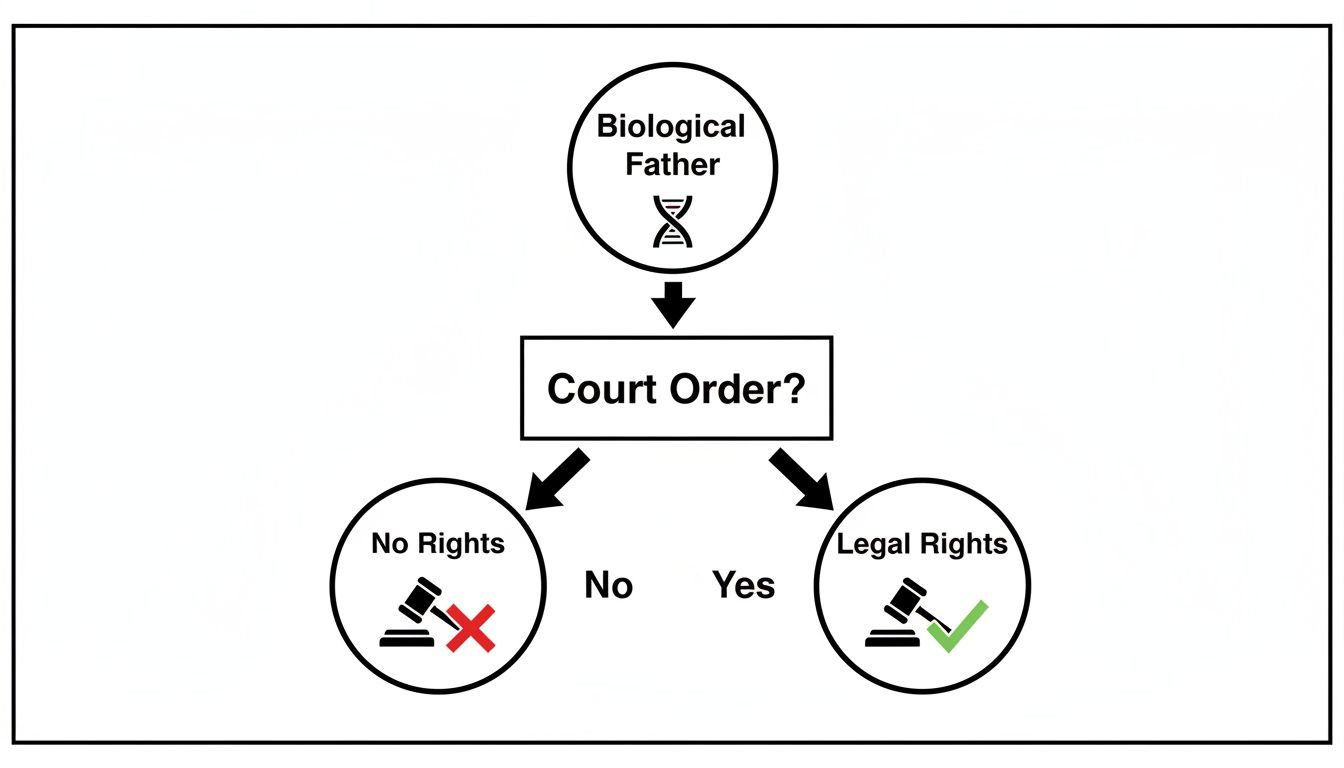
As you can see, being a biological dad is just step one. Only a court order turns that biological connection into legally protected rights you can actually enforce.
Filing a Suit to Adjudicate Parentage
What happens if an AOP was never signed, or if one parent disputes who the father is? In those situations, the path forward is through the court system by filing a Suit to Adjudicate Parentage.
This may sound intimidating, but it is a standard legal action that asks a judge to officially determine the child’s father. The court’s primary goal is to ensure every child has two legal parents, which is crucial for their well-being and access to financial support and health insurance.
A Suit to Adjudicate Parentage isn't just about proving you are the father. It is the legal proceeding where you can also ask the judge to establish custody, visitation schedules, and child support all at the same time, making it an efficient, all-in-one solution.
During this process, the judge will almost certainly order genetic (DNA) testing to get a clear, scientific answer. Once the results confirm you're the father, the judge will issue a formal order that legally establishes your paternity. This court order is the unbreakable foundation for all your parental rights. It's what gives you the legal standing to ask for a possession schedule and a real voice in your child's life.
Whether you go the route of a simple AOP or a formal court case, establishing paternity is the first and most powerful move you can make. It changes your status from an outsider with no legal standing to a recognized parent with enforceable rights.
How Texas Determines Custody: Conservatorship and Possession
Once you’ve legally established paternity, you’ve opened the door to securing your parental rights. But what do those rights actually look like day-to-day? In Texas, this is where a judge issues orders that define your specific roles and responsibilities. This is the moment when the law becomes a real-world plan for your family.
You’ll hear two key legal terms: conservatorship and possession and access. They might sound complicated, but they answer two simple, crucial questions:
- Conservatorship: Who gets to make the big decisions for your child?
- Possession and Access: When does each parent get to have the child?
Understanding these concepts is the first step in advocating for an arrangement that keeps you deeply involved in your child’s life.

What Is Joint Managing Conservatorship?
In Texas, the law starts with a powerful belief: it’s in a child’s best interest to have both parents actively involved in raising them. This principle is so fundamental that courts presume naming both parents as Joint Managing Conservators (JMC) is the right path forward. This is the most common arrangement for both unmarried and divorced parents.
Being a Joint Managing Conservator is like being a co-CEO for your child's upbringing. It means you and the child's mother share the rights and duties of parenthood, giving you both a say in the major decisions that shape your child's future.
These shared rights usually include the power to make decisions about:
- Education: Choosing schools or consenting to educational testing.
- Healthcare: Making non-emergency medical and dental decisions.
- Psychological Care: Agreeing to therapy or other mental health support.
- Religious Upbringing: Guiding your child’s moral and spiritual development.
While most rights are shared, the judge will name one parent as the "primary" conservator. This parent has the exclusive right to decide where the child lives (usually within a certain geographic area) and receives child support. The other parent is the "non-primary" conservator and typically pays child support. For a deeper understanding of these roles, our guide on conservatorship in Texas provides more detail.
Understanding Possession Schedules
While conservatorship is about decision-making, a possession order is the nuts and bolts of your parenting schedule. It’s the calendar that dictates when your child is with you and when they are with their mother. The goal is to create predictability and stability for everyone—especially your child.
For parents who live within 100 miles of each other, Texas courts typically implement the Standard Possession Order (SPO). This schedule is considered to be in the child's best interest because it provides a clear and consistent framework for parenting time.
A Standard Possession Order isn't just a suggestion—it's a legally binding court order. It sets a baseline for parenting time that protects the non-primary parent's access, ensuring they can remain a consistent, active force in their child's life.
A typical SPO for the non-primary parent often includes:
- Possession on the first, third, and fifth weekends of a month.
- Alternating major holidays, like Thanksgiving and Christmas, each year.
- An extended period of possession in the summer, usually 30 days.
This schedule guarantees you substantial, predictable time to build and maintain a strong relationship with your child. It prevents one parent from arbitrarily denying access or using visitation as a bargaining chip.
A judge can always customize a possession schedule based on a family’s unique situation, such as the child's age (different guidelines apply for children under three), parents' work schedules, or distance. However, the SPO is the default for a reason: it’s a proven model that supports countless Texas families. As an unmarried father, getting a court-ordered possession schedule is one of the most important things you can do to turn your hope of seeing your child into a legally protected right.
Your Financial Rights and Responsibilities
Parenting involves significant financial responsibility, and Texas law has clear guidelines for a father’s financial obligations and rights. It’s natural to feel anxious about this topic, but understanding how it works is the best way to ensure your child has a stable, secure future.
The most important thing to remember is this: child support isn't a payment made to the other parent. It's a right that belongs to your child.

This legal framework is designed to provide for your child's needs and applies to both parents. Once you've established paternity as an unmarried father, your financial duties come with important rights that protect you and keep the system fair.
How Texas Calculates Child Support
Many fathers worry that child support is a random number a judge decides on. In Texas, it’s actually a predictable, guideline-based formula. The process is meant to be fair, not punitive.
The court calculates support primarily as a percentage of the non-primary parent’s net monthly resources.
Here is a brief overview of the standard percentages:
- One child: 20% of net resources
- Two children: 25% of net resources
- Three children: 30% of net resources
"Net resources" includes most of your income—salary, commissions, overtime, and self-employment earnings—after deductions like taxes and the child's health insurance premiums. Knowing this formula helps demystify the process. For more information, you can learn how to get child support in our detailed guide.
Your Financial Rights as a Father
Your financial role isn't just about paying. As a legal father, you have specific rights that ensure the system is fair and truly serves your child’s best interests. It’s important to know what these rights are as you navigate your financial responsibilities as an unmarried dad.
You have the right to:
- Ensure a Fair Calculation: You should present evidence of your income and expenses to ensure the calculation is accurate. This includes providing pay stubs and tax returns so the court has a complete picture of your finances.
- Request a Modification: Life changes. If you lose your job, experience a significant pay cut, or have another child, you have the right to ask the court to modify the child support order to reflect your new reality.
- Receive Support: If you are named the primary conservator—meaning the child lives with you most of the time—you have the right to receive child support from the mother to help with raising your child.
- Provide Health Insurance: Often, the parent paying support is also ordered to provide health insurance. This is not just an obligation; it’s a right to ensure your child receives proper medical care, and you receive credit for that expense in support calculations.
- Claim the Child on Taxes: Custody orders can specify which parent has the right to claim the child as a dependent on their federal taxes each year. This is a valuable financial right that can be negotiated or ordered by the judge.
Your financial role is a huge part of being an involved, dedicated parent. Understanding both your rights and responsibilities helps you make sure your child is supported while also protecting your own financial stability.
Ultimately, these financial matters are about providing security for your child. A court order makes everyone’s role clear, eliminates uncertainty, and allows both parents to focus on what matters most: raising a happy, healthy child.
Navigating Complex Custody Situations
Family life rarely follows a simple script. For unmarried fathers who have already worked hard to secure their legal rights, a sudden change can feel deeply unsettling. It’s in those high-stakes moments—like when your child's mother wants to relocate or a military deployment looms—that a solid court order becomes your strongest ally.
Let’s walk through some of the most challenging situations unmarried fathers face. Knowing your rights here is about protecting the relationship you’ve fought to build with your child.
What Happens When the Mother Wants to Relocate
One of the greatest fears for any involved father is the thought of their child moving far away. That's why most Texas custody orders include a geographic restriction. This is a legal boundary that prevents the primary parent from moving the child's residence outside a specific area, usually the county where the order was issued and its surrounding counties.
If the mother is the primary parent and wants to move with your child outside this approved zone, she can’t just pack up and leave. She either needs your written agreement or she must get a judge's permission.
If you don't agree to the move, she must file a lawsuit to modify the custody order. Her responsibility is to convince the court that uprooting your child is in their best interest. A judge will consider many factors, including:
- The reason for the move (e.g., a better job, family support).
- How the move would impact your relationship with your child.
- Whether a realistic new visitation schedule can be created that still allows for meaningful time together.
That geographic restriction is a vital part of your custody order. It is the legal anchor that prevents one parent from unilaterally deciding to move your child away and ensures your role as a father is respected.
Special Protections for Military Fathers
Serving in the military adds another layer of complexity to parenting. Deployments and reassignments can make following a standard possession schedule impossible. The good news is, the Texas Family Code includes specific rules to protect military parents.
If your military duties prevent you from exercising your scheduled time with your child, you don’t automatically lose that time. The law gives you the right to designate a competent adult—often a grandparent, your current spouse, or another trusted relative—to have possession of your child on your behalf while you're away.
This is a powerful tool for keeping family ties strong. It ensures that even when you're serving our country, your child can still spend quality time with their paternal family, reinforcing those crucial bonds until you’re back home.
Emergency Situations and Protective Orders
Sometimes, a crisis occurs, and you have a legitimate reason to believe your child is in immediate physical or emotional danger. In these critical moments, you cannot afford to wait weeks for a standard court hearing. This is why the law allows you to seek a Temporary Restraining Order (TRO).
A TRO is an emergency court order a judge can grant almost immediately to protect a child from harm. It can establish instant rules, restricting the other parent's actions and access to the child until a full hearing can be held. For example, a TRO could prevent a parent from removing a child from school or making reckless decisions that put them at risk.
Filing for a TRO is a serious step, reserved for true emergencies where a child's welfare is at stake. It’s a legal lifeline designed to provide immediate safety and stability during a crisis. It's important to remember that custody disputes can be tough on children. Understanding the potential impact of divorce on a child's mental health is vital. Your first priority is to act quickly to keep your child safe, and the law provides a direct way to do that.
Your Action Plan for Securing Parental Rights
Throughout this guide, we’ve emphasized a critical truth for Texas fathers: your parental rights aren’t automatic—they have to be legally established. While the law requires you to take action, it also provides a clear and achievable path to securing your role in your child’s life. Feeling empowered starts with having a solid plan.
Think of this as your roadmap to turning your biological connection into a legally protected relationship. The journey begins with a firm understanding of the core principles we’ve covered.
Key Takeaways for Unmarried Fathers
Let's quickly recap the foundational concepts every unmarried father in Texas needs to know. Understanding these will give you the confidence to move forward.
- Paternity is Job Number One: This is the absolute first step. Without a court order or a signed Acknowledgement of Paternity, you have zero enforceable rights to custody or visitation.
- Court Orders Are Your Armor: A formal court order is the only thing that makes your rights to see your child and be part of their life legally binding. It is your shield against being shut out and gives your child the stability they need.
- Joint Conservatorship is the Goal: Texas law starts with the strong belief that having both parents involved is in a child's best interest. Aiming for Joint Managing Conservatorship is the standard and the best way to ensure you have a voice in major decisions.
Next Steps
Knowing your rights is one thing; taking action is another. Here’s what to do next to get the process started and protect that irreplaceable relationship with your child.
- Gather Your Documents: Start collecting essential paperwork. This includes your child’s birth certificate, any Acknowledgement of Paternity (AOP) you may have signed, recent pay stubs for child support calculations, and any proof of your involvement in your child's life—photos, receipts for diapers or formula, or anything that shows you’ve been an active parent.
- Understand the Legal Process: The path forward involves filing a petition with the court, officially notifying the other parent, and likely attending mediation before a final hearing with a judge. Knowing what to expect can reduce stress and help you prepare. As you develop your plan, considering options like affordable paralegal services can help manage legal costs effectively.
- Seek Experienced Legal Counsel: This is the most critical step. The Texas Family Code is complex, and navigating it alone can be risky. An experienced family law attorney can advocate for your rights, ensure all documents are filed correctly, and build the strongest possible case for the outcome you and your child deserve.
You don’t have to figure this out on your own. Taking these deliberate steps will put you on the path to securing the stable, loving relationship you and your child deserve.
If you need help with a child custody or visitation case in Texas, our experienced attorneys can guide you every step of the way. Contact The Law Office of Bryan Fagan, PLLC today for a free consultation.
Unmarried Fathers: Your Most Pressing Questions Answered
When you’re fighting for your child, the questions can feel overwhelming. You are not alone in feeling this way. Here are straightforward answers to the questions we hear most often from unmarried fathers in Texas.
Does Being on the Birth Certificate Give Me Rights?
No. This is one of the most common and dangerous myths for unmarried fathers in Texas. Having your name on the birth certificate by signing an Acknowledgement of Paternity (AOP) makes you the child's legal father, but it does not grant you any enforceable rights on its own.
To gain legally protected time with your child (possession) and the right to have a say in their life (conservatorship), you must obtain a formal court order. Until a judge signs that order, the mother legally has sole custody and can make all decisions without your input.
Can My Child's Mother Move Away Without My Permission?
If you do not have a court order, then yes, in most cases, she can. This is a significant vulnerability for unmarried dads who have not secured their rights. Without a court order, she could decide to move across Texas—or even out of state—and you would have almost no legal power to stop her.
This is exactly why obtaining a custody order is so important. A standard Texas custody order almost always includes a geographic restriction. This legal boundary prevents either parent from moving the child’s residence out of a specific area (like the county and its surrounding counties) without the other parent's written consent or a judge's permission. It’s a critical protection for your relationship with your child.
A geographic restriction is the legal anchor that ensures your child stays close, allowing you to remain a consistent, hands-on parent. Without it, your ability to see your child is left completely unprotected.
What if I Pay Child Support Without a Court Order?
Voluntarily making payments to support your child is the right thing to do and demonstrates your responsibility as a father. However, from a legal perspective, it provides you with zero protection and zero parental rights.
In the eyes of Texas law, those payments are often considered "gifts" and may not be credited toward any future child support a judge orders. More importantly, paying support does not grant you the right to see your child. The mother can accept your money and still legally refuse to allow you to see your child.
The only way to connect your rights and responsibilities is through a formal court order. A judge’s order ensures your financial support is properly credited and establishes an enforceable visitation schedule, creating a clear, stable, and fair plan for everyone involved.
If you need help with a child custody or visitation case in Texas, our experienced attorneys can guide you every step of the way. Contact The Law Office of Bryan Fagan, PLLC today for a free consultation.