
When your child's future is on the line, understanding your rights matters most. For military families in Texas, a Permanent Change of Station (PCS) can throw a grenade into your child custody arrangements, creating immense uncertainty and stress. This guide is for you—we're going to walk through the complexities of military relocation and child custody under Texas law, step-by-step.
Serving Your Country and Protecting Your Family

The call to duty is an honor, but it brings parenting challenges that most civilians will never face. When those military orders come down requiring you to move, it can feel like your service is directly at odds with your role as a parent, especially when a child custody order is in the mix. We understand the unique pressures you're under.
Our goal here is to empower you with the knowledge to handle this process, protect your parental rights, and build a stable, loving future for your children, no matter where your service takes you.
Understanding the Emotional and Legal Hurdles
Relocating as a military parent isn't just a logistical puzzle; it's an emotional minefield for everyone. Your child might be terrified of leaving friends and the only home they've known. The other parent might be panicked about losing precious time with them. It's normal to feel a mix of duty, anxiety, and concern for your family's well-being.
From a legal standpoint, you can't just pack up and move with your child. Texas courts prioritize stability for children, which means you'll need a formal modification of your existing custody order. This process ensures any changes serve the "best interest of the child," the legal standard that guides every single custody decision in Texas. In plain English, this means a judge's primary focus is on what is best for your child's well-being, not the wishes of either parent.
Key Considerations for Your Military Move
As you prepare for a potential relocation, thinking ahead is your greatest advantage. While service members have to juggle unique challenges like frequent moves and arranging for military vehicle transport needs, you also need to get your legal ducks in a row.
Start by asking these practical questions:
- Your Current Custody Order: Does it have a geographic restriction that limits where your child can live? Most Texas custody orders do, often confining the child's primary residence to a specific county or surrounding counties.
- The Other Parent's Position: Are they likely to agree to the move, or are you preparing for a court hearing? Open communication can sometimes lead to an agreement, which is always the simplest path.
- Creating a New Parenting Plan: How will you ensure your child maintains a strong, healthy relationship with the other parent from a distance? Think about travel costs, video calls, and extended summer visitation.
This guide will translate the dense legal jargon into clear, actionable steps. We'll cover everything from which court has authority (jurisdiction) and how to modify an order to the specific legal protections for service members, making sure you feel confident and prepared for the road ahead.
Understanding Jurisdiction in Military Custody Cases
Before any court can make a decision about your child, it first has to have the legal authority to hear your case. This authority is called jurisdiction, and for military families who move every few years, it's a critical first step. Think of it as a sports team’s home field—it's the one place where the official rules apply and the game is actually played.
Getting this right is the foundation of your entire custody case. If you file in the wrong state, your case could be dismissed, costing you precious time, money, and momentum. For military families, where one parent might be at Fort Cavazos while the other is stationed in California or even overseas, the question of which court has power is everything.
The Home State Rule Under the UCCJEA
To create consistency from state to state, Texas and nearly every other state follow a law called the Uniform Child Custody Jurisdiction and Enforcement Act (UCCJEA). This law establishes a clear pecking order for which state gets to decide a custody matter, and its main tool is the "home state" rule.
A child's home state is the state where they have lived with a parent for at least six consecutive months immediately before a custody case is filed. If your child is younger than six months old, the home state is wherever they have lived since birth.
Key Takeaway: The UCCJEA is designed to prevent "forum shopping," where a parent might try to find a court in a state they believe will be more favorable to them. The home state rule ensures the court that knows the most about your child's life is the one making the decisions.
Once a Texas court establishes jurisdiction, it generally keeps it, even if a parent later moves away. This provides much-needed stability for your child by preventing the case from bouncing between states with every new set of orders. If a move is on the horizon, understanding how to manage child custody across state lines is a critical piece of the puzzle.
How Military Life Complicates Jurisdiction
Military families move on average every two to three years, which can make applying the UCCJEA’s six-month rule tricky, especially when parents separate right after a PCS move. The frequent changes can blur the lines, making it hard to say which state truly counts as "home."
For instance, what happens if a family gets PCS orders from Texas to a base in Virginia, and the parents decide to split up a few months after arriving? The child hasn't lived in Virginia long enough to meet the six-month requirement. In that scenario, Texas might still have jurisdiction as the last established home state.
These situations can become complex quickly. It’s essential to act promptly to get a clear ruling on jurisdiction. A court will look closely at where your child has lived and their significant connections to a state to make a final call. From the very beginning, protecting your parental rights starts with making sure your case is heard in the right courtroom.
How Texas Determines Custody: The "Best Interest of the Child" Standard
When your child's future is on the line, you need to know exactly how a judge will view your situation. If you have military orders to move and need to take your child with you, a Texas judge's decision boils down to one powerful principle: the best interest of the child. This isn't just a vague idea; it's the legal cornerstone of every custody case in the state, outlined in the Texas Family Code.
This standard means the court's main focus isn't on your wishes, your ex's wishes, or even the military's needs. Instead, the judge must weigh a specific set of factors to determine if the proposed move would genuinely benefit your child's emotional, developmental, and physical well-being. Proving this is the key to a successful modification, whether you're the parent with the orders or the one hoping to keep the child in Texas.

The Holley Factors: What Judges Actually Consider
So, how does a judge determine what's really in a child's best interest? They don't just guess. Texas courts use a list of considerations known as the "Holley Factors." These factors come from a landmark Texas Supreme Court case and give judges a framework for making these life-altering decisions.
While a court can look at anything relevant, these are the main factors:
- The child's emotional and physical needs, both now and in the future.
- Any emotional or physical danger the child might face.
- Each parent's ability to provide a stable home and meet the child's needs. This is what Texas law calls conservatorship. In most cases, parents are named Joint Managing Conservators, meaning they share the rights and responsibilities of parenting.
- The stability of the proposed new home environment.
- The plans and resources available for the child in the new city (schools, activities, on-base support).
- The child's own wishes, if they are old enough to express a preference (usually age 12 or older).
- Acts or omissions by a parent that might indicate an unhealthy parent-child relationship.
For a military relocation, you must present concrete evidence that speaks directly to these factors. For example, the parent looking to move should be ready to show the court the quality of schools near the new duty station, the support systems available on base, and a real plan for how the child will thrive—not just survive—in the new location.
Key Factors in a Texas Relocation Case
| Factor (The Child's Best Interest) | What the Court Considers for a Military Relocation |
|---|---|
| Child's Needs (Emotional & Physical) | How will the move impact the child's current routine, friendships, and sense of stability? Does the new location offer better resources for any special needs? |
| Potential Danger | Is the non-moving parent a source of stability, or does their environment pose a risk? Conversely, does the new location present any new dangers? |
| Parenting Abilities | How has each parent supported the child's well-being? The moving parent must show they can handle parenting challenges in a new place. |
| Stability of New Home | The moving parent needs to present a solid plan: details about housing, childcare, schools, and the community support available at the new base. |
| Plans & Resources in New Location | Evidence is key. Think school ratings, information on youth programs, proximity to family, and medical facilities. |
| Child's Wishes | If the child is over 12, their preference will be heard. A judge will want to know why they want to move or stay, looking for maturity, not parental influence. |
| Parental Acts or Omissions | Has one parent tried to alienate the child from the other? Has the moving parent been the primary caregiver and consistently involved? |
Ultimately, the court is trying to paint a complete picture of the child's life—before and after the proposed move. The more detailed and compelling your evidence is for each of these factors, the stronger your case will be.
Building Your Case for the Child's Best Interest
Whether you're the service member with PCS orders or the parent staying behind, your entire argument must revolve around your child. Simply walking into court and saying, "The military is making me move," is a losing strategy. It is not enough.
A judge needs to see how the move itself is a positive step for the child, not just a logistical requirement for your career. This means demonstrating a clear, tangible benefit to their quality of life.
To build a persuasive case, focus on concrete evidence. The moving parent should gather everything from brochures about the new community and photos of potential homes to research on educational opportunities. On the other side, the non-moving parent should be prepared to highlight the child's deep roots in their current community—strong relationships with grandparents, cousins, friends, and their school.
Relocation Is Never a Guarantee
It's a common and dangerous misconception that courts will automatically approve a move just because it's required by military orders. The reality is, these cases are tough. Really tough.
In fact, studies show that the success rate for relocation cases in family law is just over 50 percent. That means nearly half of all parents who ask a court for permission to move with their child are told no. And courts are even more hesitant when parents share a more equal possession schedule (the legal term for visitation time). You can learn more about these relocation case findings and see for yourself why a solid legal strategy is non-negotiable.
At the end of the day, the court's job is to create an outcome that best supports the child's stability and happiness. This requires a thoughtful presentation of the facts and a relentless focus on the child's needs above all else.
Legal Protections for Deployed Service Members
When you get deployment orders, the last thing you should have to worry about is whether your parental rights are secure back home. Deployment is one of the toughest challenges a military parent can face, but it's crucial to know that specific federal and state laws are in place to protect your rights while you serve.
These safeguards exist to stop permanent, life-altering custody decisions from being made just because you are unavailable to appear in court. Your service to our country should never put your fundamental role as a parent at risk, and thankfully, the law agrees.
The Servicemembers Civil Relief Act (SCRA)
The most powerful shield for a deployed service member facing a custody hearing is the Servicemembers Civil Relief Act (SCRA). This is a federal law specifically designed to protect active-duty military members from certain legal and financial challenges so you can focus on your mission.
In a child custody situation, the SCRA allows you to request a "stay," which is a legal term for a temporary pause on any court proceedings. If your military duties materially affect your ability to participate in your case—and deployment absolutely does—you can request an automatic stay for at least 90 days.
A judge can grant even longer delays, but that initial pause is critical. It gives you the breathing room you need to connect with an attorney and figure out your next steps without the immediate threat of a default judgment being entered against you while you're away.
This isn’t a way to avoid the custody issue forever. What it does is ensure the legal process waits for you, guaranteeing your voice will be heard when you are actually able to participate.
The Uniform Deployed Parents Custody and Visitation Act (UDPCVA)
While the SCRA hits the pause button, other laws address the actual custody arrangements during your deployment. Many states, including Texas, have adopted rules similar to the Uniform Deployed Parents Custody and Visitation Act (UDPCVA). This model law provides a clear, common-sense framework for handling custody when a parent deploys.
The core ideas behind the UDPCVA are all about creating stability and predictability for your child:
- Temporary Orders: Any custody order created because of a deployment is strictly temporary. It is designed to last only for the duration of the deployment and automatically ends when you return.
- No Prejudice: A judge cannot use your deployment as the sole reason to permanently change custody later on. Your service-related absence cannot be held against you.
- Delegated Visitation: In many situations, you can delegate your possession time to a trusted family member, like a grandparent or stepparent. This helps maintain crucial family bonds while you’re gone.
These protections ensure the other parent can't use your deployment as an opportunity to permanently rewrite the custody arrangement in their favor. The focus stays where it should be: on creating a temporary, workable solution that serves the child’s best interests until you’re home. Planning ahead by creating a long-distance parenting plan before you deploy can give everyone involved a clear roadmap to follow.
Steps to Modify a Custody Order for a Military Move
When the military hands you Permanent Change of Station (PCS) orders, it sets off a chain reaction that goes far beyond packing. For service members with children, it means you must formally modify your Texas child custody order. You can’t just pack up and move with your child, especially if your current decree includes a geographic restriction. You must go through the court.
Think of it as getting official permission not just from the military, but from the legal system, to start this new chapter with your child. It’s a manageable process, but it requires clearing two specific legal hurdles. Getting this right is the only way to ensure your move is on solid legal ground and protects your child’s stability.
The Two Pillars of a Custody Modification
To get a Texas court to approve a relocation, you must prove two fundamental things. First, you must show there’s been a “material and substantial change in circumstances” since your last custody order was signed. Receiving official PCS orders is a textbook example of this. It’s a clear, undeniable shift in your life circumstances.
Second, and most importantly, you have to prove that changing the order to allow the move is in your “child's best interest.” This is the gold standard for every decision a judge makes in a family law case. It’s not about what’s best for you or the other parent; it’s about showing how this move will benefit your child’s life.
As you plan, it's also important to understand the specific protections available to you as a service member, particularly around deployments, which can happen before or after a PCS.
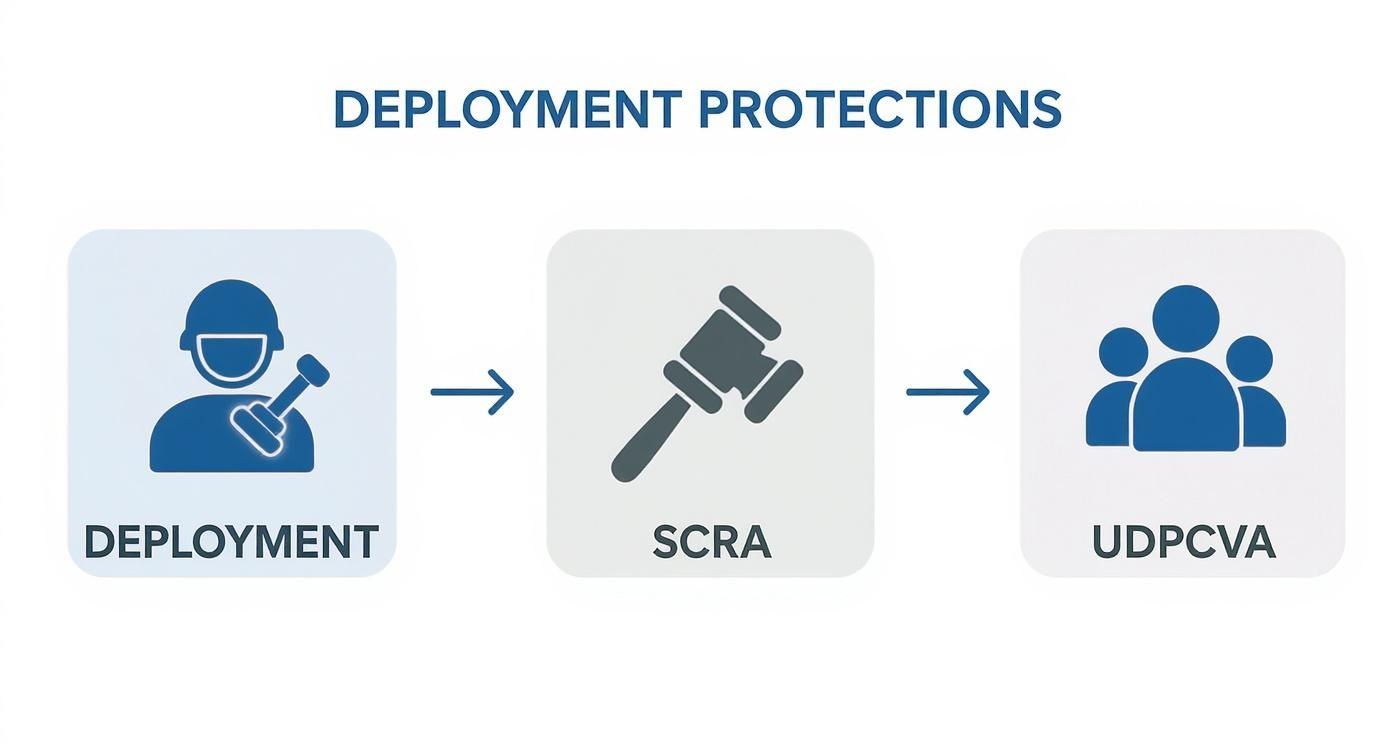
This flowchart shows how laws like the SCRA and UDPCVA create a legal safety net, ensuring that a parent's service-related absence doesn't automatically put their custody rights at risk. The key differences between a standard civilian move-away case and a military one are significant enough that it's worth seeing them side-by-side.
Military vs Civilian Relocation Requests
| Consideration | Civilian Relocation | Military Relocation (PCS) |
|---|---|---|
| Reason for Moving | Often voluntary (new job, family support). The court will scrutinize the parent's motives. | Involuntary and based on official military orders. The reason for the move is non-negotiable, which courts understand. |
| Urgency and Timeline | The parent controls the timing. The process can be more flexible. | Driven by strict military deadlines. There is a fixed "report-by" date that puts pressure on the legal process. |
| Support System | Must be proven from scratch (e.g., family nearby, new community resources). | Often includes built-in support like on-base housing, healthcare (TRICARE), schools, and a strong military community. |
| Financial Stability | The parent must prove the new job or financial situation is stable and beneficial. | The service member's employment, housing allowance (BAH), and benefits are guaranteed and stable. |
| Child's Best Interest | Focuses heavily on whether the move truly benefits the child more than staying put. | The focus shifts to how the military parent will facilitate a long-distance relationship and leverage military resources for the child. |
While both parents must prove the move is in the child's best interest, a military parent starts with a stronger, more structured foundation due to the nature of their service. The court's focus is less on "why" you're moving and more on "how" you'll make it work for your child.
Practical Steps in the Modification Process
Once those PCS orders are in your hand, the clock starts ticking. Your first move is to file a Petition to Modify the Parent-Child Relationship with the same court that issued your original custody order. This document officially gets the ball rolling, letting the court and the other parent know you are requesting to move with your child.
From that point on, your job is to build a rock-solid case. You need to gather compelling evidence that paints a clear picture of why this move is a great opportunity for your child.
This isn't just about listing facts; it's about telling a story. Key pieces of evidence usually include:
- School Information: Don’t just name the school. Provide rankings, program details, and information on extracurriculars that match your child's interests. Show the court you've done your homework.
- Community and Support: Highlight the resources available. Talk about the family-friendly community, youth centers on base, and any family or friends you’ll have at the new duty station.
- A New Possession Schedule: This is critical. You need to propose a detailed, realistic long-distance possession schedule. Show the judge you’re committed to fostering a strong bond between your child and the other parent. This often means offering the other parent most of the summer, spring break, and alternating major holidays.
Winning a modification case isn’t about defeating the other parent. It’s about presenting a thoughtful, well-researched plan that shows a judge you have put your child’s future first. For a deeper dive into the strategies that work, you can learn how to win a custody modification case in our in-depth article.
Key Takeaways and Next Steps
Juggling a military relocation and a child custody order can feel overwhelming. But you have clear rights, established legal procedures to follow, and a network of support. This journey takes patience and a solid game plan, but you do not have to do it alone.
Every decision a Texas court makes boils down to one guiding principle: the best interest of the child. Your entire strategy—whether you're the one moving or the one staying—must be built around proving how your position gives your child stability, security, and well-being.
The Bedrock Principles to Remember
For military parents, there are specific legal shields in place designed to protect your parental rights from being compromised by your service.
- Jurisdiction is Everything: The Uniform Child Custody Jurisdiction and Enforcement Act (UCCJEA) is the rulebook that decides which state gets to make the call, which is a game-changer for families on the move.
- Federal Law Has Your Back: The Servicemembers Civil Relief Act (SCRA) can pause legal proceedings when you're deployed, making sure crucial decisions aren't made without you.
- Modification Is Mandatory: Getting a Permanent Change of Station (PCS) is a legitimate reason to change your custody order, but you must go through the official court process to make it legal.
Your service to this country is a profound sacrifice. It should never cost you the relationship with your child. Both Texas and federal laws acknowledge the unique pressures of military life and have built a framework to protect your family.
Your Most Important Next Step
While this guide gives you a solid foundation and a map of the legal landscape, no two military families have the exact same story. The specifics of your orders, your current possession schedule, and your relationship with your co-parent will all shape the path forward.
That's why your single most important next step is to get personalized legal advice from someone who understands this specific intersection of family and military law. A skilled family law attorney can look at your unique situation, lay out your real-world options, and help you build a strategy to protect your child and your rights as a parent.
If you need help with a military-related child custody or visitation case in Texas, our experienced attorneys are ready to guide you every step of the way. Contact The Law Office of Bryan Fagan, PLLC today for a free consultation.
Got Questions? We've Got Answers: Military Custody FAQs
When you're dealing with a military move and a custody order, your mind is probably racing with questions. It's a stressful time, and getting clear, straightforward answers is the first step to feeling in control. Here are some of the most common questions we hear from military parents in Texas.
Can my ex-spouse prevent my military relocation with our child?
No, your ex-spouse can't simply veto your military orders. However, they can challenge the child's relocation in court.
Almost all Texas custody orders contain a geographic restriction, which limits where you can move with your child. To move outside that designated area, you have to get a judge's permission. The court’s only concern is the best interest of the child. You'll need to build a strong case showing why the move is good for your child and how you'll ensure they maintain a strong, meaningful relationship with the parent staying behind.
What happens to my possession schedule after a PCS move?
If a judge approves your out-of-state move, your old visitation schedule will be replaced. It’s simply not practical anymore. The court will create a new long-distance plan that prioritizes quality time over frequent, short visits.
A possession schedule is the part of your custody order that details when each parent has the children. For long-distance situations, this typically means the non-moving parent gets longer, uninterrupted stretches of time. Common arrangements include:
- The entire summer break, except for a week or two for the moving parent.
- Every spring break, or alternating years.
- Alternating major holidays like Thanksgiving and Christmas each year.
The new order must also be very specific about travel logistics, clearly spelling out who buys plane tickets, who accompanies the child, and how travel costs are split.
Do I still have to pay child support while deployed?
Yes, absolutely. Your legal duty to pay child support does not stop just because you're deployed. In Texas, all military pay—including special or hazardous duty pay you earn overseas—is considered income for child support calculations.
If your income changes significantly during deployment (either up or down), you may be able to request a temporary modification of the support amount. However, this is not automatic. You must formally file a request with the court. Failing to pay can trigger serious penalties. It’s critical to keep making your full, on-time payments unless a judge officially changes the amount.
If you need help with a child custody or visitation case in Texas, our experienced attorneys can guide you every step of the way. Contact The Law Office of Bryan Fagan, PLLC today for a free consultation.