
When your child’s future is on the line, the hardest part is often realizing that the old court order no longer fits your child’s real life.
Maybe your child now needs counseling, tutoring, or medical care that the current arrangement doesn’t support. Maybe your work schedule changed. Maybe the other parent moved, stopped following the order, or left most of the day-to-day parenting to someone else. What felt workable when the order was signed may now feel unstable, confusing, or unfair to your child.
That doesn’t automatically mean you need a courtroom fight. In many Texas families, modifying primary conservatorship texas is about bringing the legal paperwork back in line with what your child needs now. Texas law allows that. It also places real limits on when a judge will change a custody order, because children need consistency as much as they need protection.
When Your Child's Circumstances Change Your Custody Order Can Too
In Texas, the parent with the exclusive right to designate the child’s primary residence is often called the primary conservator. In plain English, that usually means the parent who decides where the child lives most of the time, subject to any geographic restriction in the order.
That role matters because it affects school enrollment, day-to-day structure, and often child support. A request to change primary conservatorship is serious. Judges treat it that way because changing a child’s main home affects nearly every part of that child’s life.

A modification is about fit, not blame
Parents often come in feeling guilty for wanting change. Others feel angry and want the court to “fix” the other parent. Neither emotion decides the case.
A modification is the legal process for changing an existing custody order when life has changed enough that the old order no longer serves the child well. The court’s focus stays on one question above all others: What arrangement best supports this child now?
Practical rule: If the current order creates repeated problems for school, health care, safety, or stability, it may be time to look at modification instead of relying on informal side agreements.
Informal changes can work for a weekend swap. They usually fail when the issue is ongoing. If the child is effectively living under a different routine than the signed order, you may be exposed to enforcement problems, school confusion, or conflict over medical decisions.
Parents and caregivers need a realistic view
Mothers and fathers often ask the same thing in different words: “Can I change custody because things are no longer working?” Sometimes the answer is yes. Sometimes the better answer is to modify possession, decision-making rights, or support instead of primary conservatorship.
Grandparents and other caregivers sometimes step into a child’s daily life in a big way too. But changing primary custody in Texas is not simple just because another adult has been helping. Courts want proof, structure, and a child-focused reason for making a major change.
Here’s the bigger point. The law is cautious for a reason. Children need stable homes, predictable possession schedules, and adults who solve problems without pulling them into conflict. When you approach a modification with that mindset, you’re already speaking the language the court cares about.
What Qualifies as a Material and Substantial Change
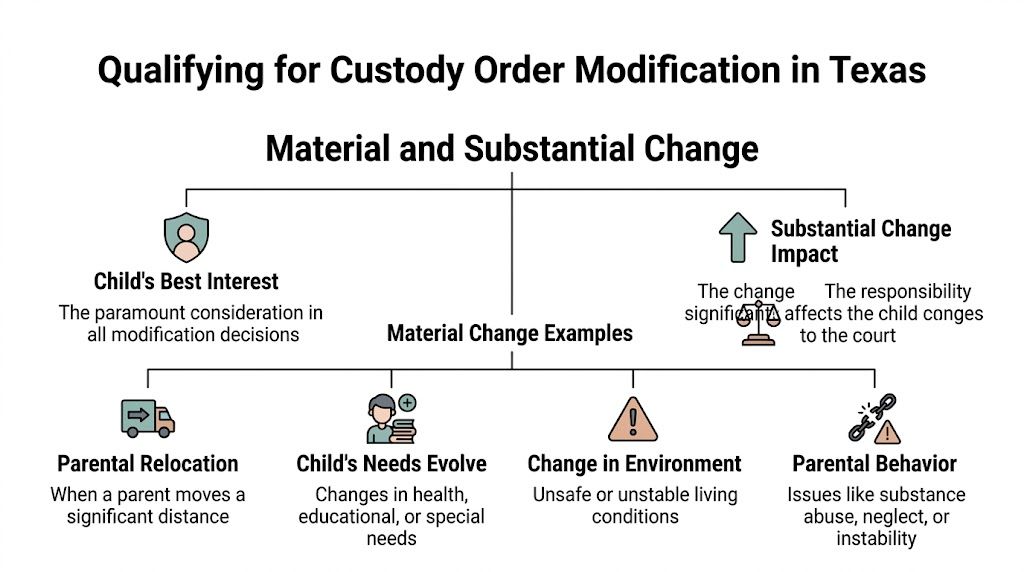
Texas courts don’t change primary conservatorship just because one parent is frustrated. The legal phrase you’ll hear is material and substantial change in circumstances. Under Texas Family Code § 156.101, that is the basis for nearly all petitions to modify conservatorship, unless a different statutory path applies, such as a child age 12 or older expressing a preference to the judge for who should have the right to designate primary residence, as discussed in this overview of Texas modification standards under Section 156.101.
What that phrase means in plain English
A change is “material and substantial” when it meaningfully affects the child or the way the current order works. It must be more than annoyance, more than ordinary life, and more than a parent wanting a better deal.
Some changes that may support a modification include:
- Relocation problems: A move that disrupts school, exchange logistics, family support, or the child’s access to the other parent.
- Evolving child needs: A child develops medical, educational, or emotional needs that require more reliable decision-making or a different home base.
- Long-term schedule shifts: A parent’s job changes in a way that directly affects the child’s routine, supervision, or attendance.
- Care has functionally changed: The parent named primary in the order is no longer providing most of the day-to-day care.
Some changes usually don’t carry much weight by themselves. A new relationship, hurt feelings, normal growing pains, or a general belief that your home is “better” will not usually persuade a judge without proof of impact on the child.
Best interest of the child is the real target
Even if you prove changed circumstances, that alone isn’t enough. The court still has to find that the requested change is in the best interest of the child.
That phrase can sound vague, but judges look for common-sense signs of stability and safety. They often pay close attention to issues like:
| Concern the court weighs | Why it matters |
|---|---|
| Emotional and physical needs | The child needs a home that supports daily care, education, health, and development |
| Stability of each home | Judges look for routine, supervision, consistency, and dependable caregiving |
| Parental judgment | The court notices which parent makes child-focused decisions and which parent creates avoidable conflict |
| Ability to meet special needs | If a child needs therapy, medication, or academic support, the court wants a workable plan |
| Safety concerns | Evidence of neglect, instability, substance issues, or dangerous living conditions carries weight |
A good modification case connects the change in circumstances to these child-centered concerns. That’s where many petitions fail. The parent tells the court what changed, but not why the child needs the order changed because of it.
Judges don’t modify custody to reward one parent or punish the other. They modify it when the evidence shows the child will be better protected or better supported by a new arrangement.
If your child is 12 or older
Texas law gives children 12 or older a limited voice. They may express to the judge which parent they prefer to have the right to designate primary residence. That can provide an alternative legal basis for modification under the statute linked above.
Parents need to handle this carefully. A child’s preference is not a veto, and it is not a final decision. Judges still look at maturity, reasons for the preference, and whether the requested change serves the child’s best interest.
The one-year rule is stricter
If you’re trying to change who has the right to designate primary residence within one year of the final order, Texas law imposes a higher barrier. The filing must include an affidavit with facts showing one of the limited statutory grounds, such as danger to the child’s physical health or significant impairment to emotional development, voluntary relinquishment of care for the required period, or a qualifying preference by a child age 12 or older, all subject to the child’s best interest, as summarized in this discussion of substantial change in Texas custody cases.
That higher standard catches many parents off guard. They assume the court will revisit the order based on general unhappiness. Usually it won’t. The law favors stability unless the facts show something more serious.
What works and what doesn't
What works is documentation, a child-focused explanation, and a request specific to the actual problem.
What doesn’t work is filing because communication is poor, because a parent got remarried, or because the child says one house has fewer rules. If your concern is really about school pick-ups, summer scheduling, or medical decision-making, the right solution may be narrower than changing primary conservatorship.
Navigating the Court Process to Change Your Custody Order
A custody modification case usually starts at a stressful moment. A child is struggling at school, exchanges keep falling apart, or one parent’s situation has changed enough that the current order no longer fits real life. The court process matters because it is the path between that disruption and a more stable routine for your child.
The case begins with a Suit to Modify the Parent-Child Relationship filed in the court that signed the current order. That pleading tells the judge what relief you want, what facts have changed, and why the requested change serves the child’s best interest, as explained in this overview of how Texas custody modification cases are filed and heard.

Filing sets the direction of the case
Good filings are specific. Weak filings are broad, emotional, and hard to prove.
If you are asking to change primary conservatorship within one year of the last order, the court may require a supporting affidavit that states facts meeting the stricter statutory standard. Judges read those early papers closely. A petition built around frustration with the other parent is very different from one built around missed school, untreated medical needs, unsafe supervision, or repeated violations that affect the child’s routine.
Service comes next. The other parent must be formally served unless service is properly waived. If service is mishandled, the case can slow down or create expensive problems later.
The response shapes your strategy
After service, the other parent has a deadline to file an answer. In some cases, that answer only denies your allegations. In others, the responding parent files a counterpetition and asks for changes too.
That response matters because it tells you what kind of case you have. An agreed case is handled differently from a contested one. A case about school stability is handled differently from one that includes accusations about endangerment, substance abuse, or interference with possession.
Some parents expect the court to sort out the truth quickly. Family courts usually work in stages, and each stage rewards preparation.
Temporary orders can stabilize things while the case is pending
If the present situation is causing immediate harm to the child’s routine, one side may request temporary orders. That can be important where attendance is dropping, a parent is withholding the child, medical care is being disrupted, or communication has broken down so badly that daily decisions are suffering.
Temporary orders are not the final result, but they often shape the rest of the case. They can address possession schedules, communication rules, school access, counseling, transportation, and other short-term issues. In some cases, Texas law limits temporary changes to the child’s primary residence unless specific facts are shown.
Judges notice who brings a calm, organized, child-focused presentation to a temporary hearing. They notice the opposite too.
Discovery is where weak assumptions get exposed
If the case is contested, both sides usually enter discovery, the formal exchange of information and evidence. Here, a parent’s story has to line up with records, messages, witnesses, and timelines.
Discovery may include:
- Interrogatories: written questions answered under oath
- Requests for production: records such as report cards, attendance records, medical files, therapy notes, calendars, photos, and communications
- Requests for admission: statements the other side must admit or deny
- Depositions: sworn testimony taken before trial
This stage often changes settlement positions. A parent may learn the facts are less favorable than expected. A well-prepared parent may uncover records that show a clear pattern of instability, noncompliance, or poor judgment. That is often what moves a case from accusation to proof.
Mediation resolves many modification cases
Texas courts often require mediation before trial. Mediation gives both parents a structured setting to work out a solution with a neutral mediator instead of asking the judge to decide every detail.
A good mediation is not about winning a speech contest. It is about reaching terms a court will sign and a family can follow. Parents can resolve who has the right to designate the child’s primary residence, set exchange terms, adjust holiday schedules, address counseling, and update child support if the conservatorship change affects support.
From a practical standpoint, mediation can protect a child from months of added conflict. It also lets parents build a plan that fits school, activities, and daily life better than a rushed courtroom ruling often can. Cases involving deployment or a proposed move may need especially careful planning, and issues like that often overlap with Texas child custody questions involving military service and relocation.
Here’s a short video that helps explain part of that process:
The final hearing is about proof, not frustration
If the case does not settle, the judge decides it at a final hearing or trial. Witnesses testify. Documents are offered into evidence. Teachers, counselors, doctors, family members, or other witnesses may be called if they have relevant firsthand knowledge. In some cases, the court may interview the child in chambers if the law allows it.
At that point, general complaints usually carry very little weight. Courts want a clear explanation of what changed, how the child has been affected, and why the requested modification will improve the child’s stability and future. A parent’s new job, new relationship, or disagreement with the other household’s rules usually is not enough by itself. The facts have to connect to the child’s best interest in a concrete way.
Timing affects cost, pressure, and leverage
An agreed modification can move relatively quickly. A contested case can take much longer because it may involve service, temporary hearings, discovery, mediation, and a final trial setting.
That is why early case planning matters. Sometimes filing immediately is the right move, especially where safety or serious disruption is involved. In other situations, the better approach is to gather records first, document the problem carefully, and make a focused request the court can reasonably grant.
The goal is not just to get back into court. The goal is to come out with an order that gives your child a steadier daily life and fewer points of conflict between the adults.
Relocation Military Service and Other Special Circumstances
A parent gets offered a job in another city. A service member receives deployment orders. A grandparent who has been doing school pickup, doctor visits, and bedtime for months wonders whether the current order still reflects the child’s real life. These cases feel urgent because they are urgent. They can change where a child sleeps, who gets them to school, and how steady their week feels.

Relocation cases rise or fall on the child’s routine
Courts do not treat every move the same. A move across town may call for exchange adjustments. A move that takes the child out of the current school district, out of the restricted county area, or out of Texas raises a much larger question: will this child end up with a more stable life, or a more fractured one?
That is why relocation cases are won with planning, not broad statements about better opportunities. A judge usually wants to see where the child will go to school, how medical care will continue, who will help with childcare, how travel will work, and what schedule will preserve meaningful time with the other parent. If your current order includes a geographic restriction, that provision often becomes the first legal obstacle.
Parents sometimes hurt their own case by focusing on why the move helps them. The stronger approach is to show how the move protects the child’s daily structure and future. For a closer look at those issues, see military relocation and child custody in Texas.
Military service changes logistics, but it should not unfairly cost a parent custody rights
Military families face scheduling demands civilian families usually do not. Deployment, temporary duty, training, and sudden transfers can all affect possession and communication. The legal question is still the same one the court asks in every modification case: what arrangement serves the child’s best interest now, while preserving as much stability as possible?
Texas law gives military parents important protections. A deployment by itself is not automatic proof that the parent should lose long-term conservatorship rights. But courts still have to solve immediate problems. Who handles school decisions during deployment? How will the child maintain contact with the deployed parent? What happens when the service member returns?
In practice, the best military cases are detailed. They address temporary caregiving, communication during service, transportation, and the plan for transition back. That kind of preparation tells the court you are protecting the child, not just asking the judge to sort out your family’s logistics.
Grandparents and other caregivers start from a harder legal position
Some children spend a great deal of time with grandparents, stepparents, or other relatives. Sometimes that support keeps the child’s life together during a parent’s crisis. Even so, Texas courts do not casually displace a parent’s rights.
A non-parent who wants conservatorship usually needs strong facts, not just proof that they have helped a lot or could provide a better home. The court generally begins with the presumption that a parent should remain in charge unless there is serious evidence showing otherwise. That is a hard standard, and families should understand that before spending money on a fight that may not fit the law.
Other facts that can change the case quickly
Some special circumstances push a modification case into a different category because they affect safety or consistent care.
- Substance abuse concerns: Judges look for testing records, treatment history, police reports, missed pickups, or other proof tied to parenting.
- Unsafe home conditions: Photos, third-party observations, school reports, and medical records usually matter more than general accusations.
- Serious interference with possession: A pattern of blocked visits, hidden information, or coaching the child can affect conservatorship and possession terms.
- A new spouse or partner: The relationship matters only if it changes the child’s safety, supervision, routine, or emotional well-being.
Anger is not a case. A documented threat to the child’s stability may be.
Strategic mistakes are expensive
Repeated filings without meaningful new facts can damage your credibility and drain resources that would be better spent on the child. Judges notice when a parent keeps returning to court with the same complaints dressed up in new language. In some situations, the court may order attorney’s fees against the parent who filed.
Other mistakes show up often:
| Mistake | Why it hurts |
|---|---|
| Overstating the facts | If the proof does not match the accusation, the judge may doubt the rest of your case |
| Using the child as a messenger or investigator | It puts pressure on the child and often becomes evidence of poor judgment |
| Relying on verbal side agreements | If it is not in a signed order, enforcement becomes much harder |
| Ignoring your own compliance problems | A parent asking for tighter restrictions will be judged on whether they follow the current order too |
The hard truth is that special-circumstance cases are rarely won by the parent who is most upset. They are usually won by the parent, or caregiver, who can show the court a workable plan that protects the child’s day-to-day life now and leaves room for a healthier future.
What Evidence Do You Need to Support Your Modification
By the time a parent asks me about changing primary conservatorship, the problem usually feels obvious to them. Court is different. A judge was not there for the missed pickups, the school calls, the medication confusion, or the child’s growing anxiety. Evidence is what turns your concern into a provable case and, just as important, shows the court how a better order would protect the child’s daily stability.
Start with proof that creates a timeline. Judges want specifics. They need to see what changed, when it changed, how often it happened, and what effect it had on the child. School attendance records, report cards, behavior reports, medical records, counseling records, calendars, and parent communications often carry more weight than broad testimony about who is the better parent.
The best evidence usually does one of two jobs. It shows a pattern, or it exposes a gap between what a parent says and what the records show.
If your case involves missed exchanges, keep a dated log and save the confirming texts or emails. If the issue is medical care, gather appointment summaries, prescriptions, portal messages, and records showing who attended visits and who made decisions. If a work schedule change affects the child’s routine, use employment records, travel calendars, or other documents that show the change is real and ongoing, not temporary or speculative.
Witnesses matter, but only when they bring firsthand facts. A loyal relative who wants to help often adds very little. A teacher who can explain attendance problems, missing homework, or who regularly responds to school issues can be far more persuasive. The same goes for counselors, doctors, daycare providers, and other neutral adults who have direct observations tied to the child’s needs.
Specific testimony wins trust. General praise does not.
Digital evidence can help if you organize it well. A single angry text rarely proves much. A clear chain of messages showing repeated refusal to share school information, repeated late pickups, or repeated interference with medical decisions is far more useful. Photos and videos can also matter, but only if you can explain when they were taken, what they show, and why they matter to the child’s care or safety.
Ask a simple question before saving any exhibit for court: would a judge understand why this matters without a long speech from me?
In some cases, outside professionals shape the record in a serious way. An amicus attorney, attorney ad litem, custody evaluator, or social worker may interview people, review records, and make recommendations that affect how the judge views the case. That is one reason organization matters so much. Sloppy proof can make a strong concern look exaggerated. Careful proof can make a difficult case easier to understand.
Parents handling an agreed change often begin by reviewing Texas custody modification forms and filing guidance so they know what the court will expect on paper. In a contested case, evidence usually needs more than collection. It needs structure, context, and a plan for how each record or witness supports the request to change the current order. Some families handle that process on their own. Others work with counsel or a family law firm such as Law Office of Bryan Fagan, PLLC, to prepare evidence, manage discovery, and present a clear record focused on the child’s future, not just the parents’ conflict.
Your Checklist for a Texas Custody Modification
If you’re thinking about changing primary conservatorship, focus on the child’s reality, not just your frustration. Courts respond best when a parent brings proof, perspective, and a practical plan.
Key Takeaway: A Texas custody modification succeeds when you can show two things clearly. Something important has changed, and the new order will give the child more stability, safety, or support than the current one.
Next steps you can take now
- Measure the change: Ask whether the problem is substantial or whether a narrower fix would solve it better.
- Start collecting records: Gather school, medical, counseling, and communication records before memories fade or messages disappear.
- Consider agreement first: If the other parent may cooperate, an agreed order can reduce stress and protect the child from unnecessary conflict.
- Study the paperwork carefully: Parents often begin by reviewing Texas custody modification forms and filing guidance so they understand what the court expects.
- Prepare for time and cost: A contested case requires patience, organization, and emotional discipline.
- Get case-specific advice: Small details often decide whether a modification request is strong, premature, or aimed at the wrong issue.
The most productive mindset is simple. Don’t ask, “How do I win against the other parent?” Ask, “How do I show the court what my child needs now?”
Common Questions About Modifying Primary Conservatorship
What if the other parent and I agree on the change
You still need a court order. Parents can reach an agreement, draft the modification paperwork, and submit an agreed order for the judge’s approval. That is often simpler than a contested case, but it is still important to make the change official. Informal agreements are hard to enforce and often cause trouble later with school, medical care, and support.
Can I stop paying child support once I file to modify custody
No. Filing a modification does not automatically change your support duty. The existing order remains in effect until the court signs a new one. If conservatorship changes, support may change too, but you should keep following the current order unless and until the judge says otherwise.
How long does a custody modification take in Texas
It depends on whether the case is agreed or contested, whether service is easy, whether temporary orders are needed, and how quickly evidence can be gathered. An agreed case may move relatively quickly. A contested case often takes much longer because it can involve discovery, mediation, and a final hearing. The more prepared and realistic both parents are, the smoother the process usually becomes.
If you need help with a child custody or visitation case in Texas, our experienced attorneys can guide you every step of the way. Contact The Law Office of Bryan Fagan, PLLC today for a free consultation.