
When your child’s future is on the line, understanding your rights matters most.
A lot of parents start looking into modifying geographic restriction texas after something important changes fast. A new job comes up in another city. A parent wants to move closer to grandparents who can help with school pickups and childcare. A remarriage changes where the household will live. Then the custody order gets pulled out of a drawer, and the problem becomes clear. The move you want may not be legal without the other parent’s agreement or a court order.
That can feel overwhelming. It can also feel unfair.
But it isn’t the end of the road. Texas law gives parents a legal process to ask for a change. The hard part is understanding what the court cares about, what evidence matters, and what mistakes can hurt your case before it even begins.
What Is a Texas Geographic Restriction and Why Does It Matter
A geographic restriction is a part of a custody order that limits where a child’s primary residence can be.
In plain English, it usually means the parent who decides where the child lives can only choose a home within a defined area. In many Texas cases, that area is one county plus its surrounding counties. Geographic restrictions are common enough that many parents don’t focus on them until life changes and moving becomes urgent.

Why courts use them
Texas courts focus on the best interest of the child. That phrase means the judge is trying to protect the child’s emotional, physical, and developmental needs.
Texas public policy under Family Code §153.001(a)(1) favors continuing contact with both parents when that’s safe and appropriate. That’s one reason geographic restrictions are so common. According to Rudd Legal’s discussion of Texas geographic restrictions, these restrictions are a standard provision in the majority of child custody orders, and over 80% of contested custody orders in urban Texas counties initially include them.
A restriction is not a punishment. It’s the court’s way of preserving regular contact, school stability, and workable possession exchanges.
How this fits into Texas custody language
Texas custody orders often use terms that sound technical but are easier to understand once translated.
| Legal term | Plain-English meaning |
|---|---|
| Joint managing conservatorship | Both parents usually share major rights and duties involving the child |
| Best interest of the child | The legal standard the judge uses to decide what arrangement helps the child most |
| Possession schedule | The parenting time calendar that says when each parent has the child |
In many families, both parents are named joint managing conservators. That doesn’t always mean equal time. It usually means both parents keep important roles in the child’s life, even if one parent has the exclusive right to designate the child’s primary residence.
That primary-residence right is often where the geographic restriction shows up.
Why parents feel stuck
A parent can read the order and realize they can’t accept a job in Houston, move near family in Austin, or follow a spouse to San Antonio if the restricted area doesn’t allow it.
That frustration is real. But the answer usually isn’t to move first and sort it out later.
A geographic restriction stays in effect until it’s changed by agreement or court order. Until then, the existing order controls.
If you’re trying to understand how these restrictions work in day-to-day custody disputes, this overview of geographic restriction custody in Texas is a useful starting point.
What matters most
The court is asking a simple question, even when the case feels emotionally complicated. Will changing the restriction help the child more than it harms the child’s relationship with the other parent?
That question drives everything that follows.
Proving Your Case for a Texas Custody Modification
Wanting to move isn’t enough by itself.
Texas courts usually expect a parent seeking modification to prove two things. First, something meaningful has changed since the current order was signed. Second, the requested change serves the child’s best interest.
The first hurdle is changed circumstances
Courts often call this a material and substantial change in circumstances.
That means more than inconvenience. It means the facts of family life have shifted in a serious way. A job transfer, remarriage, a stronger support system in another city, or a child’s educational needs may become part of that story. What matters is not the label. What matters is whether the change affects the child’s life in a real, practical way.
If you need a better sense of how courts look at this threshold, this article on substantial change in circumstances in Texas custody cases can help frame the issue.
The second hurdle is best interest
The second hurdle is best interest. Many parents lose focus on this point.
A judge doesn’t decide relocation cases based on which parent has the more sympathetic life problem. The court decides based on the child. That means your case has to explain how the move improves the child’s daily life while still respecting the other parent’s role.
A stronger case often shows several things working together:
- Educational benefit: Better school fit, better support for the child’s learning needs, or stronger academic opportunities.
- Family support: Grandparents or relatives who can help with supervision, transportation, and emotional support.
- Household stability: Reliable housing, steadier work hours, or a calmer home routine.
- Relationship preservation: A serious plan to keep the child connected to the non-moving parent through possession, travel planning, and communication.
What judges often examine in relocation disputes
Texas relocation disputes are often discussed through the framework associated with Lenz v. Lenz. The court may look at factors tied to parental involvement, the child’s age and needs, and how rooted the child already is in the current community.
That broad framework usually leads judges to practical questions such as these:
- Why is the move happening now?
- What would the child gain?
- What would the child lose?
- How involved has the other parent been?
- Can the moving parent preserve meaningful access?
These questions sound simple, but they expose weak cases quickly. If a parent can only say, “This move is better for me,” the case often stalls there.
What works and what doesn't
A workable case is child-centered. A weak case sounds like adult preference dressed up as legal argument.
| Stronger approach | Weaker approach |
|---|---|
| Showing the child will have support, structure, and a realistic possession plan | Saying the other parent can “just visit more” |
| Explaining why the current restriction no longer fits the family’s reality | Complaining that the order feels limiting |
| Presenting school, home, and caregiving details | Making vague promises about a better future |
Recent reporting from Texas Advocates on relocation and child custody agreements describes rising success rates, up 15% year over year, for parents challenging moves by presenting evidence of better local schools or community ties. The same source also notes courts are increasingly denying modifications when the other parent proves frequent past visits, prioritizing active involvement over parental convenience, amid a 28% surge in custody disputes from remote work relocations.
That trade-off matters. If the other parent has been consistently present, your case must address that reality.
Practical rule: Build your argument around the child’s future, not your frustration with the current order.
Mothers, fathers, and grandparents all run into this same legal reality. The court wants facts, not just emotion. Emotion matters because families are under strain. Facts win because judges have to sign orders that work in real life.
Navigating the Court Process to Change Your Custody Order
The legal path is structured, even when the family situation feels chaotic.
A request for modifying geographic restriction texas is usually handled as a custody modification case. That means the court isn’t starting from scratch. It is being asked to change an order that already exists.
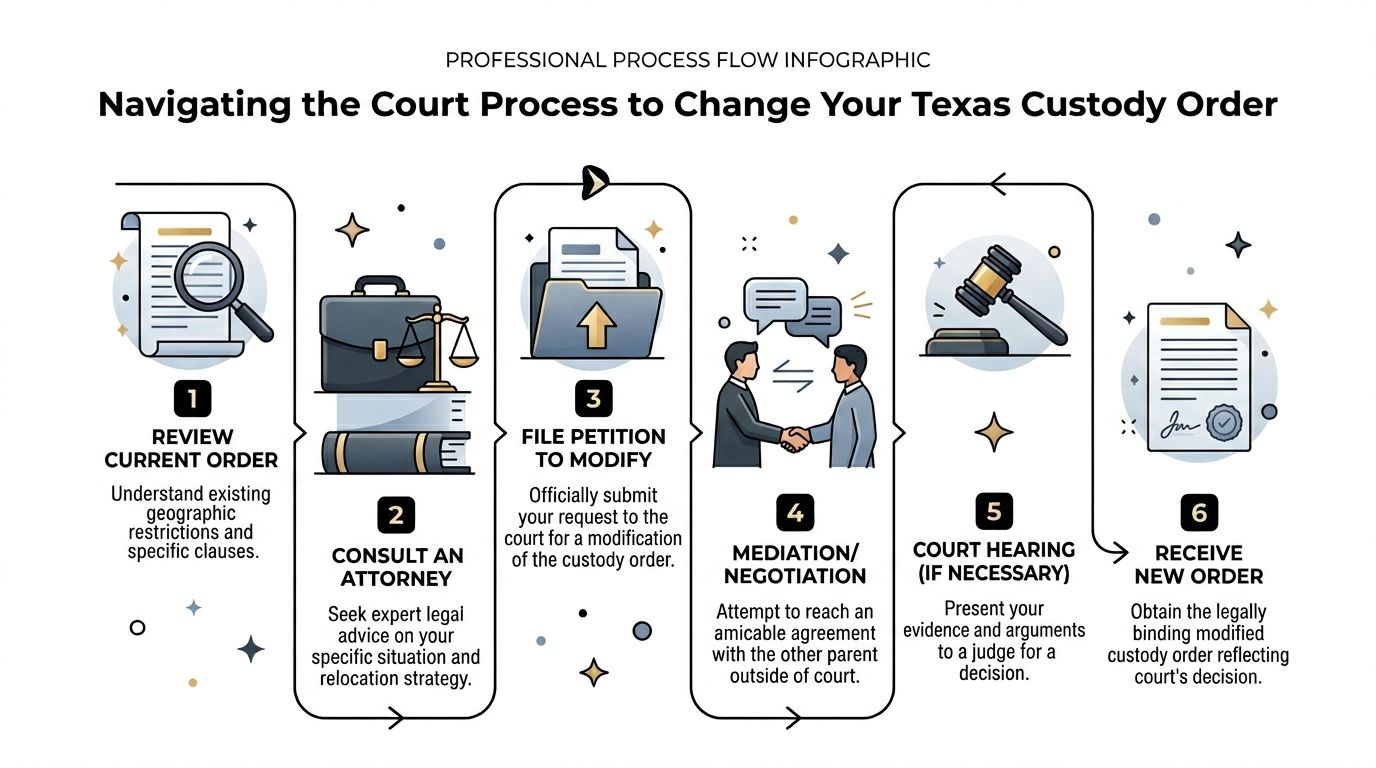
Step one review the current order carefully
Before anyone files anything, read the current order line by line.
Look for the exact wording of the geographic restriction. Some orders limit the child’s residence to one county and contiguous counties. Others include special language that matters a lot, such as provisions tied to a parent’s move, agreed exceptions, or notice requirements.
Pay attention to:
- Residence language: What area is allowed right now.
- Decision-making language: Which parent has the exclusive right to designate the child’s primary residence.
- Notice clauses: What the order requires before a move or address change.
- Possession terms: How the current schedule is built around local travel.
Step two file the right modification case
The case is typically filed in the court with continuing jurisdiction over the child custody order.
The filing usually asks the court to modify the parent-child relationship. The petition should clearly state what change is requested and why the current restriction no longer serves the child’s best interest.
Parents often look for paperwork online before they understand the strategic side of the case. Forms matter, but the facts and requested language matter more. If you want to see the procedural starting point, these Texas custody modification forms provide context for what is typically involved.
Step three give proper notice to the other parent
Service is not a technical side issue. It is a due process requirement.
The other parent must be formally notified. If that step is handled incorrectly, the case can be delayed, challenged, or thrown off course. This becomes even more important when the other parent is hard to locate.
A parent who is under stress sometimes wants to rush to the hearing stage. Courts won’t let that happen without proper notice unless the law clearly allows an exception.
Step four prepare for temporary issues
Some families need short-term court guidance while the case is pending.
For example, a job start date may be approaching. A lease may be ending. A school enrollment deadline may be close. In those situations, temporary orders may become part of the process.
Temporary orders don’t always decide the final outcome, but they can shape the momentum of the case. That’s why preparation matters early, not the night before a hearing.
Step five use mediation well
Many Texas family cases go through mediation. In relocation disputes, mediation can be one of the most useful stages.
A mediated solution may include:
- Modified boundaries: A broader area than the current order allows.
- Conditional terms: A change that takes effect only if certain events happen.
- Adjusted possession: Longer blocks in the summer, holiday changes, or detailed travel responsibilities.
- Communication terms: Video calls, school updates, and transportation coordination.
Mediation works best when a parent comes in with a real plan, not just a demand to move.
Some of the strongest relocation outcomes come from negotiated orders because parents can create practical solutions that a court might not craft on its own.
Step six know how trial decisions work
If negotiation fails, the case may go to trial.
Some cases are decided by a judge in a bench trial. Others may involve a jury trial. That distinction matters more in Texas than many parents realize. According to DFW Divorce’s discussion of lifting a geographic restriction, rare cases have moved from filing to trial in a month, but standard cases usually take weeks to several months from filing to trial. The same source notes that if the case goes to a jury trial, the judge cannot alter the jury’s findings on the relocation issue.
That creates a real strategic decision.
| Trial type | Who decides | Why it matters |
|---|---|---|
| Bench trial | Judge | One decision-maker weighs credibility and evidence |
| Jury trial | Jury on submitted questions | Jury findings on relocation issues carry special force under Texas law |
Where legal help changes the outcome
A lawyer adds value at several points in this process.
That includes drafting the requested relief carefully, preparing evidence before filing, structuring mediation proposals, and anticipating the other side’s arguments. The Law Office of Bryan Fagan, PLLC handles custody modifications, visitation disputes, and relocation-related family law matters in Texas, including cases involving changes to geographic restrictions.
The process is manageable. The stress usually comes from timing, paperwork, and strategy colliding all at once.
Gathering the Evidence You Need to Win Your Relocation Case
Relocation cases are won with details.
A judge has to decide whether changing the order gives the child a better path forward. Evidence is how you make that future concrete. Without it, your request can sound like hope instead of proof.

Build a story with documents
Every document should answer one of two questions. Why does the move make sense for the child? How will the child keep a meaningful relationship with the other parent?
Useful evidence often includes:
- Job records: A written job offer, transfer letter, or work schedule that shows the move is real and stable.
- School information: Enrollment options, program descriptions, or records showing why the proposed school fits the child better.
- Housing proof: Lease terms, home details, neighborhood information, and distance from school or caregivers.
- Family support evidence: Statements or records showing grandparents or relatives can provide consistent help.
- Child-specific records: Medical, counseling, tutoring, or extracurricular information that supports the need for the move.
A judge is more persuaded by specifics than by broad promises. “My child will have more support” is weak by itself. “My child will live ten minutes from grandparents who can handle after-school care during my work shift” is far stronger.
Don’t ignore the possession plan
Many parents miss the mark on this aspect.
If you are asking to move farther away, the court will want to know how the child will stay connected to the other parent. A long-distance case needs a practical possession schedule, not vague reassurance.
Your proposal might address:
- exchange locations
- holiday rotations
- summer possession blocks
- virtual communication times
- transportation responsibilities
- make-up time when schedules change
A thoughtful plan tells the judge you are not trying to erase the other parent.
Judges often respond well when a parent shows, in writing, “I have planned for the child’s continued bond with the other parent, not just my own move.”
Present the case like a parent who is prepared
You don’t need dramatic evidence. You need organized evidence.
Try this framework:
| Evidence type | What it proves |
|---|---|
| Employment records | The move is tied to a real opportunity, not a loose idea |
| School materials | The child’s educational interests were considered |
| Family support proof | The new location offers daily help and stability |
| Proposed schedule | The parent-child relationship can continue in a workable way |
Photos can help too. So can calendars. So can emails that show cooperative efforts.
What usually hurts a case is disorganization. Parents often have good facts but present them in a scattered way. Judges hear many cases. If your records are hard to follow, your strongest points can get lost.
Sample language that reflects the right focus
A relocation request should sound child-centered from the start.
“The requested modification is in the child’s best interest because it would allow the child to reside in a stable home environment, benefit from available family support, and continue a meaningful relationship with the other parent through a revised possession schedule.”
That is not a magic sentence. It is the right kind of framing.
Evidence mistakes that create problems
Some errors show up again and again:
- Moving before permission: This can make the court question judgment and good faith.
- Overstating problems: If you exaggerate the other parent’s weaknesses, credibility can suffer.
- Ignoring the child’s current ties: Friends, school, activities, and routines matter.
- Waiting too long to gather proof: Last-minute evidence often looks thin or incomplete.
A good case feels grounded. It shows respect for the child’s existing life while explaining why a new arrangement is better.
That balance matters more than drama ever will.
Anticipating Common Defenses and Special Situations
Most relocation cases turn into a debate over loss.
The parent who wants to move focuses on opportunity. The parent who opposes the move focuses on what the child will lose. If you don’t prepare for that response, your case can feel one-sided.
The most common objections
A non-moving parent often argues that the move will damage the parent-child relationship.
That argument can carry real weight, especially when the parent has been active, consistent, and involved in school events, extracurriculars, daily care, or regular possession. The court may also hear that the move would disrupt the child’s school routine, friendships, counseling, or community ties.
Another common defense is motive. The other side may claim the move is mainly about the relocating parent’s personal preference, not the child’s welfare.
You need a response for each point.
- Bond objection: Show how contact will continue in a realistic way.
- Stability objection: Explain why the new arrangement is stable, not disruptive for disruption’s sake.
- Motive objection: Keep returning to child-centered facts and written proof.
Remarriage does not change the order by itself
This point surprises many parents.
According to Hennan Culp’s discussion of geographic restrictions in Texas, remarriage does not automatically lift a geographic restriction unless that language is already written into the decree. The same source notes that geographic restrictions remain in effect until modified by a written agreement or court order, which is one reason mediation can be the best time to negotiate flexibility.
If a parent remarries and assumes the new spouse’s job location controls the outcome, that assumption can cause serious trouble.
If the order still says the child must live within the restricted area, that order still governs, even if your personal life has changed in important ways.
Hard-to-find parents and notice problems
Sometimes the other parent has moved, changed phone numbers, or become difficult to locate.
That does not mean notice can be skipped. Courts expect proper legal steps. A parent who cuts corners on service may win nothing except delay.
This issue comes up more often than people expect, especially in older orders where the parties no longer communicate regularly. Tracking service early is usually smarter than treating it like an afterthought.
Military families and other unusual facts
Military families often face special pressure because deployment, reassignment, and training obligations can shift on short notice.
A military parent may need added planning around timing, service, and temporary care arrangements. Federal protections can affect scheduling and procedure in some cases. The same is true when a parent works in fields with mandatory transfers or irregular schedules.
These cases are not impossible. They just require cleaner planning.
Think like the other side before filing
Before filing, ask yourself two questions.
What will the other parent say the child is losing? What proof do I have to answer that?
That exercise often changes the entire case strategy. It can improve mediation. It can strengthen testimony. It can also reveal that the best first step is negotiation rather than immediate litigation.
Practical Tips for a Smoother Transition and Your Next Steps
Even a strong legal case can become harder if the family communication falls apart.
Parents who handle this process well usually separate two things. They pursue the legal change firmly, and they communicate with the child carefully. Those are different jobs.

How to talk with your co-parent
Keep your messages short, calm, and specific.
Don’t use the child as the messenger. Don’t frame the move as a contest the child needs to judge. And don’t make promises you can’t keep about schedules, travel, or future flexibility.
Try communication that sounds like this:
- Clear notice: “I want to discuss a proposed move and possible schedule changes.”
- Child focus: “I’m trying to build a plan that protects school consistency and your time.”
- Specific proposal: “Here is a draft schedule for holidays, summer, and calls.”
That tone won’t solve every conflict, but it avoids making the record worse.
How to talk with your child
Children need reassurance more than legal detail.
A young child usually needs to hear that both parents love them and that the adults are working on a plan. An older child may have more questions about school, friends, and time with each parent. Keep the explanation age-appropriate. Don’t ask the child to choose sides.
Children do better when parents protect them from the legal conflict, even when the adults strongly disagree.
Practical support behind the scenes
A relocation case often creates a mountain of paperwork, scheduling tasks, and document organization.
Some families also use support professionals to stay organized between attorney meetings, especially when records, calendars, and communication logs are piling up. If you’re trying to streamline administrative work, resources like hire paralegal assistants can help you understand what kind of case support exists outside the courtroom.
Key takeaway
If you’re considering modifying geographic restriction texas, the strongest path is usually the same. Read the current order carefully. Build a child-focused reason for the change. Gather documents before filing. Prepare a real possession plan. Treat mediation seriously. Don’t move first and hope the court catches up later.
Next steps checklist
Review the exact wording of your current custody order.
Gather documents that show why the move helps the child.
Draft a realistic long-distance possession schedule.
Preserve respectful communication with the other parent.
Get legal advice before signing a lease, changing schools, or relocating.
Every family’s facts are different. Mothers, fathers, grandparents, and caregivers all need advice tied to their actual order, their court, and their child’s needs.
If you need help with a child custody or visitation case in Texas, our experienced attorneys can guide you every step of the way. Contact Law Office of Bryan Fagan, PLLC today for a free consultation.