
When your child’s future is on the line, understanding your rights matters most.
If you’re the parent who doesn’t have the child living with you most of the time, you may feel like you’ve been pushed to the sidelines. That feeling is common, and it’s painful. But under Texas law, being a non-primary parent does not mean you stop being a real decision-maker, a source of stability, or an active part of your child’s life.
The phrase rights of non custodial parent texas brings up one big question for most parents: “What can I do, and what am I legally entitled to?” The answer starts with the words Texas courts use, then moves into your day-to-day rights, your parenting schedule, your role in major decisions, and what to do if the other parent isn’t following the order.
Understanding What Non-Custodial Parent Means in Texas Law
A lot of parents come into a separation using the word “custody,” only to find that Texas uses different terms. That alone can make the process feel cold and confusing.
Texas family courts usually talk about conservatorship, not just custody. In plain English, conservatorship means the legal rights and duties parents have toward their child. It covers decision-making, access to information, and where the child lives.

Why Texas uses the word conservator
Texas law tries to focus on parenting roles, not labels that suggest one parent matters more than the other. That’s why you’ll often see terms like:
- Joint Managing Conservator means both parents usually share important parental rights and duties.
- Sole Managing Conservator means one parent has most of the major legal decision-making authority.
- Possessory Conservator usually refers to the parent who has possession and access under a court order but doesn’t choose the child’s primary residence.
Historically, Texas courts have treated Joint Managing Conservatorship as the standard arrangement, with both parents sharing decision-making and one parent usually having the right to determine the child’s primary residence, according to Texas family law guidance on custodial and noncustodial parents. That framework reflects Texas’s emphasis on parental equality and the child’s best interests.
What this means for you in real life
If you think “non-custodial” means “less important,” Texas law says otherwise. In many cases, the non-primary parent is still a joint managing conservator and still has substantial rights.
That’s where parents often get tripped up. The parent with the child most of the time may control the primary residence, but that does not automatically mean they control every school, medical, or emotional decision.
Practical rule: Your title in the order matters less than the specific rights listed in the order.
If you want a plain-English comparison between legal and physical custody concepts, these family law insights on custody can help connect Texas terms to the language many parents already know.
It also helps to understand the role of a possessory conservator in more detail. This guide on what a possessory conservator means in Texas breaks down how that role works in practice.
The term may feel harsh, but your rights are real
A court order may call you a possessory conservator. That can sound like you only get “visits.” But Texas law gives many parents in that role meaningful access, information rights, and legal standing.
Your relationship with your child is not measured only by where they sleep on school nights. It’s also measured by your ongoing right to stay informed, stay involved, and speak up.
Your Foundational Rights as a Texas Parent
Even if your child lives primarily with the other parent, Texas law protects a core set of rights unless a court specifically limits them. These rights are important because they keep you connected to your child’s daily life, not just your scheduled parenting time.
Many parents are surprised to learn how broad these rights are. The law recognizes that children benefit when both parents remain informed and involved.
Rights you usually keep unless a court says otherwise
Under Texas family law, both parents generally have the right to:
- Receive information about the child’s health, education, and welfare from the other parent
- Confer with the other parent before major decisions are made about those areas
- Access records from medical, dental, psychological, and educational providers
- Speak with professionals such as doctors, dentists, psychologists, and school officials
- Attend school activities and stay involved in school life
- Be listed as an emergency contact
- Consent to emergency treatment when the child needs immediate care
- Manage the child’s estate if one is created by the parent or family
These rights matter because they affect ordinary life. If your child breaks an arm, changes schools, begins counseling, or struggles in class, you shouldn’t be left in the dark just because you aren’t the parent with primary residence.
Where confusion usually starts
Parents often assume child support and parenting rights are linked together. They aren’t. A parent can’t usually cut off your legal rights because of a dispute over support, and you can’t withhold support because you’re angry about visitation problems.
Another common misunderstanding is this one: “If my ex handles day-to-day care, I don’t have a say.” That’s often not true. Day-to-day care and legal rights are related, but they are not the same thing.
Keep a copy of your court order where you can access it quickly. The order tells you which rights are shared, which are exclusive, and which you may exercise on your own.
A simple way to think about these rights
Here’s a helpful framework:
| Area | What your right usually means |
|---|---|
| Medical | You can get records and speak with providers |
| Education | You can contact teachers, school staff, and attend events |
| Safety | You can be listed as an emergency contact and act in emergencies |
| Co-parenting communication | You can receive updates and discuss major issues |
If the other parent refuses to share basic information, ignores your requests for records, or blocks your access to school or medical providers, that may be more than rude behavior. It may conflict with the court order.
These foundational rights form the base of your relationship with your child. They help you parent with knowledge, not guesswork.
Navigating Your Possession and Visitation Schedule
For many parents, this is the part that feels most urgent. You want to know when you’ll see your child, how weekends work, what happens on holidays, and how summer possession is handled.
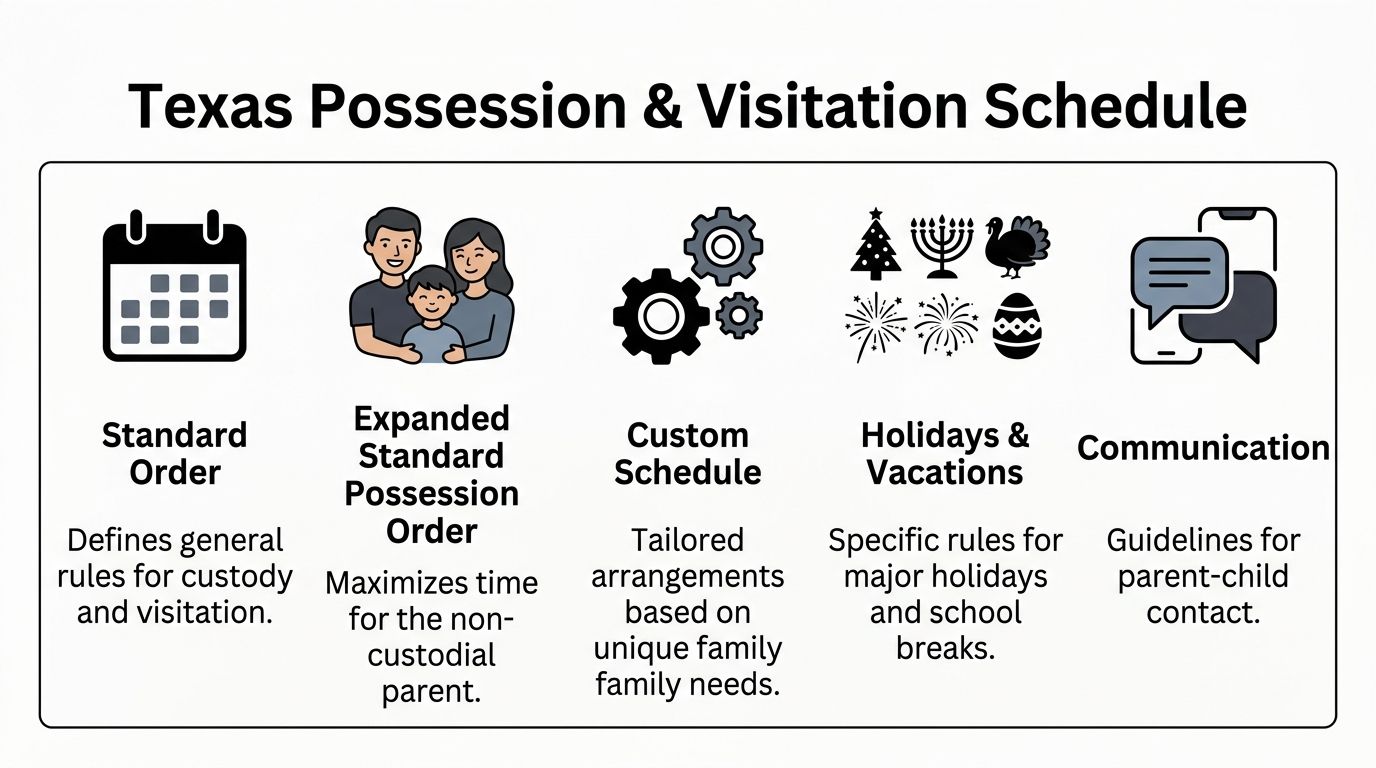
In Texas, the schedule is usually called a possession order. A common court-ordered schedule is the Standard Possession Order, often shortened to SPO.
What the Standard Possession Order usually includes
For parents who live within 100 miles of the child, the Standard Possession Order provides for first, third, and fifth weekends, Thursday evenings during the school year, 30 consecutive days in the summer, and alternating holidays, as described in this Texas non-custodial parent rights overview. Texas ties this structure to the child’s best interest standard.
That sounds simple at first. Then real life shows up. Parents ask, “What counts as the first weekend?” or “What happens when a holiday lands on my regular weekend?”
What that looks like on a calendar
Think of the Standard Possession Order this way:
Weekends
The non-primary parent usually gets the first, third, and fifth weekends of each month.Thursday periods
During the school year, there is usually a Thursday evening period of possession.Summer time
Summer possession is often a longer uninterrupted block, which gives the parent and child time for normal life together instead of quick exchanges.Holidays
Major holidays are often alternated so both parents have recurring special time with the child.
Why this matters emotionally
A possession order is more than a calendar. It gives your child predictability. It helps you plan work, childcare, school pickups, family events, and travel. It also lowers conflict because both parents know the default rule.
When a schedule is vague, arguments multiply. When it’s specific, parents have something concrete to follow.
A good possession order should answer practical questions before they become emotional fights.
Standard, expanded, and custom schedules
Not every family uses the same version of the schedule. Here’s a simple comparison:
| Schedule type | General use |
|---|---|
| Standard Possession Order | Common baseline schedule used by Texas courts |
| Expanded standard order | Often gives more time and broader pickup or return options |
| Custom schedule | Built around work schedules, school needs, or unusual family circumstances |
Some parents do better with a different arrangement, especially if they have rotating shifts, very young children, long travel distances, or a strong co-parenting relationship that allows more flexibility. If you’re comparing options, this explanation of the expanded standard possession order in Texas can help you understand whether a broader schedule may fit your family better.
What if you live farther away
Distance changes the practical reality of parenting time. A court may use a different schedule when parents live farther apart because frequent short visits become harder on the child.
That doesn’t mean your role shrinks. It usually means the schedule needs to be reworked in a way that protects the child’s routine while preserving meaningful time with you.
Read the exact language, not just the label
Two orders may both say “Standard Possession Order,” yet the pickup location, exchange time, holiday language, and summer election process can differ. Parents often rely on memory or text messages when they should be reading the actual signed order.
That’s where many enforcement problems begin. If you want to protect your time, know the exact words the judge signed.
Your Role in Major Decisions for Your Child
A parenting schedule tells you when you have your child. It doesn’t fully answer who decides the big issues.
This is one of the most misunderstood parts of Texas custody law. A parent may have regular possession but still need to check the order before making a school, therapy, or medical decision.
Possession versus decision-making
These two ideas are connected, but they are not identical.
| Topic | Possession | Decision-making |
|---|---|---|
| Main question | When is the child with you? | Who has authority to choose? |
| Common examples | Weekends, holidays, summer | School choice, counseling, non-emergency medical care |
| Where to look | Possession schedule | Rights and duties section of the order |
A parent can have parenting time without having the exclusive right to decide everything. On the other hand, many parents share decision-making even if one parent has the child more often.
Three ways orders usually assign authority
Texas orders often divide major rights in one of these ways:
Exclusive rights
One parent alone makes a particular decision. A common example is the exclusive right to determine the child’s primary residence.Joint rights
Both parents must confer or agree before acting. This often comes up with education or non-emergency health decisions.Independent rights
Either parent may act on their own in a stated area, usually within the limits of the order.
Here’s where parents need to slow down. “Joint managing conservators” does not always mean every right is split evenly. The order may divide rights very specifically.
Real-world examples
A few examples make this easier:
- Your child needs emergency treatment after an accident. You may have authority to consent to emergency care.
- Your child may need therapy for anxiety. The order may require joint discussion before starting ongoing counseling.
- One parent wants to move the child to a different school district. That may depend on who holds the right to establish the child’s residence or make educational decisions.
If your order says you must confer, try to communicate in writing, stay child-focused, and be specific about the issue you want to discuss.
How to avoid accidental conflict
Parents often start arguing because they assume, rather than verify, who has authority. Before saying yes, saying no, or accusing the other parent of overstepping, read the conservatorship section carefully.
Pay attention to phrases like:
- exclusive right
- independent right
- subject to agreement
- after consultation with the other parent
Those few words control a lot.
If your order is vague or your child’s needs have changed, a modification may be worth discussing. A child who is older, has new medical needs, or now lives in a different daily routine may need a different decision-making structure than the one entered years ago.
Child Support Obligations and Resources
Child support can trigger strong emotions on both sides. That’s understandable. But in Texas, child support is best viewed as part of the parent’s legal duty to support the child, not as a reward for the other parent.
The parent who pays support may still have meaningful parenting rights. The parent who receives support still has duties under the custody order. These issues often interact in real life, but they are not supposed to be used as bargaining chips.

What support is meant to do
Child support helps cover the child’s basic needs. Depending on the case, that may include everyday living expenses and costs tied to the child’s care, including health coverage.
Many parents make the mistake of treating support as if it buys time. It doesn’t. Parenting time and support are separate legal issues, even though they affect the same child.
Help exists when a parent is struggling
Some parents fall behind because they’ve lost work, changed jobs, or hit a financial crisis. Texas has recognized that support enforcement works better when parents also get practical help.
The Texas Non-Custodial Parent Choices program, launched in 2005, connected employment services with child support monitoring. According to the Policy Archive summary of NCP Choices, participants paid child support 50% more often and paid an average of $54 more per month.
That matters because it shows a balanced idea: Texas expects parents to support their children, but it has also used programs designed to help parents become more able to do so.
A balanced way to respond if you’re behind
If you’re struggling, the worst move is often silence. A better path may include:
- Review your order carefully so you know exactly what’s due
- Keep records of payments, job changes, and medical or financial setbacks
- Ask about enforcement consequences early instead of waiting for the problem to grow
- Explore legal guidance about whether a modification request makes sense
For parents trying to understand how support disputes are handled from a legal perspective, this Shane M. Boasberg child support attorney resource offers another helpful example of how Texas child support issues are approached.
You can also learn more about options to enforce child support in Texas if the issue in your case involves missed obligations or court enforcement.
Keep the focus where it belongs
Children usually do best when parents stop using support and visitation to control one another. If you owe support, take it seriously. If the other parent owes support, address it through lawful channels.
You protect your child best when you separate the emotion from the process and act quickly.
How to Enforce or Modify Your Custody Order
Knowing your rights matters. Using them matters more.
If the other parent keeps denying your scheduled time, refuses exchanges, or ignores parts of the order, you don’t have to accept that as the new normal. Texas courts can enforce custody orders, and they can also change them when life has materially shifted.

When enforcement may be necessary
Enforcement usually comes up when one parent violates a clear court order. Common examples include:
- Denied pickups when the order clearly gives you possession
- Missed drop-offs or late returns that keep happening
- Interference with access to records or school involvement
- Refusal to follow communication or exchange terms in the order
Not every disagreement justifies a court filing. But repeated, documented violations often do.
Start with documentation
Before you file anything, gather proof. Courts care about specifics.
Create a simple record with:
| What to track | Why it matters |
|---|---|
| Date and time of each violation | Shows a pattern |
| What the order required | Connects the conduct to the court order |
| What actually happened | Gives the judge concrete facts |
| Messages or emails | Supports your timeline |
| Costs or missed work | Helps show the impact |
Save texts, emails, call logs, and exchange details in one place. Judges respond better to organized facts than to general frustration.
What a Motion to Enforce can do
A Motion to Enforce asks the court to address violations of an existing order. Depending on the facts, a judge may order compliance, grant makeup parenting time, or use other remedies allowed by law.
The key is clarity. Courts enforce specific language far more easily than vague understandings between parents. If your current order is unclear, modification may be more effective than repeated enforcement attempts.
When modification makes more sense
Sometimes the problem isn’t defiance. Sometimes the order no longer fits reality.
Modification may be appropriate when there has been a meaningful change in circumstances, such as:
- A major work schedule shift that makes the current exchange times unworkable
- A relocation issue affecting transportation or school logistics
- A child’s changing needs, including school, medical, or emotional concerns
- Improved parental stability that supports more time or different decision-making rights
That doesn’t mean every change justifies a new order. It means courts can revisit custody terms when the facts have materially changed and the child’s best interests support revision.
A short explanation can also help if you prefer a visual overview before talking strategy:
Practical steps if your rights are being ignored
If you’re deciding what to do next, keep it simple:
- Read the signed order, not your memory of it
- Document each violation
- Avoid heated exchanges that create new problems
- Talk with a family law attorney about enforcement versus modification
One available option is to consult a firm that handles Texas conservatorship, visitation enforcement, and modification matters, such as the Law Office of Bryan Fagan, PLLC, depending on where your case is pending and what kind of relief you need.
The biggest mistake parents make is waiting too long while hoping the pattern will correct itself. Sometimes it does. Often, it doesn’t.
Handling Special Situations like Relocation and Military Service
Some custody problems don’t fit a standard pattern. A parent gets military orders. A co-parent wants to move. A child’s schedule no longer matches the original order. These cases need a more careful response because distance changes everything.
When relocation threatens your parenting time
A relocation issue often starts with a simple statement from the other parent: “I’m thinking about moving.” For the non-primary parent, that can trigger immediate fear. Will weekend time disappear? Will school breaks become the only real time you have left?
Many Texas orders contain a geographic restriction, which limits where the child’s primary residence can be established. If the planned move falls outside that area, court action may be required. That gives you a chance to raise concerns about travel, school stability, and preserving your relationship with your child.
When relocation is on the table, speed matters. Waiting too long can make it harder to protect your current routine.
Military parents face a different kind of pressure
Military service creates a separate challenge. A parent may want to stay fully involved but also has to respond to deployment, training, or a permanent change of station.
A 2023 Texas Military Family Law report noted that 15% of custody cases involve active-duty parents, and 40% face modification denials due to geographic barriers, as discussed in this Texas noncustodial parental rights article. That’s a strong reminder that military parents often need specific legal planning, not a generic visitation schedule.
What adaptable solutions can look like
Texas law does allow room for practical adjustments in military cases. Depending on the facts, that may include:
- Temporary orders during deployment or a major duty change
- Modified possession terms that fit military obligations
- Use of the Servicemembers Civil Relief Act in appropriate situations
- Detailed communication plans so contact continues even when in-person time is disrupted
Here’s a common example. A father on active duty learns he will be transferred. He doesn’t want to lose his role in his child’s life, but the old order is built around short local visits. In that situation, a revised order may focus more on longer school-break periods, clear video contact, transportation rules, and decision-making access.
Stability matters, but flexibility matters too
Judges still look at the child’s best interests first. That includes stability, but it also includes preserving the child’s bond with both parents whenever possible.
If you’re facing relocation or military service, don’t assume the current order will somehow stretch to fit a very different life. These are the moments when careful legal wording matters most. A vague agreement can create conflict quickly. A detailed order can preserve connection even through distance and uncertainty.
Your Next Steps to Protect Your Parental Rights
If you’ve been overwhelmed, that’s understandable. Texas custody law uses unfamiliar terms, and the emotional weight of parenting after separation makes every decision feel bigger.
Still, the core message is simple. You may be a non-primary parent, but you still have rights, responsibilities, and options. You can stay informed. You can remain involved. You can ask the court to enforce an order or modify it when your child’s needs or your circumstances have changed.
A good next step is to gather your current court order, keep a written record of any problems, and get legal advice based on your actual facts. If your child is struggling emotionally during the family transition, this expert advice on children's divorce coping may also help you support them outside the courtroom.
Key Takeaway: The rights of non custodial parent texas law provides are real, but they work best when you understand your order and act early.
If you need help with a child custody or visitation case in Texas, our experienced attorneys can guide you every step of the way. Contact The Law Office of Bryan Fagan, PLLC today for a free consultation.