
When your child’s future is on the line, understanding your rights matters most. Life is always changing, and the custody order that worked for your family last year may no longer fit your child's needs today. If you're feeling that your current arrangement is holding your family back, a Texas modification of child custody may be the right path forward.
But it’s not as simple as just deciding you want a change. Texas law is designed to protect your child's stability. To succeed, you have to prove two critical things: that there has been a material and substantial change in circumstances since your last court order was signed, and that changing the order is truly in your child's best interest.
How Texas Determines if a Custody Order Can Be Changed
The custody arrangement that made perfect sense for your toddler might feel completely wrong for your teenager. When your existing order—what Texas law calls a possession order—starts to feel more like a restriction than a solution, the law provides a way forward.
But courts don’t like to disrupt a child's life for every little disagreement. Stability is the top priority. So, before you can begin the formal process of changing your order, you must meet a key legal standard.

What Is a Material and Substantial Change?
The Texas Family Code is very clear: the parent asking for the change must prove a "material and substantial change" has occurred in the life of the child or one of the parents. This is the legal key that unlocks the courthouse door. But what does that legalese actually mean for your family?
In plain English, it means a major life event has happened that fundamentally alters the family's situation in a way that directly impacts the child's well-being. It's not just any change; it has to be a significant one.
Here are a few common scenarios that Texas courts often consider significant enough:
- A parent is moving. Maybe one parent received a job offer and plans to move a significant distance away. You can learn more about this in our guide on when a custodial parent moves out of state.
- A major shift in income. One parent either loses their job, creating financial instability, or gets a massive promotion that changes their lifestyle and ability to care for the child.
- Safety concerns arise. New information comes to light about drug use, alcohol abuse, neglect, or family violence in one parent’s home, putting the child at risk.
- A parent gets remarried. A new stepparent and perhaps new stepsiblings are now in the picture, which can completely change the dynamic and environment in the home.
- The child's needs have changed. Perhaps a new medical diagnosis, learning disability, or emotional issue has come up that the old possession schedule simply can't accommodate.
These are foundational shifts, not just minor bumps in the road. Proving your situation fits this description is the first—and most important—step in any Texas modification of child custody case.
The Guiding Principle: The Best Interest of the Child
Once you've shown a material and substantial change, you are only halfway there.
Every single decision a Texas family court judge makes comes down to one guiding principle: the best interest of the child. This is the standard that trumps everything else.
The judge will look at your request and ask, "How will this change actually benefit this child's physical and emotional well-being?" They will weigh many factors to figure out what's really best for your child, including:
- The child’s emotional, physical, and developmental needs.
- The stability of each parent's home environment.
- Any potential danger to the child, now or in the future.
- Each parent's ability to put their child's needs ahead of their own.
- The acts or omissions of a parent that may indicate the existing parent-child relationship is not a proper one.
Your personal wants and needs, while completely valid, take a backseat to your child's welfare in the eyes of the court. As you prepare to file for a modification, you must frame your entire case around how the change will benefit your child’s happiness, stability, and growth.
Steps to Modify a Custody Order in Texas
Knowing the legal road ahead can make the journey feel a lot less intimidating. A Texas modification of child custody isn't a chaotic free-for-all; it follows a clear path designed to ensure every decision is made with your child's best interests at heart. When you understand what to expect at each stage, you can move forward with confidence and clarity.
It all starts with a single, important document.
Filing the Initial Paperwork
Your first official step is to file a "Petition to Modify the Parent-Child Relationship." This is the legal document that kicks off your case, and it needs to be filed with the same court that issued your last custody order.
Think of the petition as your formal request to the court. It tells the judge and the other parent what changes you’re asking for and—most importantly—why you believe those changes are necessary. You have to clearly state that there’s been a material and substantial change of circumstances and that your proposal is in the child's best interest.
After filing, you must ensure the other parent is officially notified through a legal process called "service." This isn't just a courtesy; it's a critical legal requirement that protects everyone's rights and gives the other parent a fair chance to respond.
Keeping up with legal deadlines is absolutely crucial. A tool like a legal deadline calculator can be a lifesaver for tracking these important dates.
This flowchart breaks down the basic flow of a modification case, from identifying the change to presenting your evidence in court.
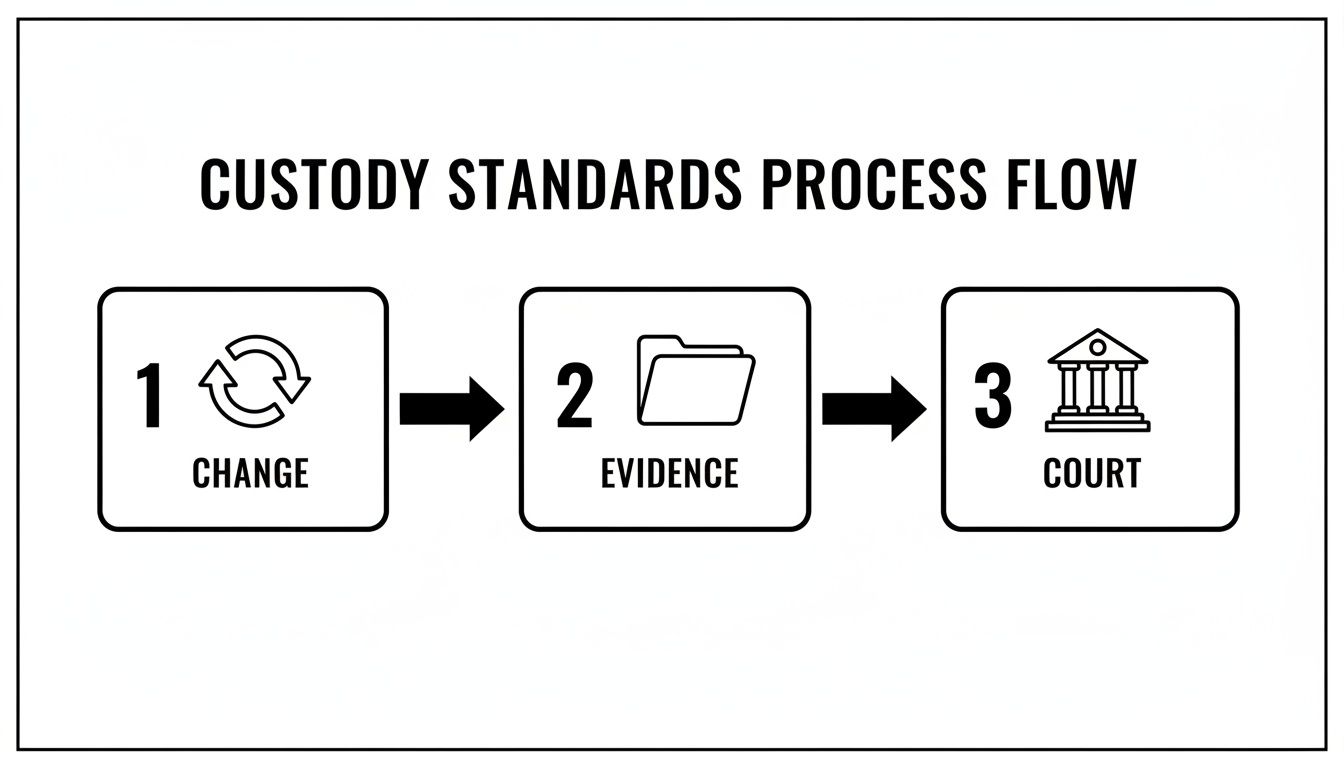
This visual simplifies the journey into three core stages: establishing a significant change has occurred, gathering the evidence to prove it, and finally, presenting your case to the court for a final decision.
Seeking Immediate Relief with Temporary Orders
Sometimes, waiting months for a final hearing just isn't an option, especially if your child's safety or well-being is at immediate risk. In these urgent situations, the law allows you to ask the court for Temporary Orders.
These are short-term rules put in place by a judge while your modification case is still pending. They can tackle pressing issues head-on, such as:
- Establishing a temporary possession schedule to create stability.
- Preventing one parent from moving away with the child.
- Ordering drug testing or counseling services if there are safety concerns.
- Making immediate decisions about the child's school or medical care.
To get these orders, you'll have a hearing where you present evidence showing the judge why immediate action is needed. If the judge agrees, these orders create a safe and stable environment for your child until a final decision can be made.
Gathering Your Evidence Through Discovery
Once the case is officially underway, both sides move into a phase called "discovery." This is the formal, court-supervised process of gathering evidence from each other. Think of it as the fact-finding mission where you build the foundation of your case.
Discovery involves several powerful tools:
- Requests for Production: Asking the other parent for specific documents like financial records, emails, or text messages that are relevant to the case.
- Interrogatories: Sending written questions that the other parent is required to answer under oath.
- Depositions: Questioning the other parent or key witnesses in person, under oath, while a court reporter transcribes every word.
The information and documents you collect during discovery are precisely what you'll use to prove that a material and substantial change has occurred and that your requested changes are in your child's best interest.
The Role of Mediation
Before you ever see the inside of a courtroom for a final trial, most Texas counties will require you and the other parent to attend mediation. This is a confidential meeting where a neutral, third-party mediator helps you try to find common ground and reach an agreement.
Mediation puts you back in control. Instead of letting a judge, who doesn't know your family, make all the decisions, you and the other parent have a chance to craft a custom solution that actually works for your unique situation. A huge number of cases get resolved in mediation, saving families the time, money, and emotional toll of a courtroom battle. If you reach an agreement, it's written up into a final order for the judge to sign, and your case is done.
Understanding Key Texas Custody Concepts
While the core principles of a Texas modification of child custody apply to everyone, some families face unique challenges. When your situation is different, it’s critical to understand how specific rules might affect your rights and your child’s future. We see families of all kinds walk through our doors, and we are here to provide clarity and guidance.
Joint Managing Conservatorship Explained
In Texas, the default arrangement is called Joint Managing Conservatorship. This is a legal term that means both parents share the rights and responsibilities of raising their child. It does not necessarily mean a 50/50 split of possession time. Instead, it ensures both parents have a say in major decisions like education, medical care, and religious upbringing. One parent is typically designated as the "primary" conservator who has the right to determine the child's residence, while the other has a visitation schedule and pays child support.
What is a Possession Schedule?
A possession schedule is the court-ordered calendar that details when each parent has physical possession of the child. Texas has a Standard Possession Order that is presumed to be in the child's best interest. It outlines a clear schedule for weekends, holidays, and summer vacation. While this standard schedule is common, parents can agree to a customized schedule that better fits their family’s needs, as long as a judge agrees it is in the child's best interest.
What Does "Best Interests of the Child" Mean in Court?
This is the most important concept in Texas family law. It is the single standard a judge uses to make all decisions about children. The Texas Family Code provides a list of factors, often called the "Holley Factors," that courts consider, including:
- The emotional and physical needs of the child.
- Parental abilities of each parent.
- The stability of the home.
- Any acts or omissions of a parent that may indicate the current parent-child relationship is not a proper one.
- Any danger to the child, now or in the future.
Proving that your requested modification serves these best interests is the key to a successful outcome. For a deeper dive, check out our guide on how to prove the best interest of the child.
Grandparents and Non-Parent Caregivers
For grandparents, aunts, uncles, or other caregivers who have stepped in to raise a child, the legal path can feel overwhelming. The first hurdle is “standing,” which is your legal right to file a lawsuit in the first place.
Simply loving a child isn’t enough. To have standing, a non-parent must usually prove that the child’s current living environment with a parent presents a real danger to their physical health or emotional well-being. This is a very high bar, as Texas law strongly presumes that a child is best off with their biological parents. If you are a non-parent caregiver, documenting everything—from when the child started living with you to every dollar spent on their care—is absolutely critical to building your case.
Using Evidence and Your Child’s Voice in Court
When you seek to modify your child custody order, your personal feelings, while valid, aren't enough. A successful modification is built on a foundation of solid, organized evidence. This is where you stop telling the judge what happened and start showing them.
The right proof can make or break your case. It gives the court a clear, factual picture of the material and substantial change in circumstances.

Building a Persuasive Case with Evidence
A Texas judge needs to see concrete proof that the change you're asking for is truly in your child's best interest. Your job, with the help of your attorney, is to gather and present the evidence that tells this story compellingly.
Effective evidence can come in many forms:
- Communication Logs: A detailed record of texts, emails, and messaging app conversations with the other parent can demonstrate patterns of conflict, missed visitations, or unprofessional communication.
- School and Medical Records: Is your child thriving or struggling? Report cards, attendance records, and notes from teachers can paint a vivid picture. Likewise, medical records can document a new health need or show a pattern of care (or lack thereof).
- Third-Party Testimony: Statements from neutral people who know your child's situation can be powerful. Think teachers, counselors, coaches, or doctors. Their professional observations often carry significant weight with a judge.
- Photos and Videos: Visuals can be very effective in documenting a child's living conditions (both good and bad) or illustrating a strong, healthy bond with a parent.
How Your Child's Preference Is Considered
This is one of the most sensitive parts of any modification case: what does your child want? In Texas, a child who is 12 years of age or older has the right to speak privately with the judge in what’s called an "in-chambers interview." It's a confidential conversation where the child can express their thoughts and feelings freely.
However, the child's preference is not the deciding factor. It's just one piece of the puzzle. The judge will carefully consider the child’s maturity and the reasons behind their preference, weighing it against all other evidence under the "best interest of the child" standard.
The Role of Court-Appointed Experts
In high-conflict modification cases, a judge might appoint a neutral expert to investigate the family's situation and provide an unbiased recommendation to the court.
Two of the most common appointments are:
- Amicus Attorney: An attorney appointed by the court to represent the best interests of the child, not the child's wishes. They act as the eyes and ears of the court, interviewing everyone involved before making a recommendation.
- Guardian Ad Litem: This professional represents the child’s best interests from a non-legal standpoint, focusing on their social and emotional well-being. To understand more, you can learn more about the role of a guardian ad litem in our detailed guide.
Recent legal reforms in Texas, like those detailed by new Texas family laws have transformed divorce and custody, have placed more emphasis on giving older children a direct voice. As courts adapt, we're seeing an increasing willingness to modify orders for parents who can clearly demonstrate their deep involvement and commitment to their child's life.
Key Takeaways and Next Steps
Navigating a Texas modification of child custody can feel overwhelming, but you don't have to do it alone. Remember these key points as you consider your next steps:
- You Must Prove a "Material and Substantial Change": This is the legal requirement to even begin the process. The change must be significant and directly impact your child.
- The "Best Interest of the Child" is Everything: Every piece of evidence and every argument you make must focus on how your proposed changes will benefit your child's physical and emotional well-being.
- Agreement is the Best Path: If you and the other parent can reach an agreement, the process is faster, less expensive, and less stressful for everyone involved, especially your children.
- Evidence is Crucial: Solid, organized proof—from school records to communication logs—is what will persuade a judge.
Your child's well-being is your top priority, and it's ours too. Understanding your legal options is the first step toward securing a better future for your family.
If you need help with a child custody or visitation case in Texas, our experienced attorneys can guide you every step of the way. Contact The Law Office of Bryan Fagan, PLLC today for a free consultation.