
When your child's future is on the line, understanding your rights matters most.
You get a text, an email, or a tense phone call. The other parent says they're moving. Maybe it's for a job. Maybe to be closer to family. Maybe they're already packing. In that moment, most parents don't think about legal procedure. They think about school pickups, bedtime routines, soccer games, and whether their child is about to be pulled away from them.
If you're facing that fear, you're not overreacting. In Texas custody cases, a parent's move can change nearly everything about how possession, decision-making, and day-to-day parenting work. But it does not mean you automatically lose your rights, and it does not mean the other parent gets to decide on their own.
Texas law has a structure for this. Courts look closely at existing orders, whether there is a geographic restriction, whether proper notice was given, and whether the move helps or harms the child's stability. If you're trying to understand what happens if the other parent moves away in Texas custody cases, the answer is this: the court focuses less on the move itself and more on how that move affects the child's life and both parents' relationship with the child.
Your World Just Tilted What to Do When a Co-Parent Plans to Move
A parent usually learns about a move in one of three ways. The other parent asks for agreement. The other parent announces a plan as if the decision is already final. Or the parent says nothing useful at all, and you hear about the move from the child, a relative, or a social media post.
Each situation creates a different emotional reaction, but the practical first step is the same. Slow down and get the order in front of you.
Start with the order, not the argument
Your current custody order is the starting point for almost every relocation dispute. In Texas, parents are often named joint managing conservators, which means they share many parental rights and duties. That does not always mean they have equal parenting time, and it does not always mean both parents can decide where the child will live.
Usually, one parent has the exclusive right to determine the child's primary residence, often within a limited area. The details matter. A lot.
A relocation case can turn on a few lines in an order that most parents haven't looked at in months or years.
If the other parent is talking about moving, check whether the order says where the child may live, what notice must be given, and whether written agreement is required before any move outside the allowed area. If you want a broader overview of how these disputes develop, this guide on Texas relocation custody disputes is a helpful starting point.
What helps and what hurts in the first few days
Parents often damage good cases by reacting too fast. Angry messages, threats, and social media posts usually create evidence the other side can use later.
A better short-term response looks like this:
- Save every message: Keep texts, emails, and voicemails about the move.
- Ask direct questions: Where is the other parent planning to go, when, and with the child or without the child?
- Stay child-focused: Ask how school, medical care, and your parenting time would work.
- Avoid self-help: Don't withhold the child outside the order just because you're afraid.
If the move is only being discussed, there may still be room for negotiation. If the move is imminent, timing becomes critical. Either way, your next move should be strategic, not emotional.
The Single Most Important Part of Your Custody Order Geographic Restrictions
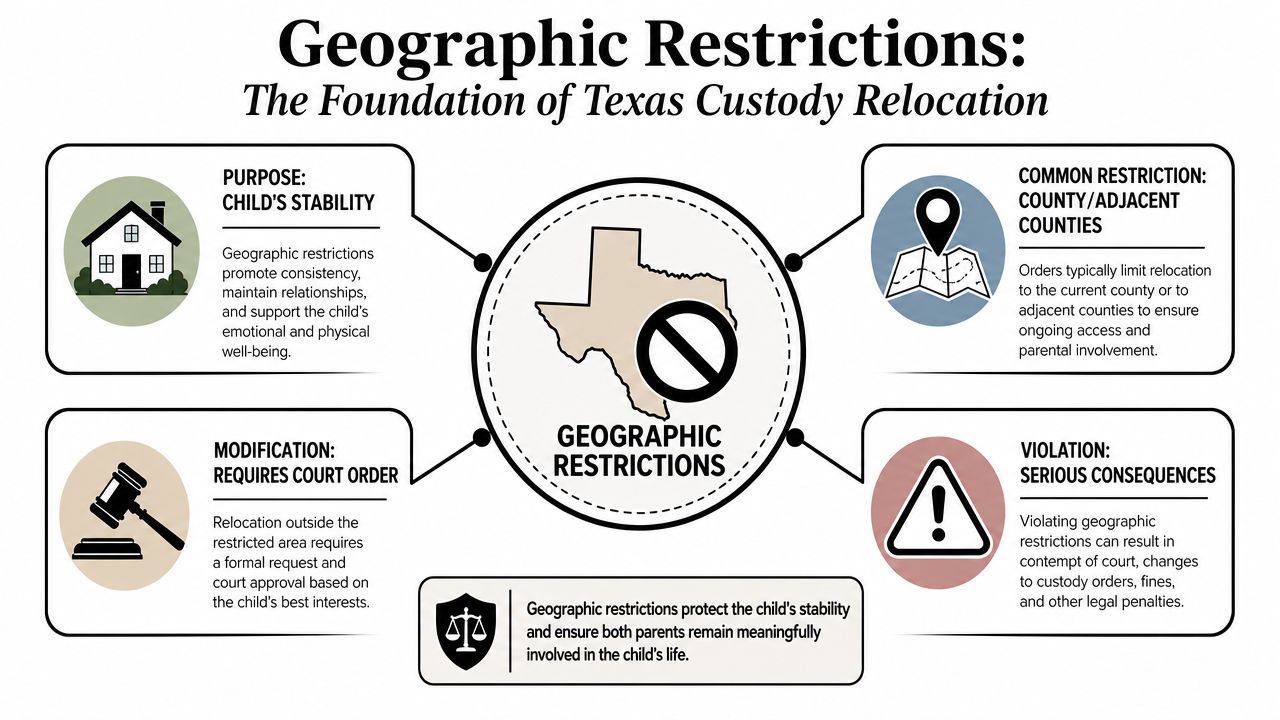
In many Texas cases, the most important paragraph in the order is the geographic restriction. That clause acts like the child's legal home base. It usually limits where the child's primary residence can be established, often to a county or group of counties.
Texas relocation disputes usually turn on whether the order contains a geographic restriction and whether the move would undermine the child's relationship with the nonmoving parent. Courts decide these disputes under a best-interests-of-the-child analysis, as explained in this discussion of Texas child custody relocation.
What geographic restriction means in plain English
Think of a geographic restriction as a boundary line around the child's home life. If the parent with the right to designate the child's primary residence wants to move the child outside that boundary, they usually need either the other parent's written agreement or a court order changing the existing one.
That's true even when both parents are joint managing conservators. Joint managing conservatorship means both parents keep significant rights and duties. It does not erase the court's power to limit where the child can live.
Where to find it in your order
Look for language about:
- Primary residence: Which parent can decide the child's main home.
- Geographic limits: A county, several counties, or another defined area.
- Written consent: Whether the other parent can approve a move without a court fight.
- Modification requirements: Whether a court order is needed before the child relocates.
For a more detailed breakdown, review this explanation of geographic restrictions in Texas custody cases.
Why this clause carries so much weight
A geographic restriction exists to protect stability. It helps preserve the child's school routine, medical care, community ties, and contact with both parents. When a parent wants to change it, the court is not just being asked to approve a new address. The court is being asked to approve a new structure for the child's life.
That is why relocation cases are rarely won by saying, “I want to move,” or “I don't want them to move.” The stronger case explains how the current arrangement works, what would change, and why that change would either support or disrupt the child's overall stability.
Practical rule: If you haven't read the exact wording of the geographic restriction, you don't yet know how strong your position is.
The Legal Playbook for Requesting or Opposing a Move
Once relocation becomes real, the legal process matters as much as the facts. Parents are generally expected to provide written notice before moving, and many custody orders or practice guides refer to about 60 days' notice so the other parent can object or seek mediation, as discussed in this academic review of relocation and notice practices.
If you are the parent who wants to move
The cleanest path is agreement. If the other parent will sign off, the agreement still needs to be made official through the court. An informal deal is not enough if the old order says something different.
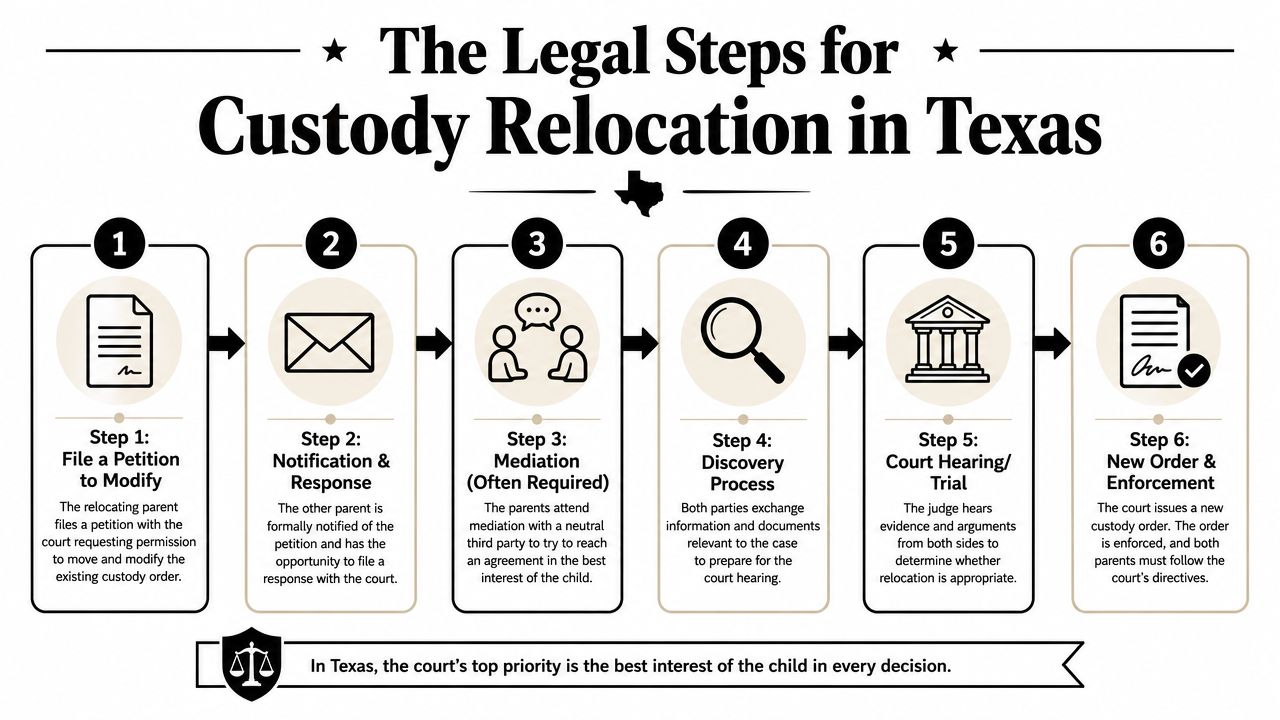
If there is no agreement, the moving parent usually needs to file a Petition to Modify the Parent-Child Relationship. In plain English, that means asking the court to change the current custody terms. The request may include changing the geographic restriction, changing possession, adjusting transportation duties, and adding notice terms.
A practical guide to that process appears in this resource on requesting permission to relocate with a child in Texas.
Here is the core issue. The parent asking to move needs to present more than a personal preference. The court will want to see why the move helps the child and how the child will maintain meaningful access to the other parent.
A short video can help frame what that process looks like in practice.
If you are the parent opposing the move
The biggest mistake is waiting to see if the other parent is serious. If you've received written notice or credible information that the move is imminent, assume the timeline matters.
Your options may include:
Filing a response quickly
If the other parent already filed to modify, don't let deadlines pass without a response.Seeking temporary relief
If there is a real risk the child will be moved before the final hearing, your attorney may ask the court to preserve the current arrangement until the case is decided.Gathering stability evidence
The strongest objections are usually specific. School records, medical routines, your involvement, and the child's ties to the current community matter.
What the court process often looks like
Relocation cases usually move through several stages:
| Stage | What it usually means |
|---|---|
| Filing | One parent asks the court to change the order |
| Notice and response | The other parent gets formal notice and answers |
| Mediation | Parents try to reach a workable agreement |
| Evidence gathering | Records, calendars, communications, and proposals are exchanged |
| Hearing or trial | The judge decides if no agreement is reached |
| New order | The court sets the new rules and schedule |
The process can feel slow when you're worried about losing time with your child. But preparation during this stage often decides the outcome.
How a Texas Judge Thinks About Relocation Cases
Judges don't decide relocation cases by asking which parent has the better reason on paper. They ask whether the move improves or damages the child's life as a whole.
That's where many parents miss the mark. They build a case around the adult's need to move, not the child's need for stability.
The strongest cases tell a child-centered story
Texas courts evaluate the reason for the move, the effect on the parent-child relationship, and the child's educational and healthcare access. Existing guidance also highlights a practical gap. Many articles discuss best-interest factors and geographic restrictions, but they rarely dig into when a move tied to job access, housing costs, or family support is more persuasive than a move based on simple preference. That point is discussed in this review of how relocating can affect a Texas custody battle.
A judge is often looking for a clear before-and-after picture:
- What does the child's life look like now?
- What would improve if the move happens?
- What would be lost?
- Can the loss be reduced with a workable possession plan?
What tends to persuade and what usually falls flat
Some reasons for moving are easier to defend than others. A move tied to stable employment, safer housing, or stronger family support can be framed around the child's daily life. A move based only on a parent wanting a fresh start is harder to sell if it weakens the child's relationship with the other parent.
What doesn't work well is vague language.
“Better opportunities” is not a case. A judge needs to see what those opportunities are and how they affect the child's real life.
For the parent opposing the move, the same rule applies. “I don't want my child taken away” is emotionally powerful, but it isn't enough by itself. The stronger approach shows your actual role in the child's routine. School involvement, healthcare participation, consistency in possession, and the child's emotional bond with you all matter.
Build around stability, not blame
A relocation hearing often turns ugly when parents focus on each other's motives. Courts do care whether a move seems designed to interfere with the other parent's relationship. But most judges care even more about whether the evidence supports a stable plan.
Ask yourself these questions:
- Education: Will the move improve or disrupt school stability?
- Healthcare: Will the child's treatment, providers, or access change?
- Emotional support: Who helps with after-school care, emergencies, and daily supervision?
- Parenting continuity: Can the nonmoving parent still stay meaningfully involved?
Parents who answer those questions with documents, calendars, school information, and a realistic parenting proposal usually present a stronger case than parents who attack each other.
What a New Possession Schedule Looks Like After a Move
When a Texas court allows a move, the order usually doesn't just change the child's address. It changes how parenting time works.
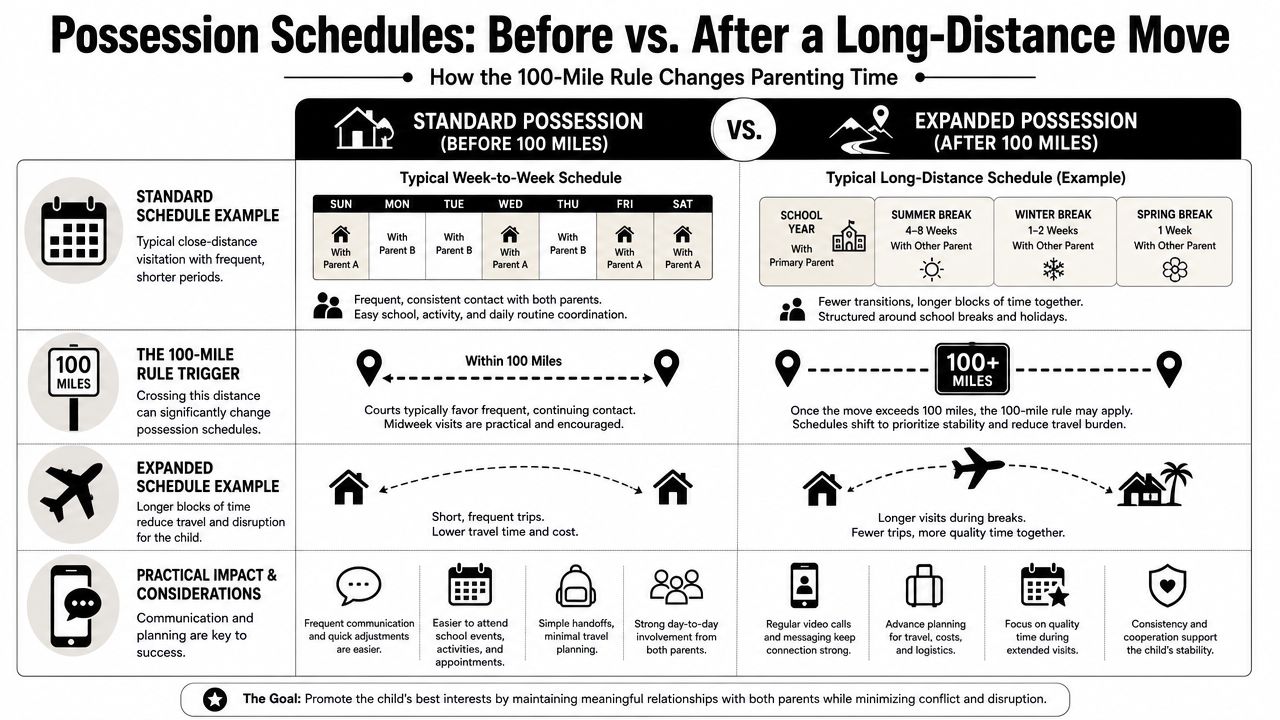
That shift can be dramatic. Frequent short visits often become fewer but longer blocks of possession. For many families, that is the core of what happens if the other parent moves away in Texas custody cases.
The distance rule that changes the schedule
When parents live more than 100 miles apart, standard possession provisions commonly shift, and a noncustodial parent living that far away is often entitled to extended summer possession of up to 42 days, as described in this explanation of Texas custody and moving out of state.
Before and after the move
Here is the practical difference many parents face:
| Closer-distance parenting | Long-distance parenting |
|---|---|
| More frequent exchanges | Fewer exchanges |
| Regular weekend contact | Longer school-break and summer periods |
| Easier attendance at school events | More planning around travel and calendars |
| Day-to-day routine involvement | More focus on preserving quality time |
That doesn't mean the long-distance parent becomes less important. It means the structure changes. Instead of seeing the child more often for shorter periods, the parent may have longer uninterrupted time during summer, holidays, and school breaks.
The trade-offs parents need to understand
A long-distance schedule can work, but only if both parents are realistic about logistics.
- Travel planning matters: Parents need clear transportation terms, exchange locations, and notice requirements.
- School calendars become central: Breaks, teacher in-service days, and summer activities affect possession.
- Communication fills the gap: Phone or video contact often becomes more important when in-person time is less frequent.
This is why relocation cases should never be treated as a simple yes-or-no question. Even when the move is allowed, someone has to build a schedule the child can live with.
When a Parent Moves Without Permission Emergency Actions and Enforcement
An unauthorized move is not something to “wait out.” If the other parent is threatening to leave with the child in violation of the order, or has already gone, the situation may require immediate legal action.
Texas Law Help explains that relocation can trigger a temporary restraining order or a custody-modification filing, and if a parent and child leave Texas after a case is filed, it can affect where the case is heard. That issue is addressed in this article on transferring a family law case to another court.
Why speed matters
The passage of time can alter the dynamics. If a parent leaves and establishes a new routine before the court steps in, the case often becomes more complicated. The child may already be enrolled somewhere else, living with relatives, or following a new schedule that the moving parent will argue should stay in place.
That is why emergency relief exists. Depending on the facts, a parent may need to ask the court to stop the move before it happens or to force a return to compliance with the order.
Waiting can make a relocation case harder. Acting quickly can preserve the child's routine and your position in court.
Common enforcement goals
When a parent moves without permission, the legal response usually focuses on one or more of these outcomes:
- Stopping the move: If the relocation hasn't happened yet, the court may be asked to maintain the current arrangement temporarily.
- Returning the child: If the move already happened in violation of the order, the court may order the child back.
- Changing custody terms: A violation can become evidence in a modification case.
- Enforcing compliance: Courts may impose sanctions for violating the order.
Parents sometimes assume courts treat these violations as private family disputes. They don't. If the order was clear and the moving parent ignored it, the consequences can be serious.
Preparing Your Case Your Practical Next Steps
When a parent tells the court, “This move is better for my child,” the judge will want proof, not just a sincere opinion. The parent who presents a clear, organized picture of the child's day-to-day life is usually in the stronger position.
Start by building your case around stability. Judges in relocation disputes are not only weighing distance. They are looking at what the child will gain, what the child may lose, and whether the proposed plan protects school progress, family relationships, routines, and emotional security.
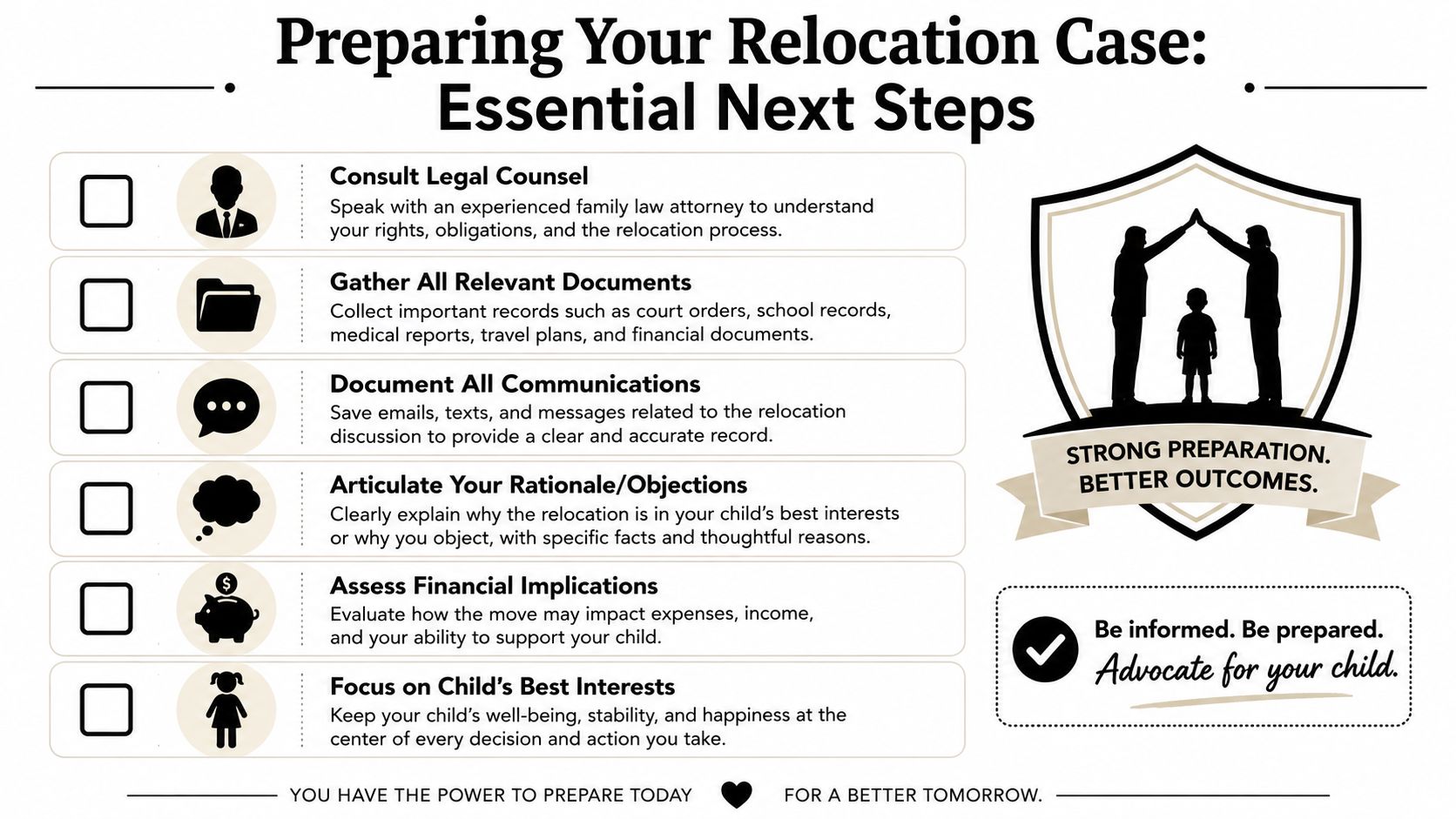
Gather the documents that matter
Create one folder, digital or paper, and keep everything in it from the start. Small details become important later, especially if the other parent changes their explanation or the court asks for specifics on short notice.
- Your current court order: Use the signed order. The exact wording matters.
- School information: Report cards, attendance records, teacher emails, tutoring records, and activity schedules help show how the child is doing now.
- Medical records: Appointment history, diagnoses, treatment plans, therapy records, and provider contact information may show why consistency matters.
- Written communications: Save texts, emails, letters, and any notice about the proposed move.
- Parenting calendars: Track actual exchanges, missed periods of possession, school pickups, doctor visits, and extracurricular involvement.
Build proof around the child's stability
A strong relocation case is usually practical, not dramatic.
If you want to move, show the court exactly how the move improves the child's life. That may include better housing, more reliable childcare, family support in the new city, a specific school plan, a job change that improves financial stability, or access to services the child needs. Judges also want to see a realistic plan for preserving the child's relationship with the other parent. General promises are weak. Specifics carry weight.
If you are opposing the move, focus on your real role in the child's routine. Document the school mornings, homework help, therapy attendance, sports practices, medical appointments, and ordinary weekly contact that gives the child structure. The goal is to show what would be disrupted and why that disruption would not serve the child well.
Communicate like a future exhibit
Every text and email should read like something you would be comfortable handing to a judge.
Ask direct questions. Request addresses, school names, travel plans, and proposed possession details in writing. Keep the tone steady, even if the other parent is angry or evasive. A parent who stays focused on the child often looks more credible than a parent who turns every message into an argument.
That also means resisting the urge to score points. Threats, insults, and sarcasm tend to hurt the person sending them.
Get legal advice early enough to shape the record
Timing matters here. A lawyer can help identify what facts matter under your order, what evidence is missing, and whether you need to act before the move happens or before a new routine takes hold.
For parents who need legal help sorting through relocation disputes, emergency custody issues, or modification requests, the Law Office of Bryan Fagan, PLLC handles those matters in Texas family law cases.
Key takeaway
A relocation case is rarely won by the parent who is loudest or most upset. It is usually won by the parent who can show, with specific facts, which arrangement best protects the child's emotional, educational, and practical stability.
If you are facing what happens if the other parent moves away in Texas custody cases, read the order carefully, preserve the evidence, and make your position clear through facts that a judge can verify. That is how strong cases are built.