Skip to content
When your child's future is on the line, understanding your rights matters most.
A lot of parents find out about a geographic restriction at the exact moment life changes. A new job opens up. A parent gets engaged. Grandparents need help. A better support system is waiting in another city. Then you read your custody order and realize the law may limit where your child can live.
That moment can feel heavy. You may be torn between building a better future and following a court order you didn't fully think about when it was signed. The good news is that this rule is understandable. More important, it's navigable when you know what it means and what steps to take.
Navigating Your Family's Future and Your Custody Order
If you're a parent after divorce or separation, moving isn't just about packing boxes and changing schools. It's also about whether your custody order allows your child's primary home to move with you.
That's where many Texas parents get stuck. You may be ready to relocate for work, family support, or a fresh start, but one paragraph in your order can stop everything until the legal side is handled. That paragraph is often the geographic restriction.
A geographic restriction is not there to punish you. It's a rule the court uses to protect a child's routine and the child's relationship with both parents. In plain terms, the court is trying to keep one parent from moving first and forcing the other parent to scramble later.
Practical rule: Before you sign a lease, transfer schools, or accept a move that affects your child's home, read the exact language in your custody order.
For some families, even planning the move itself takes enough energy. If you're also handling the logistics of a long-distance relocation, practical help matters. Parents dealing with the move side often look for resources on a stress-free Boston to Texas relocation while they work through the legal questions.
Why this issue feels so personal
Texas custody law uses words like conservatorship, primary residence, and possession schedule. Those terms can sound cold, but they affect daily life.
- Conservatorship means the bundle of parental rights and duties. Many parents are named joint managing conservators, which usually means they both keep important rights and responsibilities for the child.
- Primary residence means the home base where the child mainly lives.
- Possession schedule is the parenting time schedule. It sets when each parent has time with the child.
When a move affects that home base or makes the possession schedule harder to follow, the court pays close attention. That's why learning how geographic restrictions work in Texas custody orders can give you real peace of mind. Once you understand the rule, you can make decisions with far more confidence.
What Is a Geographic Restriction in a Texas Custody Order
A geographic restriction is a court-ordered limit on where your child's primary residence can be located. The easiest way to think about it is this. The court creates a legal home zone for the child.
That zone becomes the child's official home base. If the parent who has the right to choose the child's primary residence wants to move the child outside that zone, the parent usually can't just go. The court order has to be followed unless the other parent agrees in a way the court recognizes or the judge changes the order.

What the restriction is really doing
Texas Law Help explains that Texas geographic restrictions are typically written to keep a child's primary residence in the current county and the surrounding counties that border it, and that this is a court-enforced location rule used to preserve access for both parents in divorce decrees and custody orders (Texas Law Help on geographic restrictions).
That tells you two important things.
First, this rule focuses on the child's residence, not where a parent works, dates, or visits. Second, the restriction is tied to regular parent-child contact. Courts often use it to support ongoing involvement from both parents when that arrangement is safe and workable.
How this fits into conservatorship
Parents often confuse joint managing conservatorship with unlimited freedom to move. They aren't the same thing.
A parent can share major decision-making rights and still be restricted as to where the child primarily lives. In many cases, one parent has the exclusive right to designate the child's primary residence, but only within the geographic area named in the order.
That's why the exact wording matters so much.
The restriction doesn't usually mean you can't ever move. It means you can't move the child outside the allowed area without handling it the right way.
Why courts use this kind of boundary
A child's life is built around routines. School. Doctors. Friends. Activities. Pickups and drop-offs. The court looks at all of that through the lens of the best interests of the child, which is the core standard in Texas custody law.
In plain English, the best-interest standard asks what arrangement best supports the child's overall well-being. That includes emotional stability, physical needs, and healthy relationships with parents.
A geographic restriction is one tool courts use to support that stability. It's less like a punishment and more like a fence around the child's routine. Some fences are small. Some are wider. But the purpose is the same. Keep the child's daily life from being disrupted without court review.
Common Types of Geographic Restrictions You May See
Not every order uses the same map. Some are narrow. Some give more breathing room. Reading the wording closely can save you from a major mistake.
The main patterns parents usually see
Texas family-law guidance describes geographic restrictions as a residence-boundary clause that may limit the child's primary residence to a county, the current county plus adjacent or contiguous counties, or another defined region, with the goal of preserving regular access for both parents and child stability (Texas custody restriction overview).
Here's a simple side-by-side comparison.
| Restriction Type | Description | Typical Flexibility |
|---|---|---|
| Single county | The child must live in one named county | Lowest flexibility |
| County plus contiguous counties | The child may live in the current county and counties that touch it | Moderate flexibility |
| Defined regional area | The order lists a broader custom area | Depends on the wording |
| School-based or highly specific wording | The order ties residence to a very narrow location or practical boundary | Often very limited |
What these differences mean in real life
A single-county restriction is the tightest version. If your order says the child must live in Harris County, moving to a nearby county may still violate the order even if the drive seems manageable.
A county plus contiguous counties restriction gives more room. “Contiguous” means counties that share a border with the current county. For many parents, this allows a local move without asking the court to rewrite the order.
A defined regional restriction can vary a lot. Some orders are customized around where the parents live and where the child goes to school. Others use broader regional descriptions. You can't assume what it means from memory. Read the exact language.
For a closer look at relocation after an order is already in place, this guide on moving with your child after a Texas custody order can help you compare your situation to common relocation issues.
Where parents get tripped up
The biggest mistake is focusing on distance instead of wording. A move can be short in miles and still violate the order. Another move can be farther than expected but still fit inside the allowed counties.
If you're unsure, don't guess. Put the order in front of you and identify three things:
- Who has the right to designate the child's primary residence
- What area is named in the restriction
- Whether the order contains exceptions if the other parent relocates or agrees
That quick review often clears up confusion right away.
How Texas Courts Decide on Geographic Restrictions
When parents agree on the restriction, judges often approve that agreement. When they don't agree, the court decides what boundary makes sense for the child.
Texas family-law guidance notes that judges generally defer to parental agreement on the restriction unless the parents cannot agree, and then the court sets the boundary as part of a best-interest review (Texas family court guidance on geographic restrictions).

The best interests of the child in plain English
This phrase shows up constantly in Texas family law. It doesn't mean the judge chooses what either parent wants. It means the judge asks what arrangement best protects the child's life, stability, and relationships.
Courts often care about practical questions such as:
- How stable is the current routine for school, home, and caregiving
- How involved is each parent in daily life and parenting time
- How would the move affect possession schedules and regular contact
- Whether the proposed arrangement supports cooperation between parents
If you're a mother or father asking the court for more flexibility, your argument needs to stay child-centered. If you're asking the court to keep the child local, the same rule applies. Judges want to hear how the restriction helps or hurts the child, not just which option is easier for a parent.
Why judges often prefer structure
A judge must issue orders that are practical for people to follow. That's one reason geographic restrictions are often routine in Texas family court. They create a clear rule instead of leaving everyone to fight later about what counts as “too far.”
A clear boundary often prevents a future emergency hearing. The court would rather set the line now than force a child into conflict later.
What helps a parent make a stronger case
Parents tend to do better when they stay focused, organized, and realistic.
Consider bringing the court a picture of the child's actual life:
School routine and community ties
Show where the child is rooted and why that matters.Parenting history
Explain who handles drop-offs, homework, medical visits, and activities.A workable possession plan
If you want to move, show how the other parent will still have meaningful time.Your co-parenting approach
Judges notice whether a parent is trying to solve a problem or create one.
That same best-interest lens also shapes later requests to change the order.
Changing a Custody Order to Move or Prevent a Move
A parent gets a new job in another city. The school year is approaching. The other parent says, “You can't just take our child.” That moment feels personal and urgent, but the court treats it as a legal question with a specific process.
If your current order includes a geographic restriction, the court order stays in place until a judge changes it or both parents sign an agreement that becomes a new order. In plain terms, a conversation is not enough. A plan is not enough. You need a signed court order before the child's residence can legally change.
For a closer look at how parents ask the court to change the restriction, see how to request a change to a Texas geographic restriction.
What the judge looks at first
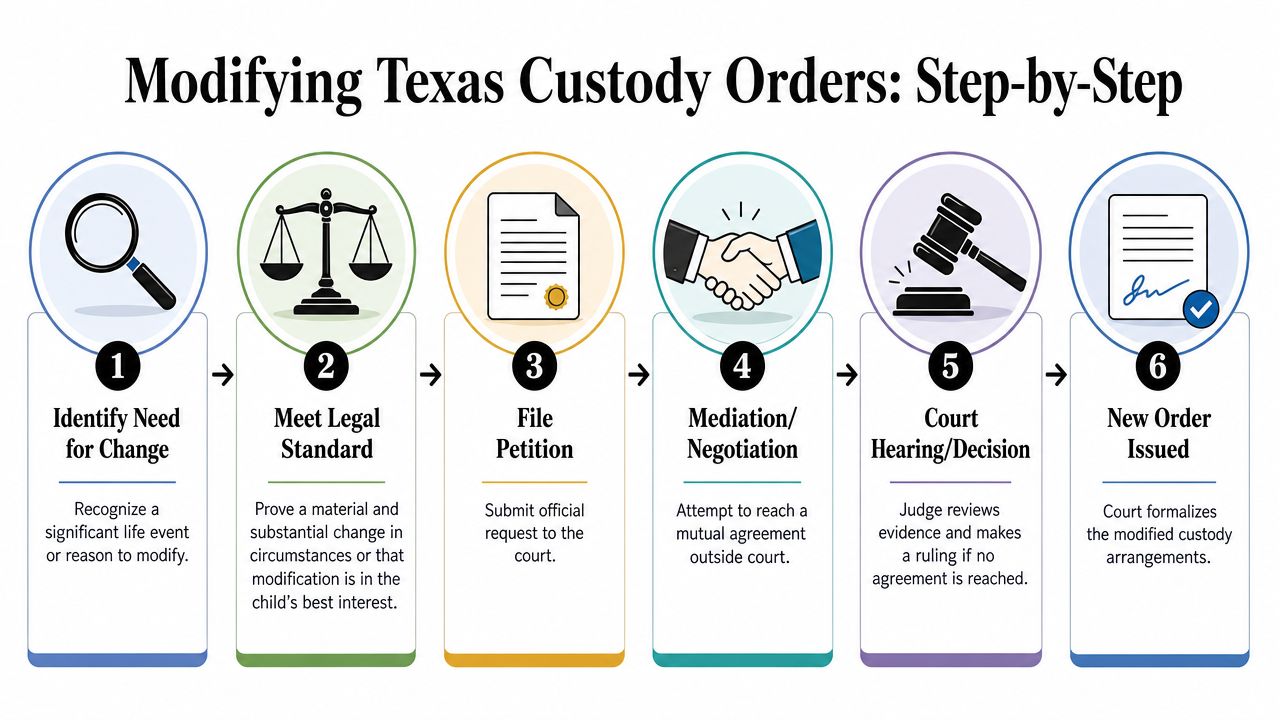
The first question is usually whether there has been a material and substantial change in circumstances since the last order. That phrase sounds technical, but the idea is simple. The court wants to know whether life has changed enough that the old rule no longer fits the child's reality.
That change might involve a new job, a remarriage, a shift in the child's medical or educational needs, or a parenting arrangement that no longer works as written.
Then the court asks the bigger question. Would the requested change serve the best interests of the child?
Both questions matter. A parent may have a real reason to move and still need to show how the child will stay connected, stable, and supported.
Here's a quick overview of the process in video form.
How the process usually works
Changing this part of a custody order works like updating a rulebook everyone still has to follow until the new version is officially approved. You do not get to rewrite it on your own.
A typical case includes these steps:
Read the current order closely
Check the exact wording of the restriction, the child's designated residence, and any exceptions already built into the order.File a modification case
The pleading is often called a Petition to Modify the Parent-Child Relationship.Give proper legal notice
The other parent must be formally served unless there is a valid waiver on file.Try to reach an agreement if possible
Many parents settle through negotiation or mediation. Even then, the judge usually must sign a new order before the change takes effect.Present evidence if the case is contested
Each parent can show why the restriction should stay the same, be adjusted, or be removed.Wait for the signed order
This is the step parents most often underestimate. A planned move is still restricted until the court signs off.
Important reminder: A verbal agreement with the other parent does not replace a signed court order.
If you want to move with your child
Start with the child's day-to-day life. Judges want more than “I have a better opportunity.” They want to understand how the move would affect school, medical care, family support, extracurricular activities, and the child's relationship with the other parent.
It helps to come to court with a practical map of the child's future. Where will the child go to school? How will exchanges work? What schedule will protect meaningful time with the other parent? The more concrete your plan, the easier it is for the court to evaluate whether the move helps or harms the child.
If you want to prevent the move
Your strongest argument is usually not “I don't want this change.” It is “Here is how this move would affect our child.”
Show the court what your involvement looks like. That may include school pickups, homework help, medical appointments, weekend activities, and regular routines the child depends on. Judges tend to respond better to specific facts than broad frustration.
This can be an emotional part of a case. That is normal. Parents often hear “geographic restriction” and think of it as a wall. In practice, it is more like a boundary line the court set to protect stability until there is a good reason to redraw it.
Special Situations Military Families and Emergency Moves
Some cases don't follow the usual timeline. Military orders can come fast. Safety concerns can become urgent. In those moments, parents need clarity, not panic.
Military family example
A service member receives relocation orders and worries that the custody order's geographic restriction makes the move impossible. The key issue is still the child's residence and what the court order allows. Military families often have to address custody and relocation on a compressed timeline, which is why advance planning matters so much.
If this fits your situation, practical guidance on military relocation and child custody in Texas can help you spot the issues early and decide whether a modification request is needed.
For military mothers and fathers, the core advice is the same. Don't assume service-related orders automatically rewrite a custody order. Get the language reviewed and take action through the court if the child's residence will be affected.
Emergency move example
Another parent may need to leave quickly because the current situation feels unsafe. That parent might be staying with relatives, seeking protection, or trying to shield a child from family violence.
In those cases, parents often need immediate legal help to request temporary relief. The court can address urgent safety concerns, but it's still important to seek court action instead of disappearing with the child if a custody order is already in place.
If safety is at risk, protecting the child comes first. But legal protection matters too. Emergency action is strongest when the parent asks the court for temporary orders as quickly as possible.
What both situations have in common
Military moves and emergency moves are emotionally very different, but they share one legal truth. Special circumstances don't make the custody order irrelevant. They change how urgently the issue must be handled.
Grandparents and caregivers should keep that in mind too. If you're significantly involved in the child's care, your observations and records may become important when a family is asking the court for emergency or relocation-related relief.
Next Steps and Answers to Common Questions
If you're feeling overwhelmed, start small. You don't need to solve the whole case today. You just need to take the next right step.
Next steps you can take now
Pull your order and read the residence language
Look for who has the right to designate the child's primary residence and what geographic area is listed.Map the proposed move
Compare the new location to the wording in the order. Don't rely on assumptions about distance.Write down your reasons
Whether you want to move or prevent a move, list the child-centered reasons that support your position.Gather practical records
School information, calendars, parenting-time history, and communication records often help clarify what arrangement is working now.Keep communication calm
Angry messages rarely help in relocation disputes. Clear, respectful written communication usually does.
Common questions parents ask
What if the other parent moves without permission
If the child has been moved in violation of the order, act quickly. Save messages, review the order, and get legal advice about enforcement or emergency relief. The court takes violations of custody orders seriously.
Can we agree to waive the restriction without going to court
Be careful. Parents can agree in principle, but relocation should be reflected in a written agreement and court order before you treat it as final. Informal side deals create risk for everyone.
Does this apply to both mothers and fathers
Yes. Geographic restrictions apply based on the order, not a parent's gender. Fathers, mothers, grandparents, and other caregivers all need to look at the exact court language and the child's best interests.
What should I say when I call an attorney
Try something simple and direct:
“I have a Texas custody order with a geographic restriction. I need to know whether I can move with my child, or what I can do to stop the other parent from moving. I have the order ready.”
That gives the attorney the starting point they need.
Key takeaway: Geographic restrictions can feel intimidating, but they usually become much clearer once you identify the exact wording, the child's current routine, and whether a modification is needed. Good decisions start with the order itself.
If you need help with a child custody or visitation case in Texas, our experienced attorneys can guide you every step of the way. Contact The Law Office of Bryan Fagan, PLLC today for a free consultation.