Skip to content
You usually can't move with your child after a Texas custody order unless your order allows it, and the first place to look is the geographic restriction in your paperwork. If the move is more than 100 miles away or out of state, one Texas relocation guide says it is typically treated as a relocation that requires special legal steps, including 60 days written notice before the move (Texas relocation guidance on notice and distance).
When your child's future is on the line, understanding your rights matters most. A lot of parents land here in the same moment. A job offer comes in. A parent wants to move closer to grandparents. Housing changes. A new spouse lives in another city. Then the excitement stops and one question takes over: can you move with your child after a custody order in Texas?
The honest answer isn't a simple yes or no. It depends on what your current order says, whether the other parent agrees, and whether a judge believes the move serves your child's best interests.
That uncertainty can feel overwhelming. You may feel stuck between building a better life and protecting your time with your child. The good news is that Texas law gives you a path forward. You just need to follow the right one.
A New Job a New City and a Texas Custody Order
You accept a job in Dallas on Monday. By Tuesday, you are looking at schools, apartments, and commute times. By Wednesday, a harder question shows up. Can you take your child with you if a Texas custody order is already in place?
That moment catches many parents off guard. The move may make complete sense for your finances, your family support, or your safety. The legal question is different. A court will look past the reason for the move and ask how the change affects your child's daily life and the other parent's time.
In Texas, a relocation request is often handled as a request to change the current order. Courts usually want to see a material and substantial change in circumstances before changing custody terms. A new job can matter. So can lower housing costs, help from grandparents, a remarriage, or a medical need. The harder part is showing why your specific move helps your child enough to justify changing the existing plan.
Start with your order before you start packing
Your custody order works like a rulebook for this decision. Before you pay a deposit or register your child in a new district, read the exact language in your final decree or SAPCR order.
Pay close attention to these three parts:
- Who has the right to determine the child's primary residence. One parent often has that right, even if both parents share many other rights and duties.
- The possession schedule. This tells you how often the other parent sees the child and how a move could disrupt that pattern.
- Any geographic restriction. That clause can limit where the child may live, sometimes to one county, neighboring counties, or a set mileage area. If you need help reading that language, this guide on modifying a geographic restriction in Texas explains how courts treat those limits.
The wording matters more than assumptions. A move that seems minor in everyday life can be a legal problem if it changes school attendance, exchange logistics, or the other parent's regular access.
Why similar moves get different answers
Parents often expect the law to focus only on distance. In real cases, the order usually matters more.
For example, a move across county lines might require court action if the order limits the child's residence to one county. A longer move might be allowed if the order gives broader geographic freedom and the parents agree. Even a move within the same general area can create conflict if it turns a simple after-school pickup into a two-hour drive.
That is why relocation cases are rarely just about leaving Texas. Some of the hardest questions involve moves to a nearby county, a new school district, or a city close enough to sound reasonable but far enough to disrupt the parenting schedule.
Judges also look closely at proof. A simple statement like “this job is better for me” may not carry much weight by itself. Details often matter more. Is the new job more stable? Does it provide health insurance? Will the move place the child near reliable childcare, family support, or better services for a medical or educational need? Those are the kinds of facts that can turn a general reason into a persuasive one.
If you are staring at a deadline and feeling pressure to decide fast, pause long enough to read your order line by line. That one step can save you from making a move that creates a much larger legal problem.
Decoding Your Custody Order The Geographic Restriction
A parent gets offered a better schedule in the next county. The drive does not seem dramatic on a map. Then they open the custody order and realize the fundamental question is not miles. It is whether the order allows the child's home to move at all.

What joint managing conservatorship means
Many Texas parents are named joint managing conservators. That usually means both parents share major decision-making rights and duties for the child. It does not answer the relocation question by itself.
In many orders, one parent has the exclusive right to determine the child's primary residence. That right often comes with boundaries. A court may give you the right to choose the home, but only within a defined area.
That is a point many parents miss under stress.
What a possession schedule means
A possession schedule is the parenting-time calendar. It may be a Standard Possession Order, an expanded schedule, or a custom arrangement built around school, work, or the child's needs.
This matters because relocation cases are not only about where the child sleeps. They are also about whether the current exchange routine still works. A move that looks small on paper can create real strain if it turns school pickups, therapy appointments, or midweek visits into long, repeated drives.
What the geographic restriction does
A geographic restriction sets the area where the child's primary residence must be located. Many Texas orders limit the child's residence to one county, or to that county and the counties touching it. Some orders are broader. Some are tighter.
The restriction works like a fence drawn on a map. If the new home is outside the fence, the move usually needs more than notice to the other parent.
This is why a move across county lines can be a legal problem even if it feels local. If your order says the child must live in Harris County, moving to a nearby county may violate the order even though you are staying in the same metro area. By contrast, a longer move might fit within the order if the restricted area is broader and the parenting schedule can still function.
Where to look in your paperwork
Look for phrases such as:
- Primary residence
- Geographic restriction
- Residency restriction
- County and contiguous counties
- Notice of change of address
Read those sections slowly, line by line. Custody orders often use formal language, but the rule is usually concrete. The child must live in a named county, within a list of counties, or in a stated area unless the order is changed.
If you want to compare your wording to real examples, this guide on modifying a geographic restriction in Texas can help you spot the clauses that control relocation.
A practical way to read the order
Your order is part map, part calendar. The map says where the child may live. The calendar says how parenting time happens. If your proposed move changes the map or disrupts the calendar, you may need court approval even if the move is only to a neighboring county.
That is why the most useful first step is often the simplest one. Before you pack, ask two specific questions: Where does the order allow the child to live, and will this move make the current possession schedule harder to carry out?
The Two Legal Paths to Relocation Agreement or Modification
A relocation case usually turns on one practical question. Will you and the other parent solve the move on paper together, or will a judge have to decide it?
Those are the two legal paths. One is agreement. The other is modification.
The difference matters because parents often assume a reasonable conversation is enough. In family law, an agreement works only if it becomes enforceable. A court order works like the rulebook. Until that rulebook is officially changed, the old terms usually still apply, even if both parents talked about doing something different for a while.
Path one is written agreement
This path works best when both parents accept the move and are willing to spell out the details. That can happen in an out-of-state move, but it also comes up in the harder gray-area cases parents ask about all the time. A move across county lines may look minor on a map, yet still require major schedule changes. A short move can create bigger problems than a longer one if school drop-offs, midweek visits, or exchanges become harder.
A useful agreement answers practical questions a judge would ask later:
- Where will the child live
- What possession schedule replaces the current one
- Who handles transportation and costs
- How holidays, summer, and school breaks will be divided
- How the child will stay in contact with the other parent
Put another way, the agreement should cover both the map and the calendar.
One more caution. A text exchange, email chain, or verbal promise can be evidence of cooperation, but it is a weak substitute for a signed and court-approved order. If disagreements show up later, informal permission often leads to a very predictable fight: one parent says there was consent, and the other says there was only a temporary discussion.
Path two is formal modification
If the other parent objects, goes silent, or supports only part of the move, you may need to file a modification case. The same is true when your reason for moving is more layered than a simple job offer. Maybe you need to relocate to care for an aging parent, get specialized medical help for the child, leave an unsafe housing situation, or move closer to family support that makes daily parenting possible. Those cases can be strong, but they usually need structure and proof.
A modification asks the court to rewrite the existing order so the move is allowed and the new parenting plan is clear. The judge will not focus only on mileage. Judges usually want to see how the move affects the child's day-to-day life, schooling, stability, and relationship with the other parent.
That is why relocation cases are rarely won by saying, "This move is better for me." They are stronger when the parent can show, with specifics, why the move is better or necessary for the child and how the other parent-child relationship will be preserved in a workable way.
Comparing the two options
| Option | Works best when | Main advantage | Main caution |
|---|---|---|---|
| Written agreement | Both parents genuinely agree on the move and the new schedule | Faster, less expensive, and more control over the details | It should still be turned into a signed court order |
| Court modification | The move is disputed, the order blocks it, or the reasons are more complex and need evidence | Creates clear legal authority and resolves conflict | It takes time, preparation, and child-focused proof |
Parents facing a bigger relocation often benefit from reading about moving out of state with a child in Texas, even when the immediate question is a move within Texas that may still disrupt the current order.
If the other parent may agree, start with a detailed proposal that shows you have thought through school, travel, costs, and parenting time. If agreement is unlikely, treat the move like a case you may need to prove. Documents, timelines, and a realistic possession plan matter.
How to Ask the Court to Modify Your Order for a Move
Your lease is ending in six weeks. You found a better job in another city, or maybe your child finally has access to the school program or medical support they need there. Then you look at your custody order and realize the move is not something that can be arranged with a moving truck and a new address. You may need the court's permission first.
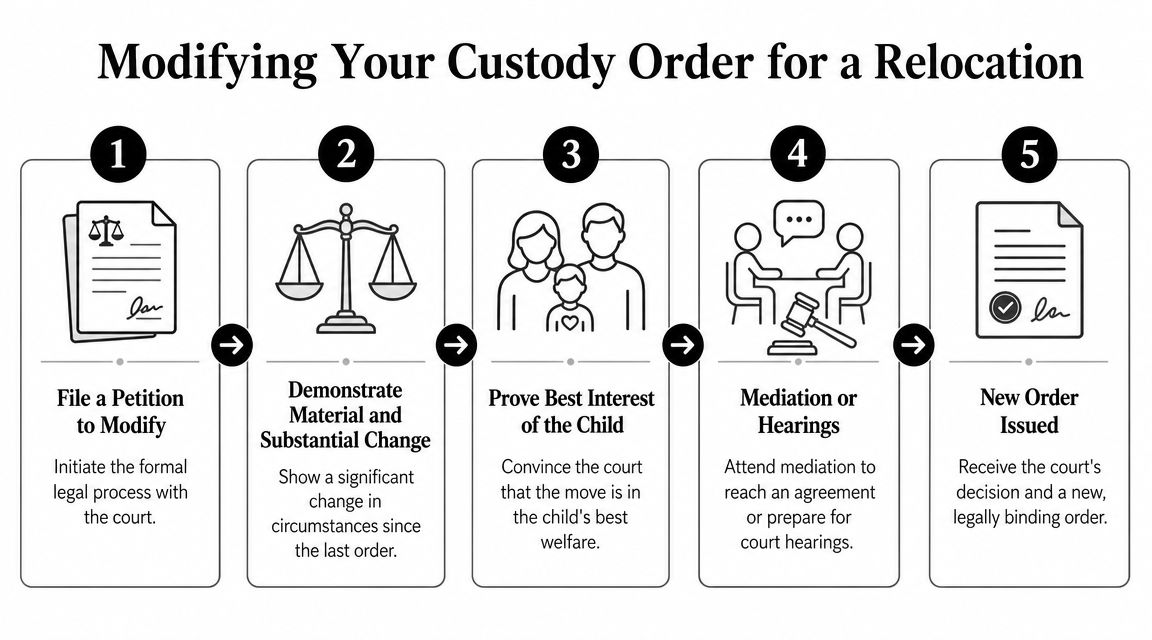
If the other parent will not agree, the usual step is to file a Petition to Modify the Parent-Child Relationship and ask the judge to change the current order so the move is allowed.
Start with the court's two main questions
A modification request usually rises or falls on two ideas.
First, what has changed since the current order was signed? Texas courts often require a material and substantial change in circumstances before they will modify custody terms. In everyday terms, the judge is asking, "What is different now, and why does that difference matter?"
Second, why is the requested change better for the child? That is the best interests of the child standard. The court is focused on the child's life, not only the parent's plans.
Those two questions sound simple, but they do a lot of work. They are the court's filter. If your evidence does not answer them clearly, the case gets harder.
What counts as a meaningful change
A move itself can be part of the change, but judges usually want the full picture. The stronger cases show a reason that is specific, real, and tied to the child's day-to-day life.
Examples can include:
- A documented job change with better pay, steadier hours, or benefits that improve the child's stability
- A support-system reason such as relocating closer to relatives who can reliably help with childcare
- A child-centered need involving school services, therapy, medical treatment, or a safer living situation
- A practical breakdown in the current setup where the existing geographic restriction no longer fits the family's reality
This is one area where parents often get tripped up. A move across state lines is not the only kind of relocation that matters. A move from one Texas county to another can still affect school pickup, weekday possession, commute times, and the other parent's ability to stay involved. If the move changes how the current order works in real life, the court may treat it seriously even if you are staying in Texas.
What evidence actually helps
Judges usually want more than a general statement that the move is a good idea. They want something they can evaluate, compare, and trust.
Here is a helpful video overview of the process:
A useful way to prepare is to build your case like a set of answers to predictable concerns.
- Employment records. Offer letters, transfer documents, work schedules, and details showing how the change improves housing or financial stability.
- School information. Enrollment options, academic programs, special education services, or other facts that show why the new school fits your child.
- Medical or counseling records. Information showing access to specialists, therapy, or treatment that matters for your child's health.
- Childcare and family support details. Names, schedules, locations, and a clear explanation of how that help would benefit the child each week.
- A revised possession schedule. Specific plans for weekends, holidays, school breaks, transportation, costs, and regular communication with the other parent.
A judge is often comparing two futures. One future keeps the current order in place. The other allows the move with a new schedule. Your job is to make the second future feel stable, realistic, and child-focused.
Complex reasons can still be valid
Some parents worry because their reason is not a single neat headline like "I got a new job." Real life is often messier than that.
Maybe the move is driven by several factors at once. Better housing. Family support. A child's anxiety. A school with services your current district does not offer. A work schedule that lets you be home after school instead of relying on patchwork childcare. Courts can consider that fuller story if you present it clearly and back it up with records.
That is why organization matters so much. A timeline, supporting documents, and a practical parenting proposal can make a complicated reason easier for a judge to follow.
Keep bringing the focus back to the child. The court is less interested in a parent wanting a fresh start than in how the move will improve the child's routine, support, and relationship with both parents.
What the process usually looks like
Many modification cases involve several stages. You file the request. The other parent responds. There may be negotiation, mediation, temporary orders, or a hearing if no agreement is reached.
Parents often feel less overwhelmed once they see the paperwork involved. Reviewing the Texas custody modification forms can help you understand what information the court will expect and what facts you should start gathering now.
If you are asking for permission to move, your goal is to present a workable plan, supported by evidence, that shows why the change serves your child and preserves the other parent's role in a realistic way.
The High Stakes of Moving Without Court Permission
A parent gets offered a better job in another city. The start date is close. School is about to begin. Family members are saying, "Just go now and deal with the paperwork later."
That choice can backfire fast.
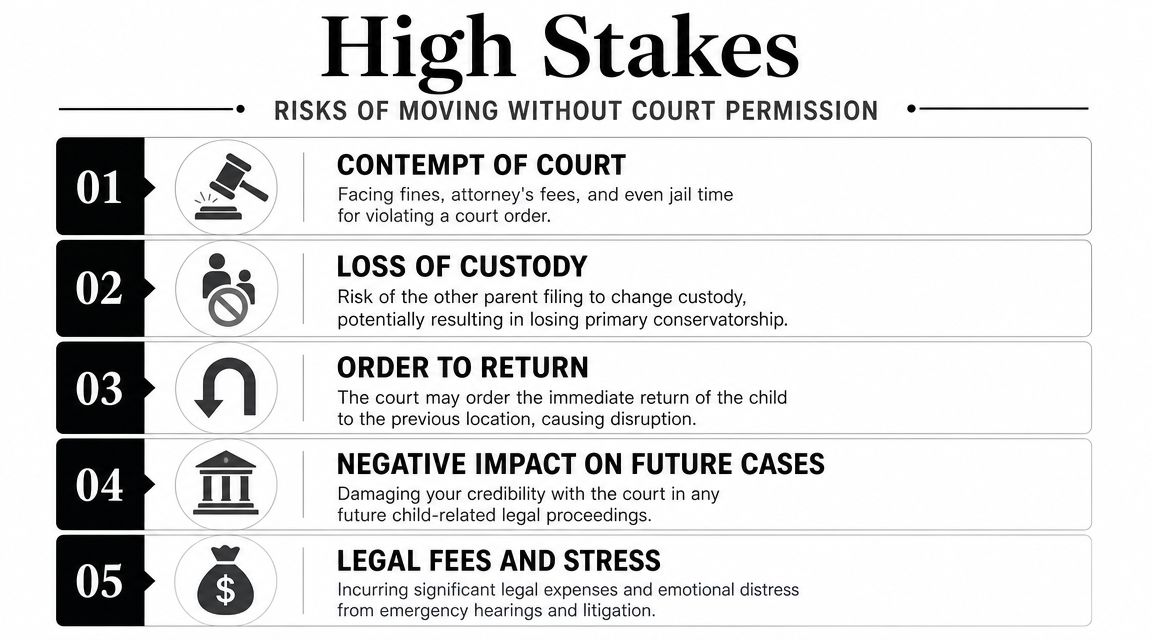
If your custody order limits where the child can live, moving first can turn a relocation request into an enforcement case. Instead of asking, "Would this move help the child?" the court may start with a different question. "Why did this parent ignore the order?"
What can happen if you move anyway
Texas courts can respond in several ways if a parent relocates with a child in violation of an existing order. The exact outcome depends on the wording of the order, how far the move is, whether the other parent objects, and how the move affects the child's schedule and stability.
Common risks include:
An order to return the child
A judge may require the child to return to the restricted area while the case is sorted out. For a child, that can feel like being asked to build two routines in a matter of weeks. One school, then another. One childcare plan, then a rushed replacement.
Contempt proceedings
A custody order is a court command, not a suggestion. If a parent knowingly breaks it, the other parent may file an enforcement action and ask the judge to hold that parent in contempt.
A change in who has the right to decide the child's primary residence
This is often the risk parents underestimate. A judge may conclude that the parent who moved without permission is less likely to support the child's relationship with the other parent. In some cases, that concern can shape future custody decisions.
Why judges take this so seriously
Judges usually care about more than mileage. A move across state lines gets attention, but so can a move across county lines if it disrupts exchanges, school attendance, therapy, or the other parent's time with the child.
That point confuses many parents. They assume a shorter move is automatically safer from a legal standpoint. Sometimes it is. Sometimes it is not. If the move breaks the geographic restriction or makes the current possession schedule unworkable, the problem is the same.
Unauthorized moves can also hurt credibility. If you later tell the court that you acted for a complicated but genuine reason, such as a safer home, family support, a new work schedule, or a child's educational needs, the judge may still wonder why you did not ask first. Following the process often matters almost as much as the reason for the move itself.
Courts tend to trust parents who protect the child's stability and respect the existing order, even under pressure.
The practical lesson
Stay within the current order until you have an agreement or a court order allowing the move.
That can feel unfair, especially when life is not waiting politely. Employers want answers. Leases expire. Family support may be in another town. But taking action first can weaken the very case you hoped to make.
If your situation is urgent, address it through the court rather than through a unilateral move. That gives you a chance to explain the full story, with evidence, before a judge is deciding whether you exercised good judgment.
Navigating Special Relocation Scenarios
Some relocation cases don't fit the standard pattern. The law still applies, but the facts call for faster decisions and more careful planning.
Military families
A military parent may receive orders that change housing, work location, or deployment status with little warning. In that situation, timing becomes a major issue. The parent still needs to review the order and address any residence restriction, but courts also recognize that service-related moves can create unique scheduling problems.
A military family may need to revise possession terms, transportation details, and communication plans so the child stays connected to both parents as consistently as possible.
Safety-related moves
Sometimes a parent isn't moving for convenience at all. The reason is safety. That may involve family violence, threats, stalking, or another urgent concern affecting the child or parent.
In those cases, the legal question becomes more immediate. A parent may need to seek emergency relief from the court rather than proceed through the usual pace of negotiation. The facts must still be presented clearly, and the parent should avoid assuming that danger automatically cancels an existing order without court involvement.
Interstate issues
If the move crosses state lines, another layer comes into play. Jurisdiction matters. Courts look at which state has authority to make or modify child custody decisions. Parents often hear the term UCCJEA, which stands for the Uniform Child Custody Jurisdiction and Enforcement Act. In simple terms, it helps determine which state's court gets to decide the custody issue.
Real-world gray areas
Many parents aren't dealing with a dramatic out-of-state move. They're dealing with a job in another metro area, a move just outside the restricted county, or a relocation to live near grandparents who can help after school.
Those are often the hardest cases emotionally because the reasons are understandable, but the legal answer still depends on the order and the child-focused evidence. Mothers and fathers both face the same core challenge. They need to show that the move isn't just better for the adult. It's better for the child, too.
Your Next Steps A Practical Checklist for Moving
You get offered a better job in a nearby county, your sister has room for you and the kids, and school starts in a month. It feels like a simple life decision. Under a Texas custody order, it may also be a legal decision that needs planning before you pack a single box.
Your relocation checklist
Start with your order. It works like the rulebook for this move. Parents often focus on the reason for relocating first, but judges usually start with the written order and then look at whether the requested move helps the child.
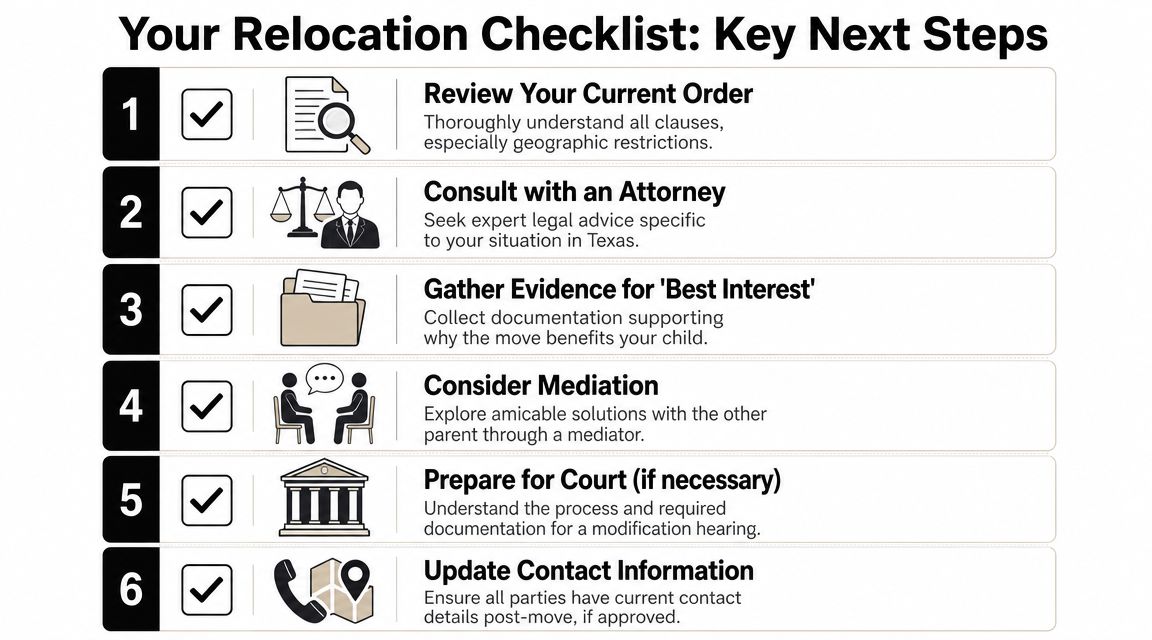
Use this checklist to get organized:
- Find your current order. Read the parts covering conservatorship, possession, the child's primary residence, and any notice requirements.
- Pinpoint the geographic restriction. Check whether the child must live in a certain county, nearby counties, or another defined area. A move across town may be allowed. A move just over a county line may require court action.
- Write down the underlying reason for the move. Job changes matter, but so do family support, housing stability, school needs, medical care, and safety concerns. If your reason is more complicated than a single job offer, spell it out clearly.
- Gather proof that answers the judge's likely question. How does this help the child, not just the parent? Useful documents may include job offers, school records, lease information, childcare plans, medical information, and details about nearby family support.
- Build a practical parenting plan. Show how weekends, holidays, summer time, transportation, and phone or video contact would work after the move.
- Decide whether agreement is realistic. If the other parent may cooperate, an early and respectful conversation can save time, money, and stress.
- Get legal advice before you act. A family law attorney can review the order, explain the risk of a proposed move, and help you choose between negotiation and a modification request. One option is The Law Office of Bryan Fagan, PLLC, which handles Texas custody modifications, visitation disputes, and relocation-related cases.
Key takeaway
The safest approach is simple. Read the order carefully, treat the geographic restriction seriously, and get approval before moving if the order requires it.
That matters in the gray-area cases, too. A move to another state is not the only move that can create a problem. A move to a neighboring county, a different metro area, or a home closer to relatives can still affect the current order and the other parent's time with the child.
You do not need every answer today. You do need a clear plan, good records, and a realistic view of what a judge will want to see.
If you need help with a child custody or visitation case in Texas, our experienced attorneys can guide you every step of the way. Contact The Law Office of Bryan Fagan, PLLC today for a free consultation.