
When your child’s future is on the line, understanding your rights matters most.
A lot of parents come to this issue the same way. They’re staring at a calendar, counting school nights, soccer games, and bedtime routines they’re missing. They don’t just want “visitation.” They want a real place in their child’s everyday life.
That’s why the expanded standard possession order texas rule matters so much. For many families, it changes custody from a weekend-only rhythm into something that feels more like real parenting. If you’re a mother, father, grandparent, or caregiver trying to make sense of Texas custody law, this guide is meant to calm the noise and give you a clear path forward.
When Every Weekend Counts Understanding Your Custody Schedule
Maria keeps the school calendar on her kitchen table. Her son’s field trip is on a Friday. His reading award ceremony is on a Thursday morning. Under an older possession schedule, those moments felt just out of reach. She had weekends, but not much of ordinary life.
That’s the part many parents don’t expect. The hard part usually isn’t only missing holidays. It’s missing the small things. Homework at the kitchen counter. A rushed search for a missing shoe. A sleepy goodnight before a spelling test.

For years, many Texas parents felt pushed into the role of “weekend parent.” That label hurts because it doesn’t reflect how most parents feel. They want to show up on regular days, too. They want to help with homework, school drop-offs, and bedtime routines.
The Expanded Standard Possession Order, often called ESPO, speaks directly to that concern. It isn’t just a technical rule in the Texas Family Code. It’s a change in how Texas courts look at parenting time and consistency.
Why this change feels so personal
Texas custody law uses terms that can sound cold. Possession means time with your child. Access means your right to visit, communicate, and stay involved. Joint managing conservatorship usually means both parents share major rights and duties, even if one parent decides the child’s primary residence.
Those legal labels matter, but your daily life matters too.
A possession schedule isn’t just a calendar. It shapes who helps with math homework, who gets the Thursday night phone call from the teacher, and who sees the child off to school on Monday morning.
If you’re worried that you’ve already lost too much time, you’re not alone. If you’re confused by the rules, that’s normal. Texas law can be complicated, but the goal behind these schedules is simpler than it sounds. Courts are trying to support the best interests of the child, which means the arrangement that best supports a child’s stability, safety, relationships, and healthy development.
What Is the Expanded Standard Possession Order in Texas
The Expanded Standard Possession Order, or ESPO, is the schedule Texas courts now often start with when parents live close enough for regular school-night and weekend exchanges to work.
As of September 1, 2025, Texas law treats the ESPO as the usual starting schedule for many parents who live within 50 miles of each other. In practical terms, that means the court begins with a plan that gives the non-primary parent more routine time with the child, not just shorter visits built around weekends.
What “presumptive default” means
That phrase can sound intimidating. It is simpler than it looks.
Presumptive default means the judge starts with this schedule unless there is a good child-focused reason to choose something else. It works like a template. The court does not have to invent a possession schedule from scratch in every case. Instead, the law offers a starting model, and either parent can argue for a different arrangement if the facts support it.
For a worried parent, that matters a lot. You are no longer walking into court asking for extra time as if regular weekday involvement is unusual. The law now starts closer to the idea that many children benefit from meaningful time in both homes.
How courts decide whether ESPO fits your family
The court still has one main job. It must decide what is in the best interest of the child.
That standard is about the child’s real life, not either parent’s sense of fairness. A judge looks at whether the schedule supports the child’s health, stability, school routine, relationships, and safety.
Common factors include:
- Consistency at home and school: Can the child keep a steady sleep schedule, get to school on time, and move between homes without constant disruption?
- Each parent’s involvement: Can both parents handle regular parenting tasks such as homework, meals, transportation, and bedtime?
- Distance and logistics: Do the parents live close enough to make Thursday nights, weekends, and school exchanges realistic?
- Age and specific needs: Does the child have medical, emotional, developmental, or safety concerns that call for a different plan?
Why this change feels different in daily life
A custody order is not just legal paperwork. It sets the rhythm of your child’s week.
Under the ESPO, a parent may have more chances to be part of ordinary moments. That can mean packing a lunch on Friday morning, checking a spelling list on Thursday night, or handling a Monday school drop-off after a weekend together. Those moments build familiarity. For many children, that steady contact helps both homes feel like real parts of life, not one main home and one place for visits.
That is also why the ESPO matters in court. It reflects a broader view of parenting. The law now starts from a schedule that often allows more routine involvement, while still leaving room for a different order if that better serves the child.
Practical point: ESPO is the court’s starting place in many cases, not an automatic result in every case. If your child’s needs, your work schedule, the distance between homes, or safety concerns make the default schedule a poor fit, the judge can order something different.
If you are reading this with a knot in your stomach, here is the reassuring part. A default schedule does not decide your case by itself. Your family’s facts still matter, and clear preparation can make a real difference.
How the ESPO Differs from the Old Standard Possession Order
The difference between the old schedule and the newer expanded schedule looks small on paper. In daily life, it can feel enormous.
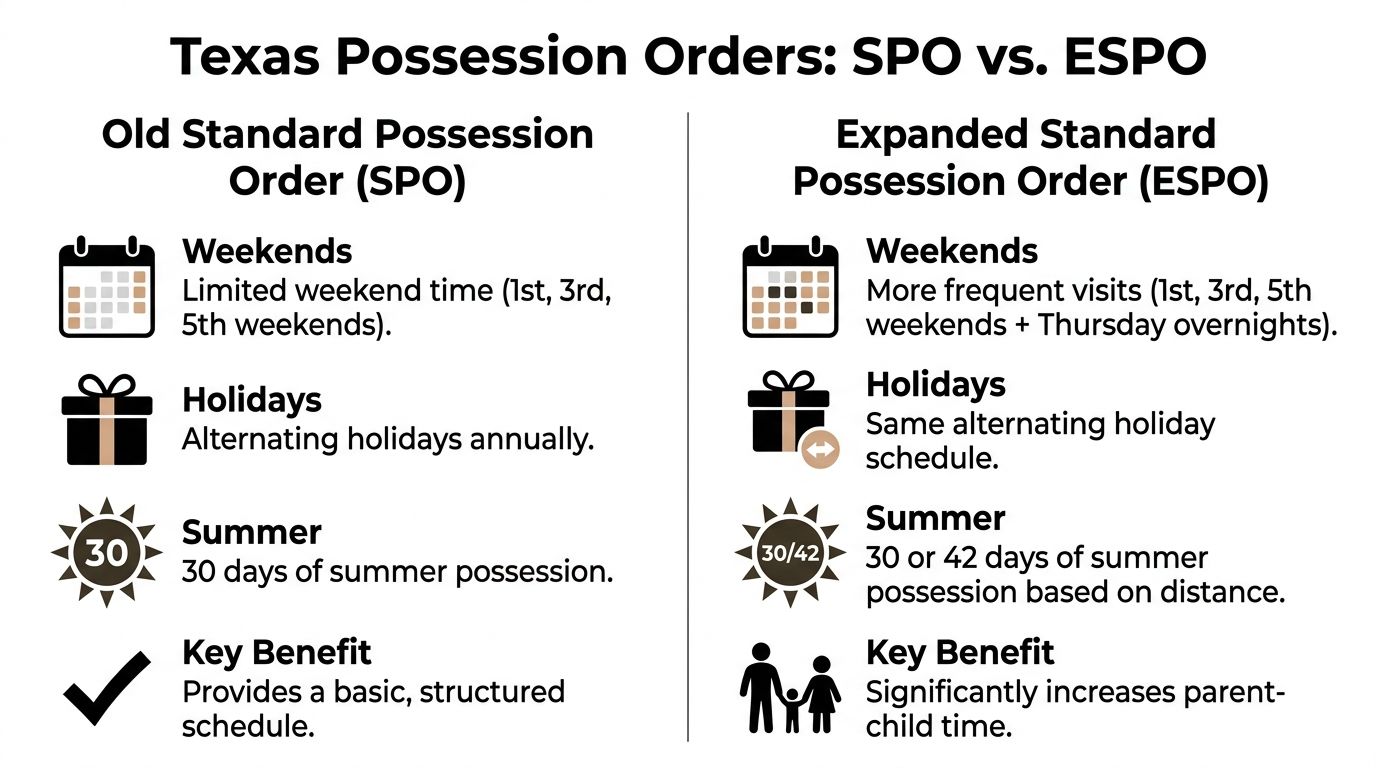
Under the older Standard Possession Order, many non-primary parents had time that centered on weekends and shorter weekday contact. Before ESPO became the norm, the traditional SPO often gave around 35% to 42% of overnights, typically from 6 p.m. Friday to 6 p.m. Sunday, while ESPO added Thursday overnights and extended weekends to Monday mornings, as explained in this overview of the change.
Why Monday morning matters
A Sunday evening return can feel rushed. Bags are packed. Homework is checked at the last minute. Everyone knows the weekend is ending.
A Monday school drop-off often feels more natural. The child goes from one home into the school day, and the exchange happens with less direct parent-to-parent friction. For many families, that lowers stress even when the legal order itself feels new.
The Thursday overnight changes the week
This is one of the biggest practical shifts.
A Thursday overnight means the non-primary parent isn’t just seeing the child for dinner and returning them the same night. That parent gets a true school-night routine. Dinner. Bath. Homework. Bedtime. Breakfast. School prep.
That’s not a small thing. It’s how children experience someone as part of their regular life.
SPO vs. ESPO At a Glance
| Feature | Standard Possession Order (SPO) | Expanded Standard Possession Order (ESPO) |
|---|---|---|
| Weekend timing | Often Friday evening to Sunday evening | Friday after school to Monday morning |
| Weekday time | Shorter weekday periods | Thursday overnight during the school year |
| Daily-life involvement | More limited school-night participation | More chances for homework, bedtime, and morning routines |
| Court posture | Older baseline in many cases | Default starting point for many parents within 50 miles |
| Overall feel | More like visitation blocks | More like shared day-to-day parenting |
A day in the life comparison
Under the older SPO, a parent might pick the child up Friday evening, enjoy the weekend, then return the child Sunday evening just as school stress begins.
Under ESPO, that same parent may get the child after school Friday, keep them through the weekend, and take them to school Monday morning. Add the Thursday overnight, and that parent now has two anchors in the child’s weekly life.
Children usually don’t measure love by legal labels. They feel it through routines, consistency, and who shows up on ordinary days.
The ESPO Schedule Explained Day by Day
A lot of parents do not get stuck on the legal words. They get stuck on Thursday at 3:15 p.m.
Who picks up from school? Where does the backpack go? Does your child sleep at your house and wake up there for school? Those are the questions that make the Expanded Standard Possession Order feel real.

For many parents who live within 50 miles of each other, ESPO changes the week in practical ways. It gives the non-primary parent more of the child’s ordinary life, not just special-event time. That usually means more school pickups, more homework nights, more bedtime routines, and more Monday morning returns.
If you want a visual reference, these Texas visitation schedule examples can help you match the legal language to a real calendar.
Weekends under ESPO
The usual weekend pattern is the first, third, and fifth weekends of each month.
The counting can feel confusing at first, so use a simple rule. Find the first Friday in the month. That Friday starts the first weekend. The next applicable blocks follow from there.
Under ESPO, weekend possession usually begins at school dismissal on Friday and ends when school resumes Monday. If school is not in session, your order may use a different exchange time. The signed order controls.
A month might look like this:
- First weekend: Pickup after school Friday. Return to school Monday morning.
- Third weekend: Same schedule.
- Fifth weekend: Applies only in months with a fifth Friday.
That extra Sunday night matters more than many parents expect. It gives you time for the ordinary parts of parenting, like packing the lunchbox, checking homework, and getting your child settled for the school week.
Thursday overnights
The Thursday overnight is often the part of ESPO that changes family life the most.
Instead of a short visit that ends before bedtime, the child usually goes with the possessory conservator at school dismissal on Thursday and returns when school resumes on Friday. For a child, that can feel less like a visit and more like having two homes that both handle regular life.
That matters emotionally and practically. A parent who handles a Thursday night is helping with reading logs, permission slips, missing socks, bedtime nerves, and the rushed breakfast before school. Those small moments build familiarity and trust.
School-based exchanges can also reduce friction between parents because the handoff happens around the school day instead of late in the evening at one parent’s home.
Helpful habit: Put every Thursday overnight and every first, third, and fifth weekend into a shared calendar as soon as the order is signed.
Holidays and school breaks
Holiday schedules usually take priority over the regular weekly schedule. Many parents make mistakes at this point. If your order says Thanksgiving goes to one parent in a certain year, that holiday schedule usually controls even if it lands on someone else’s regular weekend.
Three reminders can prevent a lot of conflict:
- Read the exact wording in your order.
- Check whether the year is even or odd.
- Assume the holiday schedule overrides the normal weekend schedule unless the order says otherwise.
Treat holidays like a separate overlay on top of the regular calendar. The weekly pattern is still there, but the holiday language can cover it up for those dates.
Summer possession
Summer often creates the most stress because camps, vacations, work schedules, and family trips all compete for the same weeks.
In many Texas orders, the non-primary parent receives 30 consecutive days in the summer. If that parent does not choose dates by April 1, the default period is often July 1 through July 31, as noted earlier. Missing that deadline can change your entire summer plan, so it is smart to calendar it well in advance.
If your child has activities, summer school, or medical appointments, start discussing those dates early. A custody schedule works best when the legal rule and the child’s real life are lined up before summer arrives.
Terms parents should know
A few labels in the order can sound colder than they really are.
- Joint managing conservatorship: Both parents usually share major decision-making rights.
- Possessory conservator: The parent who has periods of possession under the schedule.
- Primary conservator: The parent who usually decides the child’s primary residence.
These are legal job titles, not measures of love or importance. The schedule tells you when the child is with each parent. The labels tell you how the court organized the responsibilities.
How to Request or Modify Your Custody Order
If you’re filing a new custody case, the practical starting point is straightforward. Expect the court to consider ESPO if your family fits the distance and age requirements.
If you already have an older order, the path is different. You usually need a modification.
To modify a pre-2021 order to an ESPO, a parent must show a material and substantial change in circumstances, and the law change by itself is not enough. A move to within 50 miles of the child or evidence showing why the change serves the child’s best interest can support that request, as explained in this discussion of modifying an older Texas order.

If you’re trying to change an existing order, this guide on how to modify custody in Texas is a useful place to start.
What counts as a material and substantial change
Texas courts don’t modify orders just because one parent feels frustrated.
Examples that may matter include:
- A parent moved closer: The distance between homes now fits the ESPO framework.
- The child is older: A schedule that didn’t fit years ago may fit now.
- School routines are established: The child can handle overnights and transitions better.
- Family life changed: Work hours, transportation, or caregiving roles look different now.
The court still asks the same core question. Is the requested change in the child’s best interest?
The basic legal path
Most modification cases follow a familiar pattern.
File the right pleading
You usually begin by filing a Petition to Modify the Parent-Child Relationship. That asks the court to change the existing order.
Gather proof
Judges want facts, not just feelings.
Helpful proof may include calendars, school records, communication logs, work schedules, or documents showing a move and current address. If your child is thriving with more contact, details matter.
Try mediation
Many Texas courts require or strongly encourage mediation before a final hearing. Mediation is a guided settlement process with a neutral third party. It can be less stressful than trial and may help parents reach a schedule suited to real life.
Go to court if needed
If no agreement is reached, a judge decides. That’s where clear preparation matters most.
One practical option families consider during this process is working with counsel familiar with custody modifications, including firms such as Law Office of Bryan Fagan, PLLC, which handles Texas possession, modification, and enforcement matters.
Bring a written timeline to any consultation. Dates of moves, school enrollment, missed exchanges, and changes in your child’s needs can make your story easier for the court to follow.
Navigating Special Circumstances and Common Pitfalls
Not every family fits neatly into the same schedule. That doesn’t mean you’re stuck. It means the facts matter more.
When distance changes the schedule
Distance is one of the biggest practical dividing lines in Texas possession law.
If parents live 50 miles or less apart, ESPO is the default framework in qualifying cases. If they live farther apart, the schedule can change. Families who live at a greater distance often deal with a different rhythm focused on longer blocks of time and different travel planning.
That’s why a move matters so much. A relocation can affect exchanges, summer periods, school routines, and whether a modification should be requested.
Military families and relocation
Military parents often carry an extra layer of stress. Deployment orders, training schedules, and PCS moves can all affect possession.
The most important step is to act early. If a service-related move is coming, don’t wait until the last minute to review your order. A court may need to address temporary changes, long-distance possession, or makeup time.
Keep records. Save orders, travel details, and communication with the other parent. Good documentation helps reduce confusion and gives the judge a clearer picture if a dispute arises.
Children under age three
This is one area where many parents get surprised.
For children under age three, there is no presumption for ESPO. Texas Family Code §153.254 requires judges to create more customized orders based on the child’s needs and attachment bonds, often using shorter, more frequent periods instead of full overnights at first, as explained in TexasLawHelp’s discussion of possession orders.
Why toddler cases look different
A schedule built around school dismissal doesn’t fit a baby or toddler the same way it fits a school-aged child.
Judges often look closely at:
- Feeding and sleep routines
- Attachment to each caregiver
- Consistency between homes
- The child’s developmental stage
In many cases, the court uses a “stair-step” approach. That means the schedule grows as the child gets older and can handle longer periods away from each parent.
Grandparents and enforcement issues
Grandparents sometimes ask how they fit into this system. The answer is usually that grandparent rights follow a different legal path than a parent’s possession order. A grandparent may need to meet separate legal standards before the court grants access or conservatorship.
Another common problem is this: a good order exists, but one parent doesn’t follow it.
If that’s happening, review your enforcement options before the missed periods pile up. This overview of a motion to enforce custody in Texas can help you understand the next step.
Don’t rely on text-message agreements alone when problems keep repeating. Informal workarounds may solve one weekend, but they often create bigger disputes later.
Key Takeaways and Your Next Steps
A custody order is more than a calendar. It shapes who handles Thursday homework, who gets the rushed Monday morning drop-off, and how often your child gets ordinary time with each parent. That is why the last step is not just knowing the rule. It is knowing what to do with it.
Key takeaways
- ESPO is the starting point for many families: If parents live close enough, Texas often begins with an expanded schedule rather than the older, narrower one.
- Small schedule changes affect real life: A Thursday overnight or a Monday school return can shift bedtime routines, school prep, and weekday parenting time in a meaningful way.
- The child’s best interest still decides the case: Judges can use a different schedule if the usual one does not fit your child’s needs.
- Older orders stay in place until they are changed: If your current order uses older language, you may need to ask the court for a modification.
- Some families need a more specific plan: Very young children, military parents, parents who live far apart, and grandparents often raise separate legal questions.
Your next steps
- Confirm the distance between homes. Mileage can affect which possession schedule applies, so use exact addresses and measure carefully.
- Read the order line by line. Look for start times, end times, holiday terms, and school-year language. A single sentence can change who has the child on a given weekend.
- Put the schedule on a real calendar. Add school holidays, summer deadlines, and exchange details. Those details can change how the order works in practice.
- Write down what is working for your child. Keep clear notes about school attendance, transportation, medical needs, communication, and your day-to-day involvement.
- Talk with a lawyer before you file anything. A short meeting can help you spot weak points, gather the right facts, and ask the court for relief that matches your family’s actual routine.
If you are trying to protect stability, stay closely involved, or preserve an important family bond, those concerns deserve careful attention. Texas family law can feel intimidating, but it gets much easier to handle once you understand the schedule, the pressure points, and the steps the court expects you to take.
If you need help with a child custody or visitation case in Texas, our attorneys can guide you through the process. Contact The Law Office of Bryan Fagan, PLLC today for a free consultation.