
When your child's future is on the line, understanding your rights matters most.
One day, the normal parenting routine is still in place. Then a call comes from CPS. Or you're served with court papers claiming you abused your child or the other parent. Or your co-parent suddenly says visitation is off until “the investigation is over.” In a few minutes, your world can feel upside down.
If you're in that moment now, the fear is real. Parents usually ask the same urgent questions. Am I going to lose my child? Do I answer CPS right away? Can the judge stop my visits before anything is proven? If I reported abuse, did I just put my own custody rights at risk too?
Texas custody cases involving abuse allegations move fast, and they often split into two different problems at the same time. One is about child safety and CPS. The other is about conservatorship and possession in family court. Conservatorship is Texas's word for custody. It covers rights and duties, such as who makes major decisions for the child. Possession and access means the schedule for when each parent has time with the child.
That overlap is what makes these cases feel chaotic. It can help to see how other high-conflict cases are handled when facts, fear, and credibility collide. For a broader example of how contested custody accusations can be unpacked, these insights for military custody disputes show how careful evidence work can matter when one parent says the other is dangerous.
The good news is that an accusation does not decide the case by itself. Texas judges still have to look at evidence, safety, and the best interests of the child. That phrase means the court must choose the arrangement that most protects the child's physical safety, emotional health, stability, and long-term well-being.
Introduction
A parent accused of abuse in a custody case often feels trapped between panic and anger. The accusing parent often feels just as overwhelmed, especially if they're trying to protect a child and don't know whether the system will act quickly enough. Both sides usually feel that time matters, and they're right.
Texas courts under Texas Family Code Chapter 153 focus on the child's best interests, not on rewarding one parent or punishing the other. In plain English, a judge wants to know where the child will be safest, who can make good decisions, and what schedule protects the child while still preserving healthy parent-child relationships when possible.
Why the first response matters
The first few days often shape the rest of the case. What you say to CPS, what texts you send, whether you follow temporary restrictions, and how quickly you gather records can all affect credibility.
Practical rule: Don't treat an abuse allegation like a misunderstanding that will clear itself up. Treat it like an emergency that needs a calm, organized response.
If you're the accused parent, you need to protect your rights without looking defensive, evasive, or volatile. If you're the reporting parent, you need to protect the child without overstating facts or turning a safety concern into a credibility problem.
What this looks like in Texas families
In many Texas cases, the immediate issue isn't a final custody ruling. It's whether the court will enter short-term restrictions while more facts are gathered. A judge may keep the child with one parent temporarily, order supervised visits, appoint an amicus attorney in some cases, or set a quick hearing to sort out risk.
Joint managing conservatorship is the common Texas term for shared legal custody. It means both parents may share certain rights and duties. But even when parents are joint managing conservators, one parent may have the exclusive right to determine the child's primary residence, and possession schedules can differ sharply. In abuse cases, a judge may decide that shared decision-making or a standard possession schedule isn't safe right now.
That's why the right question isn't just, “What happens if a parent is accused of abuse in a custody case?rdquo; The better question is, “What happens first, what matters most, and what should I do next?rdquo;
What Happens Immediately After an Abuse Allegation Is Made
The first stage is usually noisy and confusing. CPS may call. A lawyer may file for emergency relief. The other parent may stop cooperating. A school counselor, doctor, or family member may also become involved as a witness.
The first 24 to 72 hours
If someone reports abuse, Child Protective Services may begin an initial assessment. CPS is trying to answer a practical question first. Is the child safe today? That can lead to phone calls, home visits, interviews, requests to speak with the child, or demands for background information.
At the same time, a parent may ask the family court for emergency orders. In Texas, that can include a Temporary Restraining Order, often called a TRO. A TRO is a short-term court order meant to hold the situation in place and prevent immediate harm until the judge can hear more evidence. It may restrict contact, bar a parent from removing the child, or stop certain behaviors.
If you're facing that emergency stage, it helps to understand how a Texas court can act quickly through an immediate custody order in Texas.
What parents often get wrong
Some accused parents think they should “clear things up” by sending long emotional texts, confronting the accuser, or showing up unannounced to see the child. That usually makes things worse. Judges and investigators notice behavior that looks impulsive or intimidating.
Some reporting parents make the opposite mistake. They assume that once abuse is reported, the accused parent will automatically lose custody or visitation. That isn't how courts usually work. In a major family-court dataset, mothers who reported a father's abuse lost custody in 26% of cases, while fathers found by the court to have committed physical abuse still won custody 19% to 20% of the time, according to the family-court research by Joan S. Meier and colleagues. The practical point is simple. An allegation creates serious scrutiny, but it doesn't automatically decide possession or conservatorship.
What to do right away
- Protect the child first: If there is immediate danger, use lawful channels. Call emergency services if necessary and seek emergency legal relief.
- Preserve evidence: Save texts, emails, photos, medical records, school notes, and call logs.
- Say less, document more: Keep communication brief, factual, and child-focused.
- Get legal advice fast: Delay can hurt either side, especially when temporary orders are on the table.
If a judge believes there may be a present safety risk, the court can act before the final facts are sorted out.
Navigating Two Parallel Processes CPS and Family Court
One of the hardest parts of these cases is understanding that CPS and family court are not the same thing. They run side by side, like two train tracks heading to different destinations.

Two systems with different jobs
CPS focuses on child safety. It investigates reports, interviews people, reviews conditions, and may create a safety plan. That process can influence court decisions, but CPS doesn't enter final divorce or SAPCR custody orders.
Family court decides conservatorship, possession, access, and parental rights under Texas law. The court asks what arrangement serves the child's best interests. That includes safety, but also stability, parenting history, decision-making ability, and the child's needs.
If your case involves conduct that may place a child at risk, this overview of child endangerment and custody in Texas helps explain how those concerns can affect the court's analysis.
How they interact
A CPS investigator's concerns can support a request for temporary restrictions in family court. A family court judge may also consider CPS records, interviews, and safety recommendations. But the judge is not required to copy CPS's position in every case.
A useful way to think about it is this:
| Process | Main focus | Typical outcome |
|---|---|---|
| CPS | Immediate child safety | Findings, recommendations, safety plans |
| Family court | Longer-term parenting rights | Temporary orders, final conservatorship and possession orders |
What parents need to remember
- You may be dealing with both at once: A CPS interview does not replace a court hearing.
- Documents can cross over: Records gathered in one process may matter in the other.
- Your strategy must fit both forums: What helps with CPS may not be enough for court, and vice versa.
A parent who only prepares for CPS can get blindsided in court. A parent who only prepares for court can mishandle the CPS side and create avoidable problems.
How Texas Courts Change Custody and Visitation Temporarily
Texas judges often use temporary orders to lower risk while the case is pending. These orders aren't the final answer. They are the court's short-term way of protecting the child and stabilizing the situation.

What judges look at
Judicial guidance tells courts to use a safety-first analysis. Judges are instructed to assess whether the child or either parent is at risk of physical, emotional, or mental abuse, determine whether the alleged act is part of a broader pattern, and consider the impact on the child and the other parent, as described in the National Council of Juvenile and Family Court Judges bench guidance.
That matters in real life because a judge doesn't need to wait for a full trial to act carefully. If the evidence suggests an ongoing danger, the court may order temporary restrictions.
What temporary changes can look like
A Texas judge may order:
- Supervised visitation: The accused parent can see the child, but only with a neutral adult or professional supervisor present.
- Modified possession schedules: Visits may become shorter, daytime-only, or limited to specific locations.
- Exclusive temporary rights: One parent may temporarily control decisions about residence, school, or medical care.
- No direct contact between parents: Exchanges may happen through a third party or monitored setting.
A hearing on these issues can be a turning point, especially if you're trying to understand what happens at a temporary orders hearing in Texas custody cases.
What supervised visitation really means
Parents often hear “supervised visitation” and assume it means the case is already lost. It doesn't. It means the court wants contact to happen in a controlled way while facts are still being developed.
Supervision can happen through a professional visitation center, a mutually approved third party, or another arrangement the court accepts. The details matter. Who supervises, where visits occur, whether conversations are monitored, and how reports are made can all affect later requests to expand parenting time.
A temporary restriction isn't always a final judgment about your parenting. It's often the court's way of buying time while trying to keep the child safe.
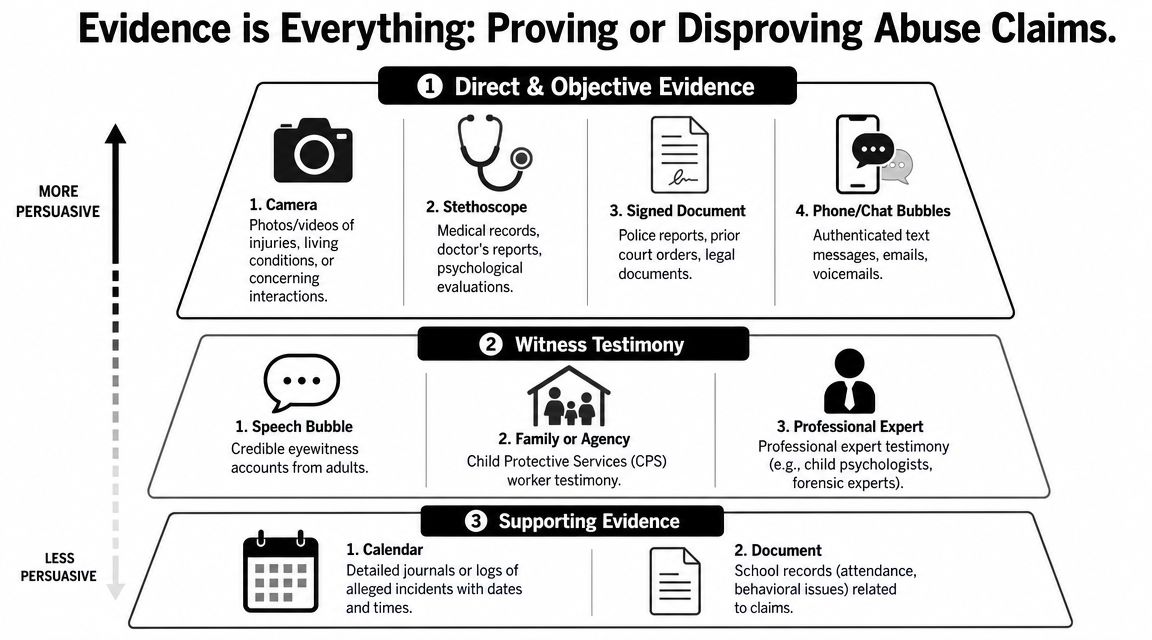
Evidence Is Everything How to Prove or Disprove Abuse Claims
In abuse-related custody cases, judges don't want speeches. They want proof. That is true whether you're trying to show abuse happened or trying to show the allegation is false, exaggerated, or incomplete.
What carries weight
Research shows that abuse allegations are not always decisive unless supported by independent evidence. In one study, allegations of intimate partner abuse by themselves did not significantly change custody mediators' recommendations. Stronger effects appeared when the accused parent had a documented criminal history or behaved belligerently during proceedings, according to this empirical study on custody mediation and abuse allegations.
That lines up with what courts do every day. The closer you can get to objective proof, the stronger your position usually becomes.
Here are the categories that usually matter most:
- Direct records: Medical records, photographs, police documentation, prior protective orders, or authenticated messages.
- Neutral witnesses: Teachers, counselors, pediatricians, CPS workers, coaches, neighbors, or supervisors.
- Behavior evidence: Missed exchanges, threatening messages, intoxication concerns, or repeated violations of prior orders.
- Case-specific context: A timeline that shows when incidents happened and what changed afterward.
This visual breaks down how different forms of proof are often viewed in practice.
Evidence for the accusing parent
If you believe your child has been abused, don't rely on memory alone. Build a clean file.
- Use original records: Keep the unedited screenshots, not just summaries.
- Get medical attention when needed: Treatment records can be important if there are injuries or concerning disclosures.
- Track dates carefully: A simple timeline often helps a judge understand a confusing fact pattern.
- Avoid coaching the child: Let trained professionals handle sensitive interviews.
Evidence for the accused parent
If you've been falsely accused, your job is not just to deny it. Your job is to rebut it with facts.
Consider gathering:
| Type of evidence | How it helps |
|---|---|
| Communication history | Shows tone, context, threats, or inconsistency |
| Parenting records | School pickup logs, medical involvement, activity participation |
| Third-party observations | Statements from neutral adults who saw your parenting |
| Contradictory timeline | Shows the allegation doesn't fit dates, travel, or events |
You may also encounter court-appointed professionals. In some Texas cases, a judge appoints an amicus attorney, who serves as the court's independent investigator focused on the child's interests. A custody evaluator may also be used in the right case. Their reports can carry real influence, so preparation matters.
The Difference Between Family Law and Criminal Law Consequences
A parent can be investigated in family court without being charged with a crime. A parent can also face criminal charges and still have separate custody litigation moving on a different schedule. These are connected problems, but they are not the same case.
Family court is about parental rights
Family court deals with conservatorship, possession schedules, and decision-making. A possession schedule is the calendar that sets when each parent has the child. Texas courts may use a standard possession order in many cases, but abuse allegations often push a case outside the standard pattern.
The judge's concern is practical. Is this child safe? Who should make decisions? Should parenting time be supervised, reduced, or temporarily suspended?
Criminal law is about punishment by the State
A criminal case is brought by the State of Texas. It can lead to probation, jail, protective orders, or other criminal penalties. The prosecutor is not deciding custody. But the facts developed in the criminal case can affect the family court case, especially if there are statements, protective conditions, or convictions.
That creates a trap for many parents. They assume that if no criminal charge is filed, the custody issue will disappear. It often won't. Family court can still impose serious limits on access to the child if the judge believes there is a safety concern.
Competing narratives can change the case
Abuse cases often become fights over credibility, influence, and parental fitness. Research presented to the National Institute of Justice found that when fathers responded to a mother's abuse allegation with an alienation counterclaim, mothers' predicted custody losses increased from 32% to 52%, according to the NIJ family court outcomes study. The lesson isn't that every alienation claim succeeds. It's that once competing narratives enter the case, the judge may start weighing a broader picture of each parent's conduct.
Family court asks, “What arrangement protects this child?rdquo; Criminal court asks, “Did the State prove a crime?rdquo; Those are separate questions.
Because of that difference, some parents need both a family law attorney and a criminal defense attorney, each handling a different risk.
Your Legal Strategy Steps to Protect Your Rights and Your Child
When people ask what happens if a parent is accused of abuse in a custody case, strategy starts immediately. The parent who becomes organized first usually puts themselves in a better position to protect the child, protect credibility, and avoid preventable mistakes.

If you are reporting abuse
Start with safety, then move to proof.
- Document carefully: Write down dates, times, statements, injuries, and who saw what.
- Use lawful channels: Report serious concerns through CPS, law enforcement, or emergency court filings when necessary.
- Stay factual: Judges notice exaggeration. Specific facts carry more weight than emotional conclusions.
- Support the child properly: Medical care, counseling, and school communication may become important parts of the record.
If you are accused of abuse
Your discipline matters as much as your defense.
- Follow all orders exactly: If the court orders supervised visitation, comply fully.
- Stop reactive communication: Don't argue by text, don't threaten, and don't try to pressure the other parent.
- Collect rebuttal evidence: Pull together records that show your parenting history and challenge the claim.
- Get legal help quickly: These cases are too risky to handle casually.
For parents dealing with fabricated allegations, outside perspectives can also be useful. This resource offers expert advice on false accusations in Georgia and gives a practical look at how defense strategy often starts with documentation, restraint, and consistency.
What doesn't work
Some mistakes show up again and again:
- Using the child as a messenger
- Posting about the case on social media
- Violating informal or formal safety plans
- Assuming truth alone will carry the day without records
- Trying to “win” by humiliating the other parent
Courts can also treat knowingly false allegations as more than a credibility issue. They may view them as a negative custody factor that affects whether a parent can support the child's relationship with the other parent, as discussed in this legal commentary on false allegations and custody consequences.
Key takeaway
The path forward depends on facts, timing, and discipline. If you're protecting a child, be precise and evidence-driven. If you're defending yourself, be compliant, organized, and calm. In either situation, your goal is the same. Show the court that you are the parent who can put the child's safety and stability first.
For Texas families, one practical option is working with a firm that handles both custody litigation and CPS-related issues, such as Law Office of Bryan Fagan, PLLC, so your response in one process doesn't undercut your position in the other.
If you need help with a child custody or visitation case in Texas, our experienced attorneys can guide you every step of the way. Contact The Law Office of Bryan Fagan, PLLC today for a free consultation.