
When your work life changes overnight, your parenting plan can start feeling impossible by the next morning.
Maybe you accepted a better job with longer hours. Maybe you were laid off and child support suddenly feels unmanageable. Maybe your schedule now includes nights, weekends, or travel, and the old exchange times no longer fit real life. If you're asking how to modify custody after a job change in Texas, you're not overreacting. You're trying to protect your child and keep up with an order that may no longer match reality.
Texas law gives parents a path to request changes, but it doesn't treat a new job, lost job, or shift change as an automatic reason to rewrite custody. The usual legal vehicle is a Petition to Modify the Parent-Child Relationship, filed in the court that already has authority over your case. What matters most is showing how the employment change affects your child, your schedule, or support obligations in a meaningful way.
That can feel frustrating at first. Parents often think, "My job changed. Isn't that enough?" In court, the better question is, "What changed for my child because my job changed?" That is where strong cases are won or lost.
Your Career Is Changing Should Your Custody Order Change Too
A job change can shake up every part of family life. School drop-offs may stop working. Daycare costs may rise. One parent may suddenly be unavailable during weekday evenings, while the other parent may now have more flexibility than before. The problem isn't always custody in the broad sense. Sometimes the issue is the possession schedule, meaning the calendar that controls when each parent has time with the child.
In Texas, many parents use the word "custody" to describe everything. Legally, that term often covers several different ideas. Joint managing conservatorship usually means both parents share important rights and duties related to the child, such as making certain decisions. A possession schedule deals with time. Child support deals with money. A job change may affect one of those areas, all of them, or only a small piece of one.
When a Job Change Matters Legally
Texas courts usually want to see a material and substantial change before modifying an order. In plain English, that means the change has to be important enough to justify court involvement. A temporary inconvenience usually isn't enough. A lasting change that affects the child's daily routine, stability, care, or financial support may be.
A judge won't assume your new work situation hurts or helps your child. You have to connect the dots.
Practical rule: A strong modification case doesn't stop at "my job changed." It shows how the new work reality affects school pickups, parenting time, childcare needs, travel, income, or the child's overall stability.
The Right First Step
If you and the other parent already agree on a new arrangement, that's helpful. But agreement alone doesn't make the change enforceable. The safe path is still a formal modification through the court. If you don't have agreement, the same legal path applies. The difference is that you may need a judge to decide what serves your child's best interests, which is the core standard in Texas custody cases.
For mothers, fathers, grandparents, and other caregivers involved in a child's daily life, the message is the same. Don't guess. Don't start swapping schedules informally and hope it works out. If the job change is serious enough to affect your current order, treat it seriously from the start.
Understanding the Legal Standard for a Custody Modification
Texas courts focus on two questions. First, has there been a material and substantial change in circumstances? Second, is the requested change in the best interest of the child? Texas guidance also notes a general one-year waiting period after the current order was signed, unless a statutory exception applies, such as endangerment to the child's physical health or emotional development, as explained in this discussion of Texas custody modification standards.
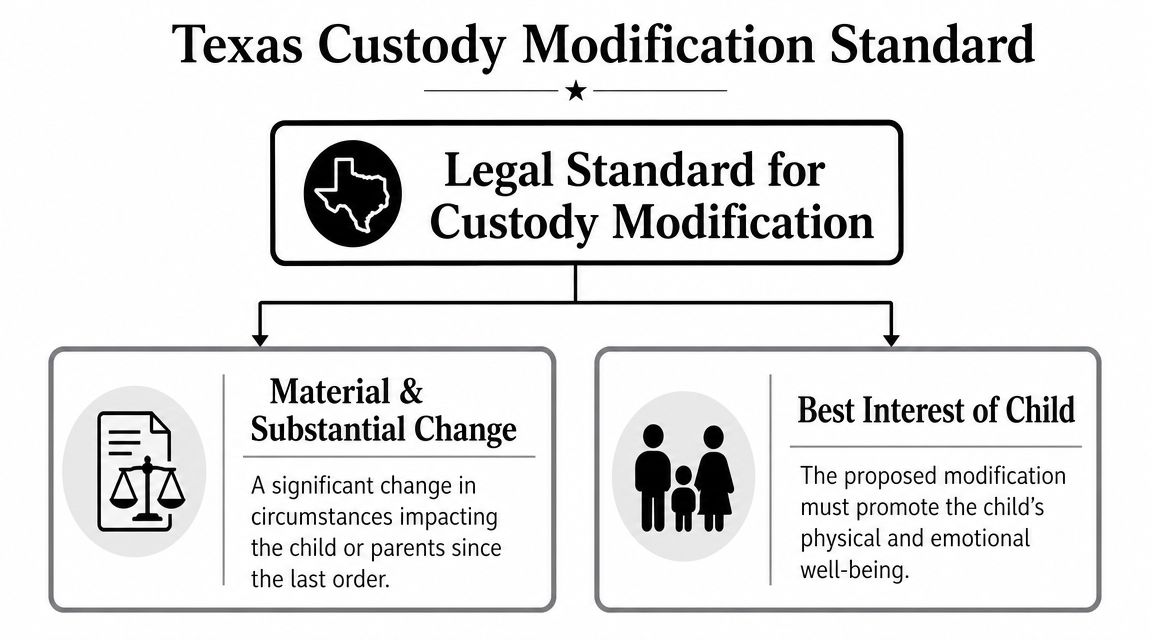
Material and Substantial Change Means More Than a New Paycheck
This part of the test is about significance. Courts look for a real shift in circumstances since the last order. A new title alone may not matter. A new title that now requires overnight travel, changes school transportation, or forces repeated missed exchanges may matter a lot.
Think of it this way. The court isn't grading your career choice. The court is asking whether the family arrangement built into the current order still fits the facts on the ground.
Examples that often need careful proof include:
- Schedule disruption: A parent now works nights, rotating shifts, or weekends that conflict with the current possession order.
- Income change: A job loss or pay reduction affects support and the ability to meet existing financial obligations.
- Relocation pressure: A new job changes commute time or creates pressure to move farther from the child's school or the other parent.
- Care arrangement changes: A parent now relies more heavily on third-party childcare because work hours changed.
For a deeper look at what Texas courts treat as a meaningful change, this article on substantial change in circumstances in Texas custody cases gives useful context.
Best Interest of the Child Is the Center of the Case
Even when a parent proves a major change, the court still asks whether the requested modification helps the child. Best interests of the child means the judge looks at the child's physical and emotional well-being, the need for stability, each parent's ability to care for the child, and whether the proposed plan is realistic and healthy.
That matters because not every job change leads to the same legal remedy. If a parent now works unusual hours, the answer may be a revised possession schedule. If a parent must relocate far enough to disrupt the child's home base, the requested change may be more significant.
Courts want evidence tied to the child's life, not just the parent's frustration.
What Doesn't Usually Work
Some arguments sound important to a parent but don't persuade a court on their own.
| Argument | Why it often falls short |
|---|---|
| "My new job is better." | Better for the parent doesn't automatically mean better for the child. |
| "The current schedule is annoying." | Inconvenience alone usually isn't enough. |
| "We agreed verbally." | Informal deals don't replace a court order. |
| "My ex should accommodate me." | The court focuses on the child's needs, not adult preferences. |
When parents understand this standard early, they make better decisions. They gather better records, ask for the right kind of relief, and avoid filing a case built on emotion instead of proof.
How Different Job Changes Impact Custody in Texas
One of the hardest parts of a modification case is knowing what kind of change you should request. A promotion doesn't always justify changing conservatorship. A layoff doesn't always justify changing parenting time. The facts matter.
Texas guidance says a parent can ask to modify custody, visitation, child support, or medical support, but the court still requires evidence meeting the legal standard. That guidance also recognizes a common problem. Parents want to know whether a promotion, shift change, demotion, relocation, or income drop is enough, and what documents matter most. It further notes that an odd work schedule can justify changing visitation, but doesn't always clearly separate a work-schedule issue from a true custody issue, as discussed by Texas Law Help on changing a custody, visitation, or child support order.

Promotion With More Travel
A parent lands a higher-paying role, but now spends several nights each month out of town. That may not support a request to become primary conservator if the child is otherwise stable. It may, however, support a request to revise exchange times, weekend periods, holiday terms, or makeup time.
What usually works here is a concrete proposal. Show the new travel calendar, identify which possession periods are regularly missed, and offer a revised plan that keeps the child on a predictable routine.
Job Loss or Sharp Income Drop
When a parent loses a job, there are often two separate issues. One is support. The other is parenting time. A parent who is unemployed may have more daytime availability, but that alone doesn't mean the court should flip the child's primary home.
If the income change is serious, support may need review. If the child's needs are still being met and daily routines remain stable, the court may leave conservatorship alone while considering financial changes.
Shift Work and Nontraditional Hours
Night shifts, hospital rotations, plant work, and emergency response schedules create real parenting challenges. These cases often call for a custom possession plan instead of a standard schedule. A judge may be more open to changing exchange days and times than changing which parent makes primary residence decisions.
This is especially true when the child is doing well and both parents remain involved. If your work hours changed, ask whether your real goal is more workable access instead of a larger fight over conservatorship.
A schedule problem should usually be solved with a schedule solution.
Relocation for Work
A move tied to employment often has the biggest impact. Commute distance, school continuity, after-school activities, and the other parent's ability to keep a strong relationship with the child all become central. In some cases, the move supports adjusting a geographic restriction or reworking primary possession. In others, the court may view the move as too disruptive.
Parents dealing with a move should pay close attention to modifying a geographic restriction in Texas, because distance can turn a manageable parenting plan into an unworkable one very quickly.
Gathering Your Evidence to Support a Modification
A parent can usually explain the problem in one sentence. "My new schedule makes the current order impossible." What wins modification cases is the proof behind that sentence.
Texas courts do not modify custody because a job changed in the abstract. They want to see what changed, when it changed, whether it is likely to continue, and how that change affects the child. The strongest evidence file answers all four questions with records, calendars, and specific examples instead of general frustration.
In custody-related cases, support issues sometimes move with them. Texas guidance on modification explains that support changes often require proof of a meaningful change in circumstances, and parents should be ready with income records such as paystubs, termination paperwork, and unemployment documents, as described in this Texas discussion of grounds for modification.
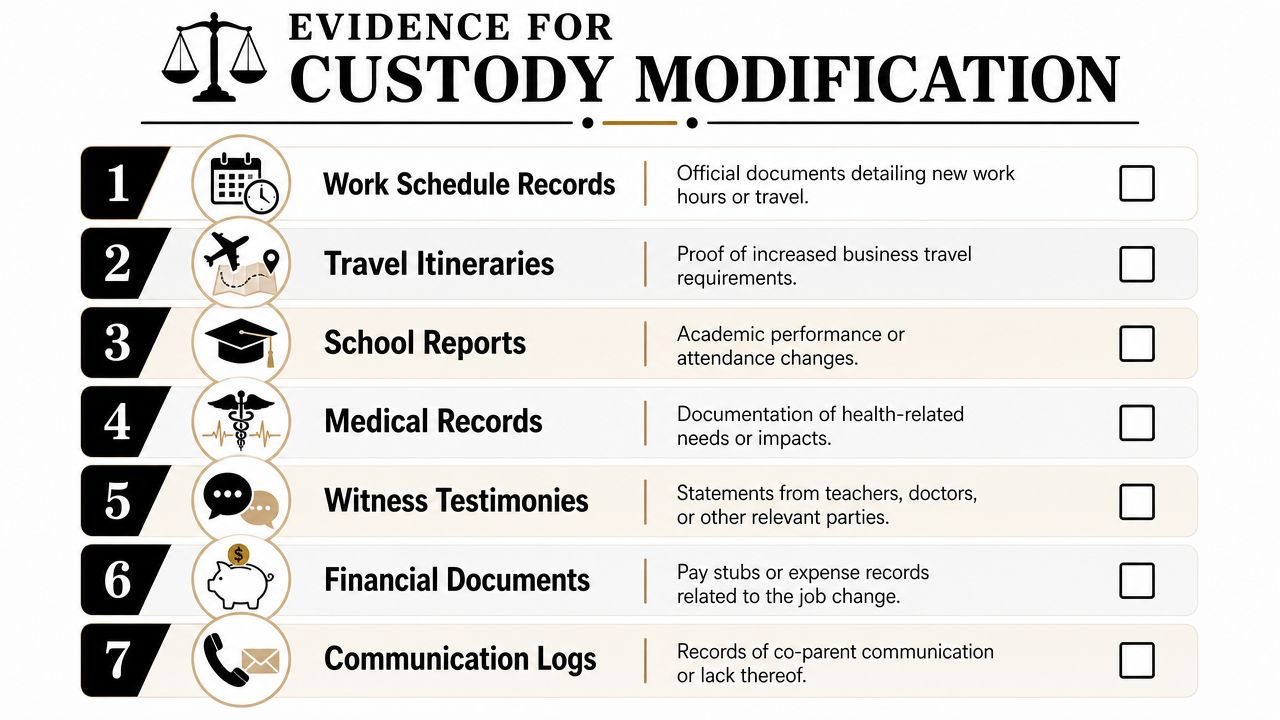
The Documents That Usually Matter Most
Start with documents that show the employment change is real, specific, and ongoing.
- Job offer, transfer notice, or employer letter: Shows your title, work location, start date, expected hours, and whether travel or on-call time is part of the job.
- Termination, layoff, or reduction-in-force paperwork: Helps show the income change was not voluntary.
- Recent and prior pay records: Lets the court compare before and after income, overtime, bonuses, and deductions.
- Work schedule records: Rotating shifts, hospital call schedules, plant calendars, or driver routes often matter more than a generic statement that you "work a lot."
- Travel records: Flight confirmations, mileage logs, hotel bookings, or company itineraries can show recurring absences that affect exchanges.
If you are preparing to file, it also helps to review the Texas custody modification forms and filing documents early so your evidence matches the relief you are asking for.
Proof That Connects the Job Change to the Child
Many parents fall short by proving the job change but not its impact on the child.
That connection is the heart of the case. A new job in Houston, a night shift at the hospital, or a layoff may all qualify as changed circumstances. The court still needs to see why the current order no longer serves this particular child.
Useful proof often includes:
- School attendance and tardy records: These can show late drop-offs, missed mornings, or pickup problems after the schedule change.
- Childcare invoices and provider statements: These help prove increased childcare needs, added cost, or gaps in supervision.
- Commute maps and drive-time logs: Show how long exchanges now take and whether school-night possession has become unrealistic.
- Exchange notes: Keep a dated log of missed exchanges, late arrivals, and last-minute coverage issues.
- Parent communications: Save respectful texts and emails showing attempts to adjust informally before filing.
- Activity records: If the child is missing practices, tutoring, counseling, or medical appointments, document that pattern carefully.
A side-by-side calendar is often one of the most persuasive exhibits in these cases. Put the court order on one side and your actual work schedule on the other. Then add school start times, exchange locations, childcare coverage, and commute times. That format lets a judge see the conflict quickly and understand why your requested change is practical, not tactical.
Build a Child-Focused Proposal
Evidence should do more than show strain. It should support a realistic solution.
| Evidence | Why it helps |
|---|---|
| Work schedule | Shows conflict with current possession terms |
| Travel itinerary | Shows recurring absences or delayed exchanges |
| School information | Connects the issue to the child's routine |
| Childcare invoices | Shows added burden created by the change |
| Proposed calendar | Gives the court a realistic alternative |
The best modification requests usually pair proof of the problem with proof that your proposed fix will work better for the child.
If you are organizing records or deciding whether your facts support filing, you may want to speak with a family law firm that handles Texas modification cases, such as Law Office of Bryan Fagan, PLLC, or another attorney in the county where your order was entered.
The Texas Custody Modification Process Step by Step
The process feels less intimidating when you break it into pieces. Texas custody modifications after a job change are usually handled as a Petition to Modify the Parent-Child Relationship in the court with continuing jurisdiction over the original order. The practical workflow includes identifying the original cause and court numbers, drafting the petition and proposed order, filing in the issuing county, serving the other parent or obtaining a waiver, and completing child-support paperwork if needed, according to Texas Law Help's guide to modifying a custody, visitation, or support order.
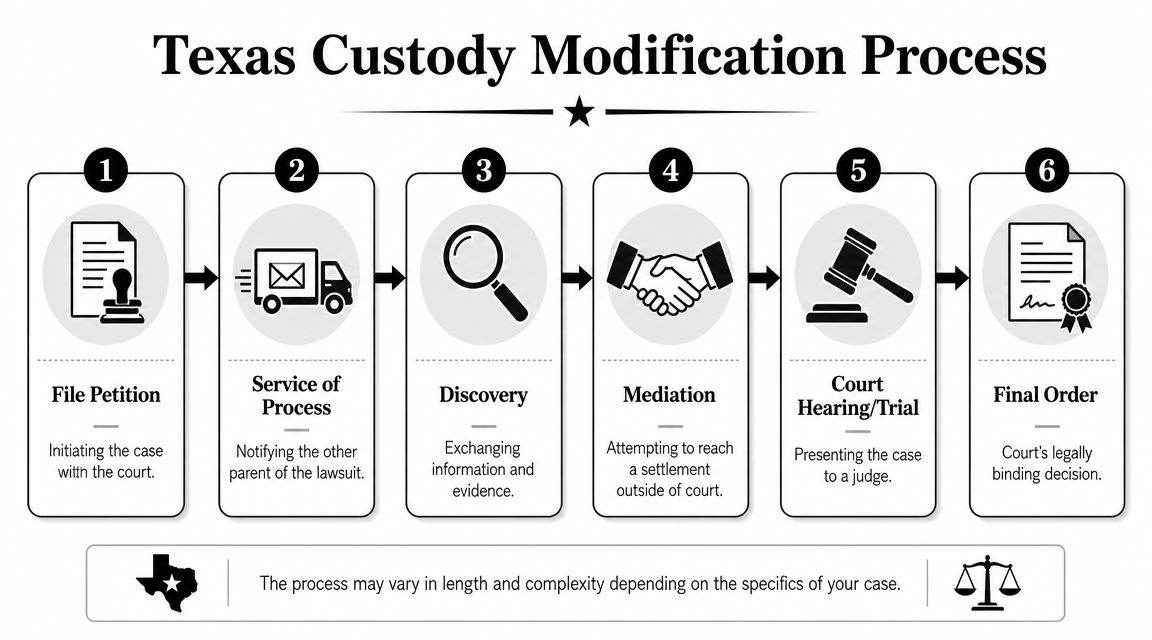
Step One Through Step Three
The first stage is paperwork and notice.
- Find the original case details. You need the right cause number and the right court.
- Prepare the petition. This document tells the court what changed and what you want modified.
- File in the correct county. Filing in the wrong place can create delays and unnecessary expense.
If support is changing too, make sure the related forms are included. Many parents also need an updated proposed order so the court can see the exact relief requested.
For readers looking for a starting point, these Texas custody modification forms can help you understand the paperwork involved.
A quick visual overview can also help:
Step Four Through Final Order
After filing, the other parent must be formally notified unless they sign a waiver. Then the case moves into information gathering, negotiation, and, if needed, a hearing.
- Service of process: The other parent gets legal notice of the case.
- Discovery and document exchange: Both sides may gather records, schedules, and other evidence.
- Mediation: Many courts encourage or require settlement efforts before trial.
- Final hearing: If no agreement is reached, the judge hears evidence and decides.
One Mistake to Avoid
Do not assume the old order disappears when your job changes.
The existing order remains enforceable until a judge signs a new one. That means missed exchanges, unpaid support, or self-help schedule changes can still be used against you. If the situation is urgent, temporary relief may be available in some cases, but the standard for urgent changes is high.
Parents who stay organized usually handle this process better. Keep a binder or digital folder with your pleadings, work records, communications, and proposed calendar. Court cases move faster when you can find what you need quickly.
Resolving Your Case Through Negotiation and Mediation
Most families don't need a courtroom fight to solve a job-related custody problem. In many cases, the better result comes from negotiation or mediation because parents can build a plan around real schedules instead of waiting for a judge to impose one.
That matters for children. A child usually benefits when parents reduce conflict, communicate clearly, and keep transitions predictable. If one parent now works weekends and the other parent can take more weekday time, an agreed schedule may serve everyone better than a rigid win-or-lose trial.
Why Mediation Often Works Better
Mediation uses a neutral third party to help parents reach an agreement. The mediator doesn't act as the judge. The mediator helps both sides test proposals, identify weak spots, and work toward practical terms.
This process tends to work well when the dispute is about logistics rather than safety. Parents can negotiate holiday swaps, school-year schedules, transportation terms, and communication rules in far more detail than most court hearings allow.
Parents often know the child's routine better than anyone else in the courtroom. Mediation gives them room to build around that routine.
Agreement Still Has to Become a Court Order
Texas modification procedure still runs through a formal suit. Even if parents agree, they can submit an Agreed Order Modifying the Parent-Child Relationship, but the change is not enforceable until the judge signs it. Texas guidance on modification procedure also notes that urgent temporary changes face high legal bars, such as significant impairment to the child's health or emotional development, as explained by the Texas State Law Library guide on modifying a SAPCR.
That point is easy to underestimate. Parents often start by "trying out" a new schedule. Sometimes that works for a while. Then conflict returns, memories differ, and one parent falls back on the old order. A signed order prevents that confusion.
What Works and What Usually Doesn't
A cooperative case usually works when both parents:
- Exchange real documents: Schedules, pay records, childcare information, and calendars.
- Stay child-centered: They talk about school nights, transportation, and routines instead of blame.
- Offer clear proposals: Specific exchange times are more useful than vague promises to "be flexible."
It usually falls apart when one parent insists on an unwritten arrangement, uses the child to gain an advantage, or treats mediation like a place to relitigate old grievances from the divorce.
If settlement is possible, it often saves stress and helps preserve a functioning co-parenting relationship. If it's not, a well-prepared case is still the best protection.
Frequently Asked Questions and Your Next Steps
A parent gets a new work schedule, starts leaving before sunrise, and realizes the current pickup times no longer fit real life. That does not mean the order changes on its own. It means the parent needs proof that connects the job change to the child's daily routine, stability, and best interests.
Can I stop following the current order because my job changed
No. You must follow the current order until a judge signs a new one. A job change may justify a modification, but it does not give either parent the right to make unilateral changes.
What if my ex won't agree
You can still file for a modification. Agreement can save time and stress, but many valid cases move forward because one parent has the better evidence. The court will focus less on who is more upset and more on who can show the practical effect of the new job on school attendance, exchange times, childcare, and the child's routine.
Does every job change justify a custody case
No. A new position, shift change, layoff, promotion, or transfer matters only if it creates a meaningful change and you can show why the current order no longer fits the child well. In some cases, the right answer is narrow. Adjusting weekday exchanges, transportation duties, or holiday periods may solve the problem without asking for a major conservatorship change.
What should I do first
Start with three tasks:
- Collect proof tied to the child. Gather work schedules, offer letters, pay records, childcare invoices, school attendance records, and commute estimates. The goal is not to show that your job changed in the abstract. The goal is to show how that change affects mornings, pickups, supervision, overnights, or consistency.
- Define the legal problem clearly. Decide whether you need a possession change, child support review, relocation-related relief, or a broader custody modification. A vague request is harder to prove and harder to settle.
- Get legal advice before positions harden. Early advice helps you avoid asking for too much, asking for the wrong fix, or walking into court with documents that do not answer the judge's real question.
When considering how to modify custody after a job change in Texas, do not wait for missed exchanges, school problems, or repeated conflicts to create a larger record against you. Early planning usually leads to better outcomes for both parents and for the child.
If you need help with a child custody or visitation case in Texas, the attorneys at The Law Office of Bryan Fagan, PLLC can help you assess your options and prepare the right next step. Contact the firm today for a consultation.