
When your child’s financial security is on the line because of unpaid child support, the stress can feel absolutely crushing. You're not just dealing with a financial shortfall; you're worried about your child's future. A Texas court order for child support isn't just a suggestion—it's a legally binding mandate designed to protect your child. The good news is, you have powerful options for Texas child support enforcement, and you don't have to face this alone.
The two main paths you can take are working with the Office of the Attorney General (OAG) or hiring a private family law attorney to take direct legal action. Understanding how each works is the first step toward securing the support your child deserves.
Your First Steps in Texas Child Support Enforcement
Facing unpaid child support puts you in a tough spot. You're left covering all the expenses alone while worrying if your child's needs are being met. It’s a frustrating position for any parent, but it’s critical to know you are not powerless. Texas law, primarily found in the Texas Family Code, provides clear and robust ways to make sure your child gets the financial support they are legally owed. This legal framework is built around one central principle: the "best interests of the child."
Understanding your options is the first real step toward taking back control. You can either get help from a state agency or take a more direct, personalized approach with your own lawyer.
- Office of the Attorney General (OAG): This is a state-run agency that can enforce child support orders at no cost to you. The OAG handles a massive number of cases and has significant authority to collect payments.
- Private Family Law Attorney: Hiring your own lawyer means you have a dedicated legal advocate who can file a private enforcement lawsuit on your behalf. This route often provides more personalized attention and can lead to faster results.
This decision tree can help you visualize which of these two powerful avenues for enforcement makes the most sense for your family.
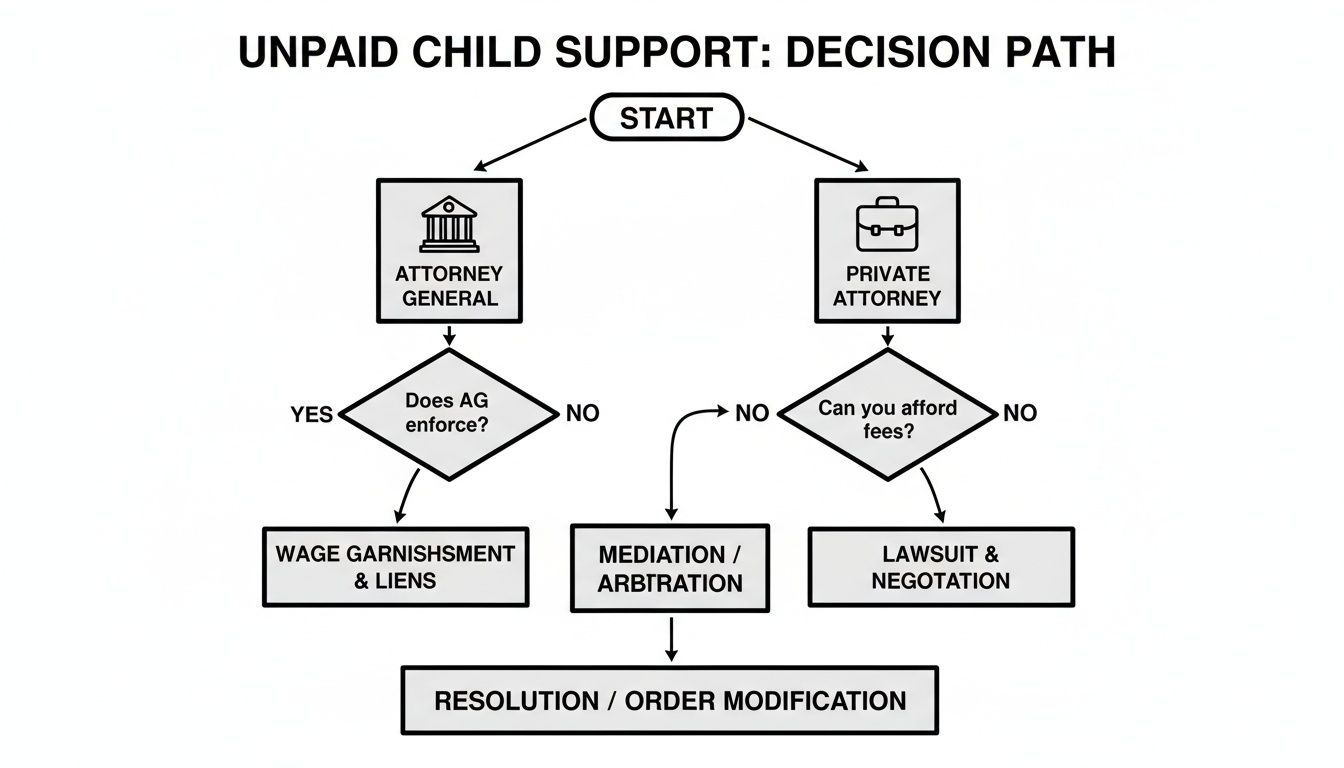
As you can see, the right path really depends on your specific needs—things like cost, speed, and how complicated your case is. Picking the right one can make a huge difference for your family's outcome.
Understanding the Scale of the Issue
The problem of unpaid child support is unfortunately widespread, but Texas has built a formidable system to tackle it head-on. The Child Support Division of the OAG manages an incredible 1.5 million cases, affecting 1.7 million children across the state.
This operation is remarkably efficient, collecting $11.34 for every dollar spent on the program. However, national data reveals that nearly 30% of noncustodial parents pay nothing at all, which underscores just how critical effective enforcement is.
To get the full picture, it helps to be familiar with broader family law principles. Every enforcement tool, whether it’s administrative or judicial, is grounded in the Texas Family Code, which always prioritizes the child's best interests. Knowing these fundamentals will empower you to make smarter decisions as you move forward.
When child support payments stop coming, the Texas Office of the Attorney General (OAG) can be a powerful resource for custodial parents. This state agency has a whole toolkit of administrative methods designed to enforce a court order for support, often without you ever having to step back into a courtroom. Knowing how the OAG operates can take a lot of the mystery out of the process and show you what’s possible.

The OAG’s job is straightforward: get the money your child is legally entitled to receive. To do that, they have the authority to take direct action. It's important to understand these aren't punishments; they are simply administrative remedies to make sure the other parent complies with the court's order.
Wage Withholding: The Go-To Tool
By far, the most common and effective method the OAG uses is an income withholding order. Think of it as a legal notice sent directly to the non-paying parent's employer. It instructs them to deduct the child support payments right from the parent’s paycheck before they even see it. It’s automatic and incredibly reliable once it’s set up.
In fact, under Texas Family Code Chapter 158, wage withholding is the default way to collect child support in our state. It completely bypasses the other parent, which cuts down on the chances of missed or short payments. For many of the families we work with, understanding that support can become consistent brings a huge sense of relief.
Intercepting Funds and Placing Liens
What if the other parent doesn't have a traditional W-2 job? The OAG can go after other sources of money. This is a powerful form of Texas child support enforcement that can sometimes collect a large amount of past-due support all at once.
Here are a few ways they do it:
- Intercepting Tax Refunds: The OAG has the power to seize federal income tax refunds to pay down child support arrears.
- Collecting Lottery Winnings: If the other parent gets lucky and wins the Texas lottery, those winnings can be claimed to satisfy the child support debt.
- Placing Property Liens: A lien can be put on assets like a house, land, bank accounts, or vehicles. This means the property can't be sold or refinanced until the child support is paid off.
A lien is just a legal claim against a piece of property that acts as security for a debt. So, if the parent tries to sell their house, the child support arrears have to be paid out of the sale proceeds before they get a dime.
Suspending Licenses to Force Payment
When a parent falls significantly behind—usually by more than three months—the OAG can get their attention by moving to suspend various state-issued licenses. This is often the wake-up call a parent needs to start making things right.
Under Texas Family Code Chapter 232, the OAG can trigger the suspension of:
- Driver’s licenses
- Professional licenses (like for a doctor, lawyer, or plumber)
- Hunting and fishing licenses
The idea isn’t to stop the parent from earning a living. It’s to create a serious incentive to contact the OAG and work out a payment plan. Once the parent makes arrangements to pay what’s owed, the licenses can typically be reinstated. When you're sending information back and forth with a state agency, it's always smart to think about the secure transmission of legal documents, especially with sensitive personal data involved.
Using the OAG is a robust, no-cost option for parents who need help with enforcement. While their caseloads are high and the process can sometimes feel slow, their actions are backed by the full authority of the state. They have a proven track record of collecting the financial support Texas children have a right to.
Taking Legal Action With A Private Attorney
While the Office of the Attorney General provides essential services at no cost, the reality is that their caseload is massive. That can often mean a slower, less personal process when you're trying to collect overdue child support. For parents who need faster results or have a more complicated situation on their hands, hiring a private family law attorney for Texas child support enforcement is a powerful alternative.
Going this route gives you a dedicated advocate whose only job is to fight for your family’s best interests.

A private attorney works for you, and only you. They can file a private enforcement lawsuit immediately, often getting your case in front of a judge much quicker than the OAG might be able to. That speed can be a game-changer when the unpaid support is piling up and your child's financial stability is on the line.
Filing A Motion For Enforcement
The main tool your private attorney will use is a Motion for Enforcement. Think of this as the official start of the legal process. It’s a formal document filed with the court that lays out every single violation of the child support order—down to the penny. It lists each missed or partial payment, including the date it was due and exactly how much went unpaid.
But this motion does more than just list numbers. Its critical purpose is to ask the judge to hold the non-paying parent in contempt of court. Contempt is a serious finding. It means the other parent knew about the court order and willfully chose to disobey it.
Once a judge finds a parent in contempt, they have some serious leverage to compel payment. The consequences are designed to be strong enough to make sure it doesn't happen again.
- Jail Time: A judge has the power to sentence the parent to jail for up to six months for contempt.
- Fines: The court can impose financial penalties for each and every violation.
- Probation: Often, the court will place the parent on community supervision (probation) with very strict conditions, including a detailed plan to get the past-due support paid back.
This legal action sends a crystal-clear message: ignoring a child support order has severe repercussions.
Securing A Judgment And Interest
Here’s one of the biggest advantages of working with a private attorney: they can seek a cumulative money judgment. Your lawyer will ask the court not only to confirm the total amount of unpaid support but also to add 6% annual interest to the arrears and award you attorney's fees and court costs.
A money judgment is a legal declaration from the court that one person officially owes another a specific amount of money. Once you have this judgment, it becomes an incredibly powerful debt collection tool, letting you pursue the other parent's assets much more aggressively.
This judgment isn't just a piece of paper. It transforms the child support debt into a legally enforceable obligation, giving you far more control and more options to collect the funds your child is rightfully owed.
Advanced Enforcement Tools Your Attorney Can Use
Beyond a standard enforcement motion, a skilled family law attorney has access to more advanced legal strategies to get you paid. These tools are especially effective when the other parent is self-employed, tries to hide assets, or has non-traditional income that’s tough for the OAG’s automated systems to track.
- Turnover Orders: This is a powerful remedy that forces the other parent to turn over non-exempt assets—things like a second car, a boat, or other luxury items—to a constable or sheriff to be sold. The money from the sale then goes directly toward paying down the child support debt.
- Asset Garnishment: While Texas law is famous for protecting wages from most types of garnishment, it offers no such protection for funds sitting in a bank account. With a judgment in hand, your attorney can seek to garnish bank accounts, seizing the funds directly to satisfy what’s owed.
These advanced methods require a deep understanding of Texas law and court procedures, which is precisely why having an experienced attorney in your corner is so valuable. They can quickly identify which tools are the right fit for your situation and pursue them relentlessly on your behalf. Hiring a private attorney for Texas child support enforcement gives you a direct, personalized, and often more aggressive path to getting your child the financial support they deserve.
Enforcing Child Support Across State Lines
When the parent who owes child support moves out of Texas, it's easy to feel like your options have just vanished. A state border can seem like a giant legal wall, and many parents understandably fear that their right to collect support for their child stops right at the state line. But here’s the good news: a powerful federal law ensures your Texas child support enforcement efforts can continue, no matter where the other parent lives.
This protection is called the Uniform Interstate Family Support Act (UIFSA). Every single state in the U.S. has adopted this act, creating a unified, cooperative system for enforcing support orders across the country. Think of it as a legal handshake between states, where they all agree to help each other make sure parents meet their financial duties to their kids.
How UIFSA Works For Your Family
Under UIFSA, a Texas child support order is fully valid and enforceable in any other state. This is a huge relief because it means you don't have to start your case all over again from scratch. Instead, Texas can work directly with the other state's child support agency to collect the payments your child is owed.
The process usually unfolds in one of two ways:
- Direct Income Withholding: This is often the most straightforward route. Texas can send an income withholding order directly to the other parent's new employer in their new state. That employer is legally required to honor the Texas order and deduct the child support from the parent’s paycheck, just as if they were still in Texas.
- Registration and Enforcement: Alternatively, your Texas order can be officially registered in the new state. Once registered, that state's courts and child support agency have the power to enforce it as if it were their own order. They can use all their local enforcement tools, like license suspensions or seizing funds from bank accounts.
This teamwork between states is the heart of interstate enforcement. It’s designed specifically to prevent a parent from simply moving away to dodge their responsibilities.
Special Cases And Complex Incomes
Of course, not every situation is simple. For parents who are self-employed or work as independent contractors, there isn't a regular paycheck to withhold from, making income tricky to track. Military families also present a unique challenge, as enforcing support involves a specific set of federal rules and regulations that must be followed precisely.
When dealing with a self-employed parent, a private attorney can use powerful legal tools like bank garnishments and turnover orders to seize assets when income is inconsistent or intentionally hidden. For military members, federal law is on your side, allowing for the garnishment of military pay and even retirement benefits to satisfy child support obligations. An experienced attorney knows how to navigate the proper channels to secure these payments for your child.
The key takeaway here is that you have options, even in complex situations. Whether the other parent is a business owner in Colorado or an active-duty service member stationed in California, there are specific legal pathways to ensure your Texas child support enforcement order is respected.
It's also smart to stay aware of changes in Texas law that could affect your order down the line. For instance, effective September 1, 2025, Texas lawmakers significantly raised the child support cap, a change that will impact high-income cases. You can explore recent changes to the Texas child support guidelines to learn more about this major update. While this won't automatically alter existing orders, it’s a perfect example of how laws evolve and why having expert guidance is so valuable.
Building a Strong Enforcement Case with the Right Evidence
When you decide it’s time to take action on unpaid child support, it’s completely normal to feel buried in paperwork and frustration. The key is to channel that energy into building a rock-solid, evidence-based case. Every successful Texas child support enforcement action, whether handled by the OAG or a private attorney, is built on a foundation of clear, organized proof.
Think of it this way: a judge can't act on what they don't know. Your job is to paint a clear, undeniable picture of what your child is owed. The more organized your evidence, the stronger your case—it's as simple as that.
Your Essential Documentation Checklist
Getting your documents in order is the most empowering first step you can take. It puts you back in control and signals to the court that you are serious and prepared. Before you do anything else, track down these critical items:
- The Original Child Support Order: This is the legal cornerstone of your entire case. It’s the signed court order that legally obligates the other parent to pay, and nothing can happen without it.
- A Clear Payment History: This is, without a doubt, the most crucial piece of evidence. You need a detailed record showing every single missed or partial payment.
- Relevant Communication: Dig up any texts, emails, or letters where you discussed child support with the other parent. This documentation can help prove they were fully aware of their obligation and your attempts to resolve the issue.
These documents serve as the official record, proving that the court's order has been violated.
Creating a Simple and Effective Payment Ledger
You don't need to be an accountant to create a powerful payment ledger. A simple notebook or a basic document on your computer works just fine, as long as it’s clear and easy for a judge to understand. This ledger will become your single source of truth for every payment—or lack thereof.
For each payment that was due, create an entry with these details:
- Date Payment Was Due: List the exact date the support payment was supposed to be made.
- Amount Due: State the full amount required by the court order for that pay period.
- Amount Actually Paid: Record what you received, even if it was $0.
- Date Paid: Note the date any payment—full or partial—was actually made.
- Amount Unpaid (Arrears): Calculate the difference between what was due and what was paid. Keep a running total of the arrears.
A well-maintained ledger does more than just track numbers; it tells a compelling story of non-compliance. When presented in court, it provides a simple, chronological account that a judge can quickly grasp, making your case far more persuasive.
To help you get organized, we've put together a simple checklist of the documents and information you'll need to gather. Having these items ready will make the enforcement process much smoother and give your attorney the tools they need to effectively fight for you and your child.
Child Support Enforcement Evidence Checklist
| Document/Information | Why It's Important | Where to Find It |
|---|---|---|
| Final Divorce Decree/Custody Order | This is the legally binding document that establishes the child support obligation. It's the foundation of your case. | Your personal legal files, your previous attorney's office, or the District Clerk's office in the county where it was filed. |
| Payment Ledger (Your Record) | Your personal, detailed log of payments due, received, and missed. It tells the story of non-compliance chronologically. | You create this yourself. A simple spreadsheet, Word document, or even a handwritten notebook works. |
| Bank Statements | These provide official proof of what payments were (or were not) deposited into your account and on what dates. | Your bank's online portal or by requesting printed statements from your local branch. |
| Communication Records | Texts, emails, or letters discussing child support show the other parent was aware of the arrears and your attempts to collect. | Your phone's messaging app, email account, or physical files where you keep letters. |
| OAG Payment Records (if applicable) | If payments go through the state, the OAG's official record can corroborate your own ledger and serve as official evidence. | Your online account with the Texas Office of the Attorney General Child Support Division. |
| Proof of Child's Expenses | Receipts for medical bills, school fees, or other costs the non-paying parent was ordered to contribute to. | Your personal financial records, receipts from medical providers, schools, or daycare centers. |
Putting this evidence together is the first major step toward holding the other parent accountable. It provides the clear, factual basis a judge needs to issue an enforcement order and get your child the support they are legally entitled to receive.
How Technology Is Changing Enforcement
The state is also working to make payment tracking more efficient. The Texas OAG's modernized Child Support Automated Management Program (CHAMP) aims to improve services for families with real-time online portals for tracking cases and payments. While this system promises greater efficiency in enforcement, it’s still wise for you to keep your own detailed records as a personal backup. To see how these state-level systems are evolving, you can learn more about the new CHAMP program in Texas.
Ultimately, gathering this evidence does more than just prepare you for a legal proceeding. It helps you reclaim a sense of agency in a difficult situation, arming you with the facts needed to effectively advocate for your child’s financial future.
Key Takeaway: Taking the Next Step
It’s completely normal to feel overwhelmed when child support goes unpaid, but we want you to know you're not powerless. We’ve walked through the key methods for Texas child support enforcement, and the path forward is clearer than you might think. This is where you can start to take decisive action.
Whether you decide to work with the Office of the Attorney General (OAG) or hire a private attorney, you have strong options. The single most important thing you can do right now is act.
Moving From Worry to Action
Here’s the hard truth: delaying enforcement lets the unpaid balance—the arrears—pile up. This not only increases the financial strain on your family but makes it more difficult to collect down the road. Taking immediate steps protects your child's well-being and sends a clear message that a court order isn't a suggestion; it's a mandate.
The legal system is on your side, but it needs you to start the engine.
Your main paths forward are pretty straightforward:
- Leverage the OAG's administrative tools. This means using the state's power to withhold wages, intercept tax refunds or other funds, place liens on property, and even suspend licenses.
- File a private court motion. Working with an attorney, you can file a motion for enforcement to seek contempt charges. This can lead to serious consequences for the non-paying parent, including jail time, fines, and a judgment for the arrears plus interest.
Remember: A Texas child support order is not a suggestion. It's a legal mandate. Taking action now is the most powerful move you can make to secure the financial stability your child is entitled to.
Understanding how payments are processed is also a key piece of the puzzle. For most parents in Texas, payments are supposed to flow through a centralized system. You can get a better handle on how that works by reading our guide to the Texas Child Support Disbursement Unit. This knowledge helps you track payments more effectively and spot a problem the moment it starts.
Consider this your final encouragement to shift from a state of worry to one of empowered action. You have the tools, the legal backing, and the absolute right to pursue what is owed to your child.
If you need help with a child custody or visitation case in Texas, our experienced attorneys can guide you every step of the way. Contact The Law Office of Bryan Fagan, PLLC today for a free consultation.
Common Questions About Enforcing Child Support In Texas
When you're trying to enforce a child support order in Texas, it’s easy to feel overwhelmed. The legal process can be confusing, and when your child’s financial stability is on the line, the stakes couldn't be higher. We get it. Here are some of the most common questions we hear from parents just like you, answered in plain English.
How Long Does Enforcement Take In Texas?
Honestly, the timeline can vary quite a bit. If you go through the Office of the Attorney General (OAG), their caseload is enormous, so it can sometimes take several months just to get the ball rolling.
On the other hand, a private enforcement action filed by an attorney can move much faster. We can often get you in front of a judge within a few weeks to a couple of months, depending on how packed the court's calendar is. The bottom line? The sooner you take action, the quicker you’ll see results.
What Is The Statute Of Limitations For Back Child Support?
Here’s some good news: Texas law is firmly on your child's side. There is no statute of limitations for a court to confirm the total amount of unpaid child support (the arrears) and turn that into a formal judgment.
However, some of the enforcement tools do have a time limit. For example, a motion asking a judge to hold a parent in contempt for not paying generally has to be filed within two years after the child turns 18 or the support obligation officially ends.
Can The Other Parent Go To Jail For Not Paying?
Yes, they absolutely can. A judge has the power to order jail time for a parent found in contempt of court for deliberately failing to pay child support. Each violation can carry a sentence of up to 180 days in county jail.
It's common for a judge to sentence the parent to jail but then suspend that sentence, placing them on community supervision (probation) instead. This gives the parent a final chance to get on a payment plan and follow the order. If they mess up again, the judge can revoke the probation and send them straight to jail.
Can You Enforce An Order If The Parent Is Self-Employed?
Definitely. It's trickier than with a standard W-2 employee, but it is far from impossible. A standard income withholding order won't work, which is where a private attorney can make a huge difference.
An experienced lawyer can use more advanced legal tools to get the money your child is owed, such as:
- Placing liens on assets like real estate, vehicles, or bank accounts.
- Requesting a turnover order to seize non-exempt property, which can then be sold to pay the debt.
- Garnishing bank accounts once a judgment for the back child support is finalized.
It's also worth remembering that as your child gets older and life changes, the original support order might not fit the current reality. If the other parent's income has changed significantly, it might be time to revisit the order itself. You can learn more about the process of revisiting and updating your child support order in our detailed guide.